• Hey Guest!
    British Car Forum has been supporting enthusiasts for over 25 years by providing a great place to share our love for British cars. You can support our efforts by upgrading your membership for less than the dues of most car clubs. There are some perks with a member upgrade!

    **Upgrade Now**
    (PS: Upgraded members don't see this banner, nor will you see the Google ads that appear on the site.)
Tips
Tips

TR2/3/3A TR3A regulator mystery

NutmegCT

Great Pumpkin
Bronze
Offline
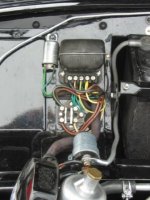
Could anyone identify the "condenser" type item at the right of my voltage regulator?

One black lead appears to run into (or under) the regulator. The other black lead is capped off. No clue what it's for.

There's no evidence of the car ever having a radio, and the "condenser" looks to have been mounted a long time ago.

Also, there's no ballast resistor anywhere in the coil circuit. It's a Lucas standard coil.

Should there be a resistor somewhere in that circuit?

Is the "mystery" item an old ignition circuit resistor of some kind?

Thanks.
Tom
 
No idea Tom, but my 3A does not have one, nor is one shown on the several wiring diagrams I have. May have something to do with an Item that is no longer on the car.

Good luck, Tinkerman
 
Even though there's no evidence of the car's having one, my vote would still be an AM (or CB) radio. The wire going behind the regulator is most likely grounded, and the wire capped off would have been on one of the terminals of the reg. Pretty common fare back in the day.
 
Tom: That is probably a noise suppression condenser (capacitor). At some point in time a previous owner had a radio. These cars had/have solid copper, non-suppression ignition wires and originally a generator (dynamo), both a source of RFI (radio frequency interference). A period-type radio would have been AM and subject to this noise. The condenser when connected from the source of noise to earth suppresses the noise by providing a path for the high-frequency component. You can test this theory. if you have a small AM radio, bring it close to your car (while the engine is running) and connect/disconnect the condenser. Did some of the noise disappear? No? If not, the condenser is bad and/or the non-suppression wires are radiating so much noise that they're overwhelming the radio reception. The fix for this source of RFI is to install suppression-type plugs, plug terminals and coil HT terminal.

Another place where you will often find one of these condensers is at the main generator terminal! :banana:
 
NutmegCT said:
Also, there's no ballast resistor anywhere in the coil circuit. It's a Lucas standard coil.

Should there be a resistor somewhere in that circuit?


Thanks.
Tom

There's not supposed to be a ballast resistor in the TR3s if you have the proper coil. If you measure the coils resistance between the two small terminals, you should get about 3 ohms of resistance. If it measures about half that, then the coil would require a ballast resistor. If the coil hasn't fried yet, then I would say that the coil is correct.
 
Thanks gents.

Today I got my new Lucas standard coil.

I was concerned the old Lucas standard coil was dying, as it got *very* hot after five minutes use. When the engine was hot on a hot day, the ignition seemed to "quit" - engine would just stop after about ten seconds (altho' it would start right up again).

Problem seemed to clear itself up when the engine was cold (overnight).

Regardless, I put in the new coil ... and IT also gets very hot after five minutes use (ignition on). Engine runs fine, no stalling, etc.

Both the old and the new pass the 3 ohm test when isolated.

So before I check myself into the local asylum ... are coils always supposed to get hot when in use?

Thanks.
Tom
 
In my experience they do get hot -- not sure how much of that is electrical and how much is due to the decision to attach then to the side of the block.

I've coils die suddenly and 100% and coils fail only when hot. If changing the coil resolved your problem that may be all the proof you're going to get.
 
Kind of depends on how hot is "very hot". It's bolted to the engine block, which normally gets plenty hot enough to burn your skin ... and the coil contributes heat of it's own (think 25 watt light bulb).
 
angelfj said:
These cars had/have solid copper, non-suppression ignition wires

However, they did have a resistor in the distributor cap, to help suppress ignition radiation.

<div class="ubbcode-block"><div class="ubbcode-header">Quote:]Another place where you will often find one of these condensers is at the main generator terminal.[/QUOTE]

I added one of those to my previous 56 (with front drums). Made a huge difference in the CB radio! (Which BTW left no permanent scars as the antenna was a magnetic mount and the radio just lay on the floor when I was driving.)
 
The black wire you say is capped off is normally screwed to the rim of the battery box where you see it in your photo. It is (was) a ground wire and my 1958 TR3A came with it like that and it's still there. I'm running with the original cable harness and the original coil. I never had a radio and have always used copper spark plug cables.
 

Attachments

  • 29007.jpg
    29007.jpg
    29.2 KB · Views: 184
That would make a lot of sense, if that second wire that appears to go into the mystery can is actually connected to the body underneath the can.

But the "capped off" wire pretty clearly originates with the mystery can, so I'm pretty sure it is not the ground wire between the control box and body.
 
TR3driver said:
That would make a lot of sense, if that second wire that appears to go into the mystery can is actually connected to the body underneath the can.

But the "capped off" wire pretty clearly originates with the mystery can, so I'm pretty sure it is not the ground wire between the control box and body.

:iagree:

Looking at it again, I think the wire going under the capacitor/condenser is a ground wire from the voltage reg., and the capped wire was attached to one of the terminals (the one with brown/yellow wire, maybe...) as a noise suppressor.
 
7pm update:

The "bracket" that holds the condenser thing is screwed into the firewall. Some time in the past, the device was bent over and was covering up the screw.

The rear black wire runs up and connects to the bracket screw (so that wire is a ground), then runs somewhere under the regulator box - I *think* into the harness that passes through the firewall.

The other black wire is the one that's capped off.

Would there be any clues that there was a radio at one time? Bracket mount holes, etc.? The Heritage certificate shows the factory fitted equipment as whitewall tires and tonneau cover.

Thanks.
Tom
 

Attachments

  • 29008.jpg
    29008.jpg
    66.3 KB · Views: 160
Back
Top