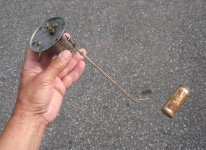
Good place to start would be to learn if the problem is the gauge or the sender. Fill the tank and measure the sender resistance with the gauge disconnected from it. Drive 20 miles or so, check again. Repeat.
My TR3 still has its original gauge & sender AFAIK; and it isn't very linear either. Like yours, it reads full for several days (40-60 miles) after a fill-up. But then it starts falling slowly, but more or less evenly. Below 1/2 tank indicated, it starts falling more rapidly; so its less than 40 miles from 1/4 to empty. It probably just needs better calibration; but could also be that the variable resistor in the sender is worn out. They do wear over time, and generally the wear is the worst in the middle of the range.
BTW, the article linked to above is for a MGA, which doesn't have quite the same resistance range as the TR3-4. If you want a really good calibration, you need to measure your sender and calibrate the gauge to match.
Resistors with leads are getting harder to find, but are still fairly cheap when you do find them. Eg,
https://www.radioshack.com/product/index.jsp?productId=2062304
(I found a better assortment at my local electronics shop, but those are getting harder to find, too.)
PS, Hopefully this is too obvious for words, but JIC : You can always combine multiple resistors to get the value you want. For two resistors in series, the total resistance is the sum of each resistance. Eg, to get 1200 ohms you could combine a 1000 ohm and 200 ohm resistor in series (ignoring the effects of tolerance for the moment).
For resistors in parallel, the formula is more complicated. 1/Rtotal = 1/R1 + 1/R2 Thus for the example of a 1000 ohm plus a parallel 200 ohm, the result is 1 / (1/1000 + 1/200) = 166 ohms.


 Hey Guest!

 Hey - did you know if you click on the title of a thread it will take you to the first unread post since you last visited that thread?
 but were afraid to ask:
  STOP!! Never post your email address in open forums. Bots can "harvest" your email! If you must share your email use a Private Message or use the
  smilie in place of the real @
 Pretty Please - add it to our Events forum(s) and add to the calendar! >>