• Hey Guest!
    British Car Forum has been supporting enthusiasts for over 25 years by providing a great place to share our love for British cars. You can support our efforts by upgrading your membership for less than the dues of most car clubs. There are some perks with a member upgrade!

    **Upgrade Now**
    (PS: Upgraded members don't see this banner, nor will you see the Google ads that appear on the site.)
Tips
Tips

TR2/3/3A TR3A Engine Work

rlandrum

Jedi Trainee
Offline
We have a stock TR3A engine. As part of our restoration, we're rebuilding the whole engine. I'm sure it's in good condition now, but we want to be 100% sure.

I have some prior engine experience having built a small block from the ground up.

I'm pretty sure this engine has never had a valve job, or any head work, to bring it up-to-date with the new lead-free gasoline. What exactly is required? I'm planning on having my machine shop do the work to the head, but not entirely sure what to ask for.

As I understand it, the rear mains on these engines are prone to leaking. I'd like to replace the rear main with one of the aftermarket conversion kits. Is this really necessary, or is the rear main seal issue overblown?

Assuming everything comes apart fine, and the piston sleeves look to be in good condition, should I replace them anyway? According to the odometer, the car (and probably the engine) has 88000 miles on it. I'm already planning on replacing the rings and other wear items.

At 88000 miles, what are the chances that the lifters are still in good condition? Should they and their push rods be replaced? Is the cam prone to excessive wear? Should I replace the oil pump?

Are there any other items I should address as I overhaul the engine?

Thanks,

Rob
 
when I did mine, I used an original style real main seal and it did not leak. Just take your time and make sure you have some way of centering it all. I was a bit shy to have the crank ground for the modern one. I did have the crank ground for the bearings though and that worked out fine. As for the head I think all that was needed was to install hardened seats (plus any valve replacements that will be needed). As for the sleeves, I measured mine and they were within spec in all directions (oval, linear etc.) and there were no scratches. I would suggest that you check to see if they are in spec and that there is no sign of the figure eights leaking. If both those hold true I would not replace them, unless you have to replace the pistons. I machined (well I used a diamond stone and lots of elbow grease) the top of the oil pump to get the clearance down to minimum and I put on a new screen for the oil pump. The pressure is now 50 at idle warm and 70 at speed warm with nothing else done to the pump.

All this is on an engine that had over 100,000 miles on it (the odometer had broken when it turned over, so I don't know how many miles in total the engine had, but it did have a craked head I had to replace).

It is a fun project, you will enjoy it. There are some poor res pictures of mine in pieces on my web site. Have fun with the engine work.
 
IMO the rear seal issue is overblown. However, part of the problem is that the dimensions given in the manual for the "setting mandrel" apparently result in too large a clearance; plus the mandrels offered for sale are even larger. According to Hardy Prentice (and others), the part of the mandrel that goes inside the seal should be only 2.818", not the 2.822 shown in the book.

The conversion seals have their own share of issues.
https://www.socaltriumphs.org/docs/mainseal.htm

As Adrio says, hardened exhaust seats for unleaded. May not be necessary if you don't machine the seats; since the lead effect apparently can last a very long time; but required if the seats need to be machined.

If you are replacing exhaust valves & guides anyway, I would suggest going for the later valves and special conversion guides, with 5/16" stems instead of 3/8.

Another tidbit; if you opt for the bronze guides, they must be reamed oversize after installation. They are designed to crush a bit as they are installed (to ensure a tight fit), plus need extra clearance because the bronze expands more with heat than the original cast iron does. Your shop probably won't know this, so be sure to tell them.

At the very least, check the valve springs for seat pressure. The original springs are almost certainly 'tired' by now, which can lead to borderline valve float and subsequent burning.
 
Well it depends on how much money you want to spend. Me I am Scottish. Anyways I like the way that you have gone after this thing, good job. I have not seen your engine or know the condition, so let me throw this out. They do not really have a rear main seal (per say) they had a ground in crank shaft oil thrower that throws the oil back, but there is felt soaked seal that goes in the back with this aluminum diverter catcher dealie . Anyway if yours did not leak much and the top of mains looked good to the eye, I might leave the crank shaft in and call the main bearings good. They often last a long time. I would gently pull the cam shaft, timing chain stuff, and pistons & sleeves out and clean it at home, and perhaps use the old cam bearings and the big end cam bearing if they looked good to the eye. I would put new rod bearings in and have the rods trued at a machine shop. You basically pull the pistons off slip the bearings out and bolt the two bearing half back together and they cut/true the hole round again This fixes an egg shaped rod, and use new wrist pins. I would most likely use the old oil pump after a gentle cleaning. Have the lifters resurfaced and clean the push rods at home. You probably want a new chain and tensioner. Again I would clean the oil pan and timing cover at home with solvent. I would probably purchase new pistons and liners with new rings and keep the old stuff for extras. They are probably wore out, but I have seen people ball hone the sleeves and put new rings on and go good for a long time. I would take the head to a known machine shop and have them do what they felt they needed.You will need a new tappet shaft and bushings. Just rebuild that yourself. They are going to most likely replace the springs, guides, and valves. Check the bear plate for a big cut made by the tensioner and have it filled in with weld and ground flat and maybe a speedy sleeve for the front pulley. True up the edges on the pan and chain cover. You can paint each piece black or put it together and paint it. Do yourself a favor and get a nos distributor. Yada yada yada
 
Rob,
I had larger valves installed in my TR3's head, along with hardened exhaust seats. I also had the head gas flowed while I was at it.
Then after a bit of a mishap, I fitted larger pistons and liners. My crank and cam shafts were fine at about 75,000 miles.
I like keeping the standard cam shaft as I like the lazy torque of the TR engine. I am not keen on fast-road cams or race cams as I think it is a shame to have to rev the engine to get the most out of it.
I think the rear oil seal is worth doing while the engine is in bits. My car with the original type of seal drips a few drops of oil after each journey.
If your liners are OK you should probably keep them and have them honed before fitting new rings to your pistons (assuming they are OK). If your liners need work then I would recommend going for something a bit bigger.
I suppose the chances of components being in good condition depends very much on how well maintained the engine was in the past. At 88,000 it could be great or it could be wrecked depending on oil changes, etc.
Again the oil pump should be checked for wear. If it OK, re-use it, if not it may have to be replaced. Beware of poor quality replacements. There was a batch a few years ago in the UK that used to fail quite quickly. It is certainly not worth cutting any corners with the oil pump.
Nick
 
I recently went through my TR6 motor with 55,000 miles on it.
Overall, it was in very good shape; but....
1)All the bearings (main and rod) showed the bronze through the babitt metal.
2)The cylinders were very good with no measurable wear, I changed the rings anyway and crosshatched the bores.
3)Half the lifters were pitted on the wear surface and I replaced them all since I was putting in a new cam anyway, went with the nitrided ones from BPNW.
4)The thrust washers were a little worn and I replaced them to get to spec float.

Replacing the bearing shells made a huge difference to oil pressure.
 
No reason to change the cylinder liners. Check for ware on the power stroke side. If in specks just hone and put a good cross hatch pattern and you should be fine. I had my TR3A re-bored to 87mm with the liners in the block. Being careful it can be done. The machine shop said they were probably so rusted in they won't move. That was 1979 and still no problems.
If you have the valve seats reground you should put in harden exhaust valve seats. Grinding the seats removes the lead lubrication and you only have to do the exhaust. I like going to 5/16 valves stems. All modern car manufactures are reducing the valve stem sizes for more air flow. Follow the above valve guide info. It's excellent! If possible resurface the tappets instead of purchasing new ones. Unless they are worn in circumference. Delta Cam can resurface the lifters, cam and re-bush the rockers at a reasonable price.
Check the gaps on the pistons to ensure that the rings are not to loose. If so renew the pistons. I reused the pistons in my TR250 with 45k on them but had them ceramic coated and used Total Seal piston rings. Ceramic coatings aids in ware and quits the pistons down.
Always replace the rod and main bearings when the engine is apart. False economy if you don't. Also replace the timming chain and sprockets.
 
I got it down to the short block last night.

https://xjguy.com/triumph/aug20/800x600/00018.jpg

As you can see, the water passages are very badly blocked. That said, it doesn't look like the head gasket is blown from overheating, although the 3-4 cylinder seperator shows some discoloration.

The 2 and 3 cylinders have some slight wear marks, but I cannot feel them. I can still see the cross hatch pattern on 2. I have not seen 1 and 4 yet.

I pulled two lifters, the first looked like it was in excellent shape. No uneven wear on the face, and no marks on the shaft. The second had some slight discoloration on the face, and some marks on the shaft. I wasn't able to remove the others (yet) to examine them.

The pushrods appear to be in pretty good condition. The bottoms were coated in a nice blob of parafin, which suggests this engine was last apart during the period that they still used parafin in motor oil.

Everything came apart really easily, another indicator that this engine was apart at some point in the past. Also, the head gasket is copper. If I'm not mistaken, the original was steel, right?

The rockers appear to be in good condition. The rocker tip that connects to the valve shows some wear, suggesting a possible oil shortage at some point. How exactly do they get oiled? The pushrods don't flow any oil (mine aren't hollow like on a SBC) and the only other oil passages I saw are on top of the rocker.

https://xjguy.com/triumph/aug20/800x600/00021.jpg

The head appears to be in good condition, but the springs are shot. I can compress them with my hand.
 
rlandrum said:
Also, the head gasket is copper. If I'm not mistaken, the original was steel, right?
The original looks just like yours -- copper composition. There are solid copper and solid steel aftermarket versions, but yours looks like the original unit looks.

The one thing I noticed, looking at the picture of your block, is how clean your piston crowns look. Very little carbon build-up...
 
Rob,
It is not unusual so have so much rust in the water channels. Just a sign that the car has not had anti-freeze/corrosion inhibitor in the past.
When I took the liners out of mine, great piles of rust fell out!
I think that the engine would have had a copper gasket originally.
The oil gets to the rockers through the rear pedestal. You should see a hole next to the stud.
Nick
 
Rob: I know its real easy to spend someone else's money, but here is a suggestion. Look very carefully at the rocker shaft, rockers and pedestals. If your engine had high mileage, regardless of the level of maintenance, you might consider replacing at least the shaft, springs and rockers. Also consider a "tuftrided" shaft.
 
angelfj said:
Look very carefully at the rocker shaft, rockers and pedestals.
I'll agree, but keep in mind they are easy to change later if you are short of funds, etc.

I'll also throw in a plug for Rocker Arm Specialists. They did a great job, at about the same price as the parts would have cost me. Result looked brand new (though I'm certain they reused the pedestals and probably just refaced/bushed/etc the rockers). Not sure what they did to the (obviously new) shaft, but it was plenty hard. Springs, adjusters, locknuts were all new. NFI, just a satisfied customer.

Rocker Arm Specialist
19841 Hirsch Court
Anderson, CA 96007
Tel (530) 378-1075
fax (530) 378-1177
mailto:rocker@c-zone.net
https://www.rockerarms.com/index.htm
 
I believe you get what you pay for. As such, I'm not shy about spending money, especially if it means I don't have to worry about something later.

So far, my list includes a full gasket set, full bearing set, a ring set, a new valve spring set, a new timing chain and tensioner (and gears, maybe), a oil seal conversion, and a new ARP stud kit (two of mine are rusted and two are bent slightly).

I've budgeted $2500 for the engine overhaul, which includes all the head work, machining and block cleaning. I suspect I will probably go over that though, if I end up replacing the pistons and liners. Exhaust, Intake, and carbs are excluded from this rebuild as they have already been addressed.
 
Some interesting developments... I managed to get the short block torn down. The first thing I noticed was how nice the pistons looked. They looked brand new. I measured one, and it measures 3.417 inches, just shy of 87mm.

I mic'd the crank mains, and they measure 2.480, .0005 more than the "New" value (2.4795) specified in the manual. The rod journals measured 2.087, .0004 more than spec (2.0866). Block and rods both spec out as standard.

The cam looks to be after market... It has has "Chambers Cams" hand ground into it, with "BL#3" below it. The web turned up a 2004 posting about Chambers Cams and Machine shop, of Arlington or Alexandia Virginia. Unfortunately, they seem to be out of business.

All four piston liners were in excellent shape. Aside from the scale around them, we'll use them as-is. The rings also appear to be new. I'm planning to reuse those as well.

The head was interesting as well. All valves were 5/16ths. All the springs were two-piece.

Originally, this engine had the larger (longer) intake, and the TR4A twin-tube exhaust. Now I'm wondering if I have a TR4A engine, rather than the original TR3A engine I thought had simply been modified.

Aside from a few minor items, like a worn rocker shaft, and some rusty lifters, it looks like it should be pretty solid engine upon rebuild.
 
rlandrum said:
Now I'm wondering if I have a TR4A engine, rather than the original TR3A engine I thought had simply been modified.
One indicator to look for : is the outside diameter of the exhaust valve guides larger than the od of the intake guides? Was true for heads originally fitted with 3/8" stems, but the 5/16" heads have the same size holes in them.
 
The head is at the machine shop, so I'm not 100% positive, but as I recall, the intake and exhaust valve guides were identical in size.

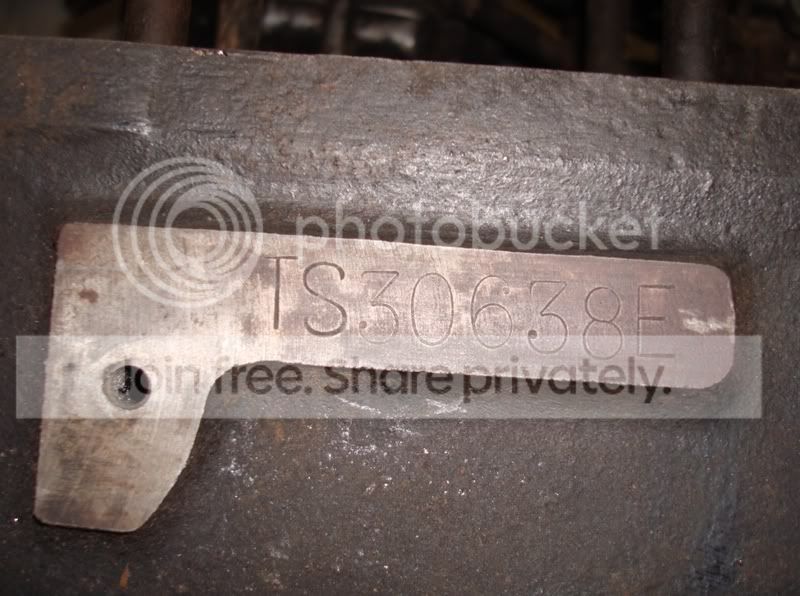
And... the engine block code doesn't start with TSXXXXXE or CTXXXXXXE. My father recorded it as:

P245
BIL
601458

Not sure what that means.
 
rlandrum said:
The head is at the machine shop, so I'm not 100% positive, but as I recall, the intake and exhaust valve guides were identical in size.

And... the engine block code doesn't start with TSXXXXXE or CTXXXXXXE. My father recorded it as:

P245
BIL
601458

Not sure what that means.

Rob: I think those numbers are casting numbers put in the mold by the pattern maker at the foundry. The engine number was stamped onto the block on a machined surface just below the plug hole for cylinder no. 3.

engine_no-1-1.jpg


engine_no-2.jpg
 
Back
Top