• Hey Guest!
    British Car Forum has been supporting enthusiasts for over 25 years by providing a great place to share our love for British cars. You can support our efforts by upgrading your membership for less than the dues of most car clubs. There are some perks with a member upgrade!

    **Upgrade Now**
    (PS: Upgraded members don't see this banner, nor will you see the Google ads that appear on the site.)
Tips
Tips

TR2/3/3A TR3A Clutch Bleeding

mapleaf

Senior Member
Bronze
Country flag
Offline
I just rebuilt the clutch master and slave cylinders on my TR3A but haven't been able to get the system bled. I have checked previous post and have tried the; 2 person method; gravity bleeding; and the pump and hold for 15-20 seconds, release for 15-20 seconds, repeat 4 or 5 times method, and still no luck. When I pump the pedal a few times pressure builds up and I can shift gears with no problem but after about 10 seconds or so the system losses pressure. Also noticed when I pump and release the pedal, the pedal and pushrod on the M/C return as normal but the piston takes 2-3 seconds before it returns to its resting position. M/C has a new internal spring but I can't recall if this delay is normal or not??
Any ideas or suggestions will be greatly appreciated before I start tearing everything apart again.
TIA
 
Are you sure the slave is properly adjusted?
 
Quick question before I crawl under to check the slave cyl adjustment. On the 3A (ser.76000s) is the slave cylinder installed from the engine or transmission side of the mounting bracket? Haynes manual (pics pages 107, 109)is confusing me. It shows the slave cyl installed from the trans. side for the TR2, 3, 3A and from the engine side for the TR4. My setup is identical to the TR4. Possible production change during TR3A run??
TIA
 
My mounting bracket is on the back side of the bell housing and the slave goes in from the engine side. Moss shows only one part number for the clutch m/c from TS13046 to 3B. The delay in return of the piston is not right, but its cause uncertain. I am inclined to suspect a problem in the master with the plunger cup (the cup that pushes the fluid)or the valve stem/valve seal that controls flow between the reservoir and the cylinder. With the pedal up, open the bleed valve and have someone depress the pedal. A significant slug of fluid should come out. If it does, suspect the valve seal, if not, the plunger cup. At any event, you are going to have to take the guts out of the master as it is hard to imagine that the slave would be causing these symptoms.
Bob
PS I assume you got the Girling repair kit?
 
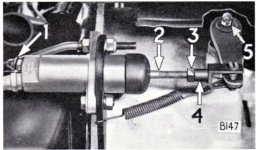
Ah yes, the Haynes strikes again! The illustration is only for TR2 and early TR3 with front drum brakes (and Lockheed hydraulics). As Bob says, the Girling slave was the same until the TR250.

But the important thing about the adjustment is that, with the slave piston fully bottomed in the bore, there is 0.1" or less of freeplay in the pushrod. I asked about it because I have seen symptoms very similar to yours, caused by having way too much freeplay but the slave piston is very slow to return all the way (because the spring is also too weak).

In turn, having way too much freeplay is sometimes caused by the dread broken taper pin. BTDT, got the greasy T-shirt.
 

Attachments

  • 28940.jpg
    28940.jpg
    78.7 KB · Views: 362
If the pedal shaft and spring are not hanging up and the internal spring in the mc is okay, it would seem to me that the problem is hydraulic. A defective or incorrect valve seal possibly. Tom
 
bobhustead said:
I took mapleaf to be saying that the m/c piston was slow, not the slave piston.
I did too. But the MC piston cannot return any faster than the slave piston, until the MC piston is almost all the way out (thereby opening the valve to the reservoir). Normally, the return spring on the slave acts to push both pistons, but it might not do that in the scenario I described above.

At any rate, it's just one thing to check. I'm not trying to say that's the only possibility, just the first one I thought of.
 
Thanks guys, Well the slave cylinder is installed properly and the adjustment is slightly under .1" so now I'll pull the master and slave cylinders and check to see if the repair kits are properly installed.
Randall, Just wondering, if the slave adjustment is correct and the slave piston/rod returns quickly would that eliminate the slave cyl as the problem?
BTW Bob, I bought the parts from a Moss redistributor but I doubt that they are actual Girling parts. No Girling markings just a clear zip bag with the Moss parts number.
Thanks again
 
mapleaf said:
Randall, Just wondering, if the slave adjustment is correct and the slave piston/rod returns quickly would that eliminate the slave cyl as the problem?

Pretty much. There isn't a lot to go wrong with it. But I don't see how it could return fast while the MC is returning slow. Are you certain the piston is actually bottomed in the cylinder when you check the adjustment?
 
Long as you got the Girling replacement part #, not the Lockheed number.
My hypothesis on the fact that the cylinders are moving at different speeds is that there is either not any real bleeding going on so the hydraulic connection is staying part pnuematic or the stem seal is not properly closing, allowing returning fluid to divert into the reservoir. Just grasping at the only straws I can see. Possible we are not getting proper bleeding because the plunger cup is on backward and slow return is caused by same condition? As I said a couple of posts ago, you should just pull the guts out of the m/c and look.
Bob
 
My position on the MCs is that they can only tolerate so much rebuilding, and perhaps you might have re-assembled the MC incorrectly. Anymore, I just buy them new from BPNW and have had good luck with that.
 
Well, I took the clutch M/C apart and the valve seal fell off the stem. Obviously not installed the correct way, but I did get the plunger seal and spring washer right. It will be the weekend before I can get it back in the car but if it gives me much more grief I'll probably go for a new one.
Thanks again
 
Back at it. I've reassembled the clutch m/c, this time correctly, but I thought it might be a good idea to bench test the plunger action before installing it on the car, so, after liberally lubricating it with brake fluid I manually pushed the pushrod numerous times and found that occasionally the plunger would stick at full extension and also at about 1/2" before resting position. Thinking it could be the plunger seal I replaced it with a new one but got the same results. Next step, replaced the internal spring with a new heavier one (Moss part)just in case the problem was a weak spring. Now the plunger still hangs up but not as frequently. The only other possible cause that I can come up with is a rough cylinder bore. Any suggestion, comments or ideas would be greatly appreciated.
TIA
 
Had a very similair problem last month. After much taking apart, honing and checking, I determined the kit from Moss was slightly too big.
Got another kit from another source and all is well. May redo the lines as I don't like them but that is another story.....
Dorien
 
I'm not quite ready to give up on the original master cylinders, especially with all the past negative reports on the reproduction ones and because these are Moss parts I'll probably go Dorien's route first. BTW, just in case, does anyone know which of the big 3 sells a master cylinder that looks identical or is the closest to the originals.
TIA Barry
 
There are two companies (Apple - who did one for me & another called White Post) who will install new bores in your existing master cylinders. If you go that route, be sure to also include the pistons so they can hone the bore to the correct inside diameter.

Guess how I found this out. Right ! I only asked for the new bore to be installed but didn't include the piston and had to hone it myself to fit the piston back into the new bore.

They put in a brass tubular bore 13 years ago with no issues since. Some advocate the stainless steel bore, I've got 13 years and 71,075 miles driven in my 1958 TR3A since 1998 with the brass bore.

For the rear brake pipes around the diff & rear springs, etc. send me a message with your e-mail address and I'll send you all my photos of this.
 

Attachments

  • 29048.jpg
    29048.jpg
    58.9 KB · Views: 197
Back
Top