• Hey Guest!
    British Car Forum has been supporting enthusiasts for over 25 years by providing a great place to share our love for British cars. You can support our efforts by upgrading your membership for less than the dues of most car clubs. There are some perks with a member upgrade!

    **Upgrade Now**
    (PS: Upgraded members don't see this banner, nor will you see the Google ads that appear on the site.)
Tips
Tips

TR2/3/3A TR3A Alternator hookup

TRusty

Freshman Member
Offline
I have no idea how a forum works. I Hope it gets to wherever it should...

My new alternator has three spade terminals on the back and a "bolt" terminal (about 3/16"?)on the side. One of the spade terminals is about 1/4" wide the other two are about 3/8" wide. These two wider terminals are connected at the base.

Coming from the voltage regulator area is a small yellow/green wire and a thicker yellow wire.

Does the thick yellow wire goes to the bigger spade terminal and the smaller yellow green wire to the smaller spade terminal? From which terminal does the wire run to the "bolt"?

I have seen wiring diagrams but none are clear enough for me to get the answer.

Thanks for any help.

Tom Tom
 
Since TR3As did not originally have alternators, you may need to specify just what alternator you have or (if you recently bought it) a link to the source.

Since I do not know how familiar you are with the car (and to assure we haven't lost something in translation) I will point out that a <span style="font-weight: bold">generator</span> looks something like this:

GeneratorHeavyDuty.jpg


...whereas an <span style="font-weight: bold">alternator</span> will look more like this:

RatsportLucas_alternator_cutout_smaller.jpg
 
The vast majority of modern alternators do not require an external voltage regulator, and in any case your original regulator would not be appropriate. So if you are converting to an alternator (aka AC generator) from the original DC generator, there will be some rewiring required.

The original yellow wire will not be large enough for almost any alternator (even a low-output "mini" alternator puts out twice as much as the original generator) so it will have to be replaced.

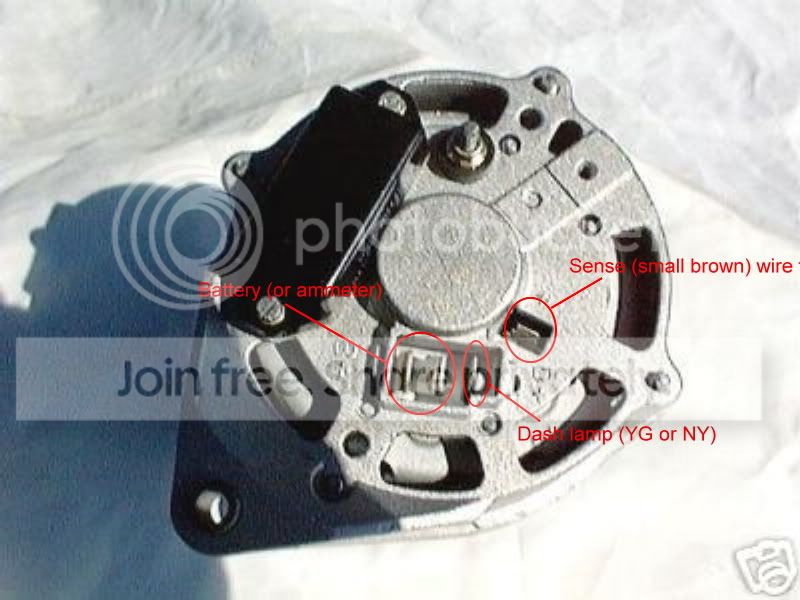
Does your alternator look something like this?

BOSCHALTERNATORCONNECTIONSANNOTATED-1.jpg


PS, welcome to the asylum! Your post is just fine, no worries there. But we'd love to know more about you and your car, preferably with photos if you can.
 
It is an alternator. The engine was rebuilt locally. It was returned with the alternator mounted. I added stainless headers, intake manifold, with carbs, etc. and dropped it into the car so now there isn't much room to see. I have examined the alternator from all directions with a mirror and can't see any manufacturers name nor can I see that the terminals are labled in any way. I can't identify things any better without taking it out and it is so well adjusted, etc. I don't want to do that. The alternator supplier is not particularly helpful, but more from lack of knowledge, I suspect. I've looked at a lot of diagrams and read a lot too but it doesn't do any good when it says "connect to terminal L" (or whatever) on the alternator terminal when I don't know which terminal is L.
 
Hello Randall,

Hadn't seen the rest of your message. Next I'll need computer help...The car is TS 77824L. I tried to download a pic or two and evidently I did that wrong too as nothing was accepted. I know about old British cars (prior to invention of the alternator) but computers and electronics in general I find a bit too challenging. It's ten PM here so I'll give another try at pics tomorrow. Anyw, thanks for the message.

I'm not sure where the Tom-Tom tag came from. Something to do with Moss-Europe I think, it's

Paul
 
I have a link I will attach as soon as my grandson shows me how, which gives some pretty concise info on this conversion. It is from VTR.

Phil, aka Crank
 
The VTR site articles are good, but I believe they only describe the wiring for a Delco alternator. Delco never used the 3/8" tabs that Paul described, so I don't believe that is what he has (especially since he is in Germany).

I hate to make assumptions when it comes to alternators, but if the arrangement looks similar to the 3 tab opening in the photo above, then I am going to guess that the two 3/8" terminals are the output. You will need to make up a new, heavy gauge (10 AWG will do, I used 8) wire that attaches to both terminals. Trying to run the full current through just one terminal will work at first, but is apt to lead to problems down the road.

There are several ways to link the new output wire into the rest of the car. The simplest (and most often recommended) is to simply attach it to the hot post on the starter solenoid, where the heavy gauge cable to the battery is attached. That will work fine, but the ammeter will no longer work correctly and always show discharge even when the battery is being charged.

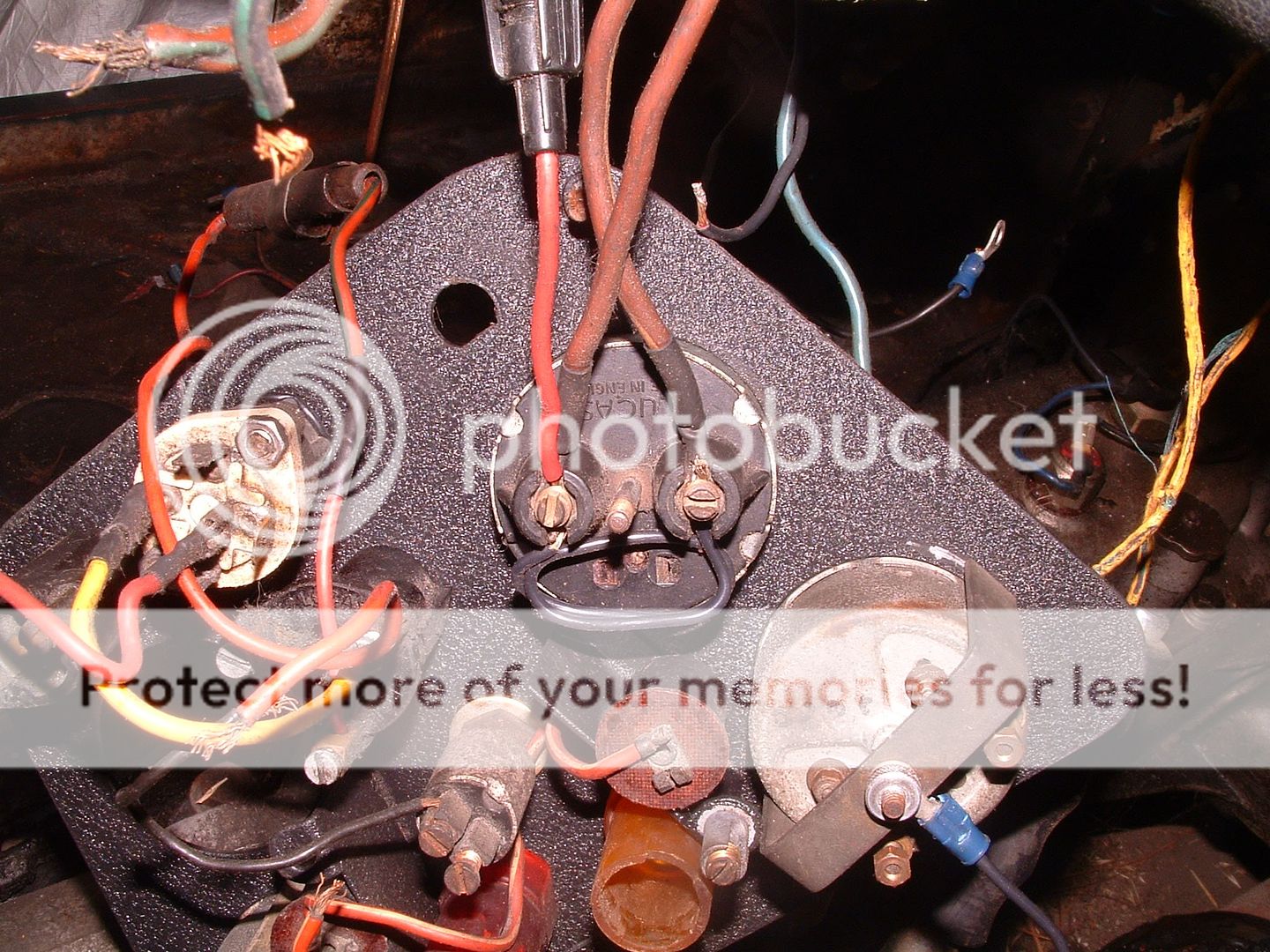
What I did instead was to join together the new wire along with the NU and NW wires where they originally attached to the control box (aka voltage regulator). That will correctly route the charging current through the ammeter. I then added a shunt across the back of the ammeter, to change the range from the original 30-0-30 to roughly 60-0-60.
Ammetershunt1.jpg


The 1/4" tab is likely the output to the warning lamp (which depending on your alternator, may double as the excitation current when the engine first starts). You can use either of the original wires if you want to (the current is small); it needs to be connected to the small yellow wire that was originally on the 'D' terminal of the control box. That small yellow wire runs through the harness back to the red 'Ignition' warning lamp on the dash.

The alternator I used (an old Motorcraft) needed more excitation current than the dash bulb would pass, so I added a resistor across the back of the bulb. The symptom was that I would have to rev the engine up fairly high (like 3000 rpm) to get the warning lamp to go out and the alternator to start charging. If memory serves, I used a 10 ohm 10 watt resistor, and spaced it out somewhat away from the bulb base (so it couldn't heat the plastic too much).

In the photo above, at least, the stud is a ground point. Strictly speaking, as long as the mount is all metal, you probably don't need to ground the alternator separately. But I ran a heavy gauge (10 AWG) wire to one of the solenoid mounting bolts anyway.

Oh yes, don't forget that you must convert to negative ground (if it hasn't been done already). Hooking the alternator up backwards will very likely damage it instantly and there are practically no positive ground alternators available today. In addition to swapping the battery cables, you should swap the connections to the ammeter and ignition coil.

 
Back
Top