 but were afraid to ask:
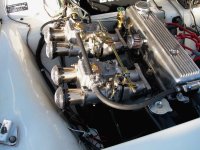
 Just a quick update on the progress of my TR3 rebuild. I finally installed the Weber 45 DCOEs. They run pretty good right out of the box. There is a slight "stumble" coming off idle, but other than that, they really come on strong! The filters you see are out on the Mercedes V12 air box. One of my clients is RENNtech and they were able to give me four of these until I get the filtration figured out. I had to cut out the pie shapes in order to make them fit, but it will keep birds and small children out of the engine. I would like to find a low-profile air box and smaller velocity stacks with a 3" flex pipe through the cardboard radiator deflector and into a cone-type air filter. TWM does have an air box, but it is too wide to fit between the Webers and the inner fender. One of the guys at the shop where I'm doing the work said he saw a low-profile air box at the PRI show, but he doesn't remember the manufacture's name.


-
 Hey Guest!
British Car Forum has been supporting enthusiasts for over 25 years by providing a great place to share our love for British cars. You can support our efforts by upgrading your membership for less than the dues of most car clubs. There are some perks with a member upgrade!**Upgrade Now**
(PS: Upgraded members don't see this banner, nor will you see the Google ads that appear on the site.)

Tips
- We have a special forum called "Member Articles" where you can submit actual articles for consideration for publication. Learn More
- Don't have an Avatar? If not, your avatar will default to the 1st character in your username. Go into "Account Details" to change your Avatar.
- Some basic forum navigation info: click
 Hey - did you know if you click on the title of a thread it will take you to the first unread post since you last visited that thread?
- Hey Guest - Is your British Car Club in our Clubs database? If not, send me a PM - Basil

- Looking for a local club? Click the "Clubs" tab above and browse hundreds of clubs world-wide.
- Add Android or iPhone APP: click
- Did you know - any picture or video you add in your posts in any marque-specific forum will also get added to the Media Gallery automatically.
- A few more tips about posting and replying: click
- Hey there Guest - be sure to keep your profile page up to date with interesting info about yourself: learn more
- More tips and tricks on Posting and Replying: click
 STOP!! Never post your email address in open forums. Bots can "harvest" your email! If you must share your email use a Private Message or use the
  smilie in place of the real @
- Want to mention another member in a post & get their attention? WATCH THIS

- So, you created a "Group" here at BCF and would like to invite other members to join? Watch this!
- Hey Guest - A post a day keeps Basil from visiting you in the small hours and putting a bat up your nightdress!
- Hey Guest - do you know of an upcoming British car event?
 Pretty Please - add it to our Events forum(s) and add to the calendar! >> Here's How <<
- Hey Guest - you be stylin' Change the look and feel of the forum to fit your taste. Check it out
- If you run across an inappropriate post, for example a post that breaks our rules or looks like it might be spam, you can report the post to the moderators: Learn More
- If you would like to try some different "looks" or styles for the site, scroll to the very bottom, on the left and click the Style Selector.
You are using an out of date browser. It may not display this or other websites correctly.
You should upgrade or use an alternative browser.
You should upgrade or use an alternative browser.
TR2/3/3A TR3 Weber photo
- Thread starter markctr3
- Start date

Alan_Myers
Luke Skywalker
Offline
Hi,
Your Weber installation looks good!
What size chokes (main venturi) are you using in those carbs? What other modifications have been done to the engine?
That stumble might be incorrect idle jetting (which actually isn't an idle jet at all, but an "off idle" jet that functions when the butterfly first opens). It's probably either too lean or isn't enriching quickly enough. But, it could also be related to the accelerator pump, it's jetting, an even the secondary venturi.
By far the best thing you could do would be get some time on a dyno at a Weber tuning specialist to set up those carbs *exactly* for your engine. An experienced Weber tuner will have a selection of jets to swap out, while the car is on the dyno. Trying to do this "shade tree" style ourselves usually ends up costing a *whole lot more*, since we need to acquire many different parts and jets (4 of each, in most cases) to swap out on a trial and error basis. Any future engine/exhaust modifications will usually require a check and more minor changes to the Weber setup.
Due to the fender clearance in TR3, especially at the front-most air horn, you might consider having an air box made up. Might be able to get one done locally at a body shop or other type of sheet metal shop, or maybe even a local community college, tech school or high school that offers sheet metal and welding classes. (Or take a class and make one yourself.)
I don't think a low-profile air box will work with those longer air horns on the carbs (and I'd try to keep them as long as possible on a street car... short ones and full radius type are for high rpm race track work).
In case you haven't seen a Weber air box, take a look at www.revingtontr.com The airbox simply mounts behind the air horns, which are then reinstalled and the air box cover put on. An airbox should have 1" clearance min., from the mouth of the carb's air horn, a little more if possible. Besides that, there an air box is little more than an box that can be opened on one side, provides a fitting for the flex hose and/or filter, fits under your car's hood and won't interfere with anything when the engine moves around normally.
I would recommend *not* routing the 3" air intake flex pipe out through the radiator shroud. Webers like to run in still air and you will get some ram effect at speed if you put the hose through the shroud (plus steal some air from the radiator, which needs all it can get in most TRs).
Instead, just put a filter on the end of the hose and clamp it to the fender or something up near the front of the engine compartment, where air can be drawn in as needed, not forced in. Perhaps near the RH headlight bucket.
Alternative to an air box are sock-type filters that just slip over and clamp onto the air horns on Webers. This type can mess with the air flow into the carbs, but that may not be significant, depending upon how highly tuned your engine is, overall. The wire mesh you have in place now could possibly be left as is to support the sock-type filter. If you want to drive the car until you get an air box made up, this might be a relatively inexpensive solution.
A third possibility, depending upon clearance, is a deep set of K&N oval filters. They make 3.5" deep version for Weber 40/42/45/48 DCOE, that fits over air horns up to about 40mm long (yours look like they might be a little longer). However, on TR3 the inner fender much be modified to make room for this type filter. Also check carefully for hood and other body clearance. It differs depending upon which manifold is used. (You can see a set of these K&N filters installed on my TR4's DCOE, at the link below by my signature, if you wish.)
One other thing, I can't tell from the picture, is there a support bracket for the Webers? The reason I ask is it's recommended in Weber installation manuals to fabricate some sort of support (this can be incorporated in the air box design). Now, I ran Webers on my TR4 for many years without any proper support bracket and never had a problem. It's got one now, though, because I've seen any number of Weber DCOE with one or more of the mounting ears broken off and welded back on. There's a lot of weight hanging out there on those four mounting ears per carb. Adding an air box will add even more weight, with even more leverage on the mounting ears.
Hope this helps.
P.S. You might take a look also at TerriAnn Wakeman's website for tons of info on Webers installed on TRs. https://www.tjwakeman.net/TR/index.html is the URL.
Cheers!
Your Weber installation looks good!
What size chokes (main venturi) are you using in those carbs? What other modifications have been done to the engine?
That stumble might be incorrect idle jetting (which actually isn't an idle jet at all, but an "off idle" jet that functions when the butterfly first opens). It's probably either too lean or isn't enriching quickly enough. But, it could also be related to the accelerator pump, it's jetting, an even the secondary venturi.
By far the best thing you could do would be get some time on a dyno at a Weber tuning specialist to set up those carbs *exactly* for your engine. An experienced Weber tuner will have a selection of jets to swap out, while the car is on the dyno. Trying to do this "shade tree" style ourselves usually ends up costing a *whole lot more*, since we need to acquire many different parts and jets (4 of each, in most cases) to swap out on a trial and error basis. Any future engine/exhaust modifications will usually require a check and more minor changes to the Weber setup.
Due to the fender clearance in TR3, especially at the front-most air horn, you might consider having an air box made up. Might be able to get one done locally at a body shop or other type of sheet metal shop, or maybe even a local community college, tech school or high school that offers sheet metal and welding classes. (Or take a class and make one yourself.)
I don't think a low-profile air box will work with those longer air horns on the carbs (and I'd try to keep them as long as possible on a street car... short ones and full radius type are for high rpm race track work).
In case you haven't seen a Weber air box, take a look at www.revingtontr.com The airbox simply mounts behind the air horns, which are then reinstalled and the air box cover put on. An airbox should have 1" clearance min., from the mouth of the carb's air horn, a little more if possible. Besides that, there an air box is little more than an box that can be opened on one side, provides a fitting for the flex hose and/or filter, fits under your car's hood and won't interfere with anything when the engine moves around normally.
I would recommend *not* routing the 3" air intake flex pipe out through the radiator shroud. Webers like to run in still air and you will get some ram effect at speed if you put the hose through the shroud (plus steal some air from the radiator, which needs all it can get in most TRs).
Instead, just put a filter on the end of the hose and clamp it to the fender or something up near the front of the engine compartment, where air can be drawn in as needed, not forced in. Perhaps near the RH headlight bucket.
Alternative to an air box are sock-type filters that just slip over and clamp onto the air horns on Webers. This type can mess with the air flow into the carbs, but that may not be significant, depending upon how highly tuned your engine is, overall. The wire mesh you have in place now could possibly be left as is to support the sock-type filter. If you want to drive the car until you get an air box made up, this might be a relatively inexpensive solution.
A third possibility, depending upon clearance, is a deep set of K&N oval filters. They make 3.5" deep version for Weber 40/42/45/48 DCOE, that fits over air horns up to about 40mm long (yours look like they might be a little longer). However, on TR3 the inner fender much be modified to make room for this type filter. Also check carefully for hood and other body clearance. It differs depending upon which manifold is used. (You can see a set of these K&N filters installed on my TR4's DCOE, at the link below by my signature, if you wish.)
One other thing, I can't tell from the picture, is there a support bracket for the Webers? The reason I ask is it's recommended in Weber installation manuals to fabricate some sort of support (this can be incorporated in the air box design). Now, I ran Webers on my TR4 for many years without any proper support bracket and never had a problem. It's got one now, though, because I've seen any number of Weber DCOE with one or more of the mounting ears broken off and welded back on. There's a lot of weight hanging out there on those four mounting ears per carb. Adding an air box will add even more weight, with even more leverage on the mounting ears.
Hope this helps.
P.S. You might take a look also at TerriAnn Wakeman's website for tons of info on Webers installed on TRs. https://www.tjwakeman.net/TR/index.html is the URL.
Cheers!
trfourtune
Jedi Knight
Offline
i read somewhere that the wire mesh screens you have give LESS airflow than filters, even paper filters let alone k&N filters, and they don't remove any dirt anyways. look cool though.
what model of dcoe's are those? are they the new spanish 152's? would like to hear how the tuning goes with those.
rob
what model of dcoe's are those? are they the new spanish 152's? would like to hear how the tuning goes with those.
rob
Alan,
As usual, thanks for taking the time to reply. Your experience and insight is TRULY appreciated!
As far as engine modification, I have installed a "D" grind cam, slightly oversize stainless steel valves with custom-made valves guides, 10.2:1 compression, mechanical advance only "racing" distributor and high-output coil. The chokes are 36 mm, the main stack consists of 145 main jet, 155 air correction jet and a F16 emulsion tube. The idle jet I believe is a 45. I don't know the accelerator pump jet.
I agree that I need to get it on a dyno to tune it, and that is in the works. And as far as the intake, I intend to mount an air cleaner to limit the ram air effect.
I'll keep you guys up to date on the tuning progress...
As usual, thanks for taking the time to reply. Your experience and insight is TRULY appreciated!
As far as engine modification, I have installed a "D" grind cam, slightly oversize stainless steel valves with custom-made valves guides, 10.2:1 compression, mechanical advance only "racing" distributor and high-output coil. The chokes are 36 mm, the main stack consists of 145 main jet, 155 air correction jet and a F16 emulsion tube. The idle jet I believe is a 45. I don't know the accelerator pump jet.
I agree that I need to get it on a dyno to tune it, and that is in the works. And as far as the intake, I intend to mount an air cleaner to limit the ram air effect.
I'll keep you guys up to date on the tuning progress...
Rob,
The screens are only there until I can fabricate some sort of air filtration system. I installed those to keep the "great unwashed" from throwing crap into the intake while I'm showing the car (yeah, maybe I'm a little paranoid, but an ounce of prevention, etc).
The carbs are 45 DCOEs, but I'm not sure about the "Spanish" thing...they are brand new however.
The screens are only there until I can fabricate some sort of air filtration system. I installed those to keep the "great unwashed" from throwing crap into the intake while I'm showing the car (yeah, maybe I'm a little paranoid, but an ounce of prevention, etc).
The carbs are 45 DCOEs, but I'm not sure about the "Spanish" thing...they are brand new however.
trfourtune
Jedi Knight
Offline
Alan,
what size venturi's have you run in the past. i think i recall you are planning to run 34's? will 34's let you run to 6000 or do they only work to 5500? i have 34's i plan to use but also have a spare set i plan to bore to 35 or 36 as required to get to 6000.(dellorto's-basically same as webers)
rob
/ubbthreads/images/graemlins/confused.gif
what size venturi's have you run in the past. i think i recall you are planning to run 34's? will 34's let you run to 6000 or do they only work to 5500? i have 34's i plan to use but also have a spare set i plan to bore to 35 or 36 as required to get to 6000.(dellorto's-basically same as webers)
rob
/ubbthreads/images/graemlins/confused.gif