
-
 Hi Guest!
If you appreciate British Car Forum and our 25 years of supporting British car enthusiasts with technical and anicdotal information, collected from our thousands of great members, please support us with a low-cost subscription. You can become a supporting member for less than the dues of most car clubs.
There are some perks with a member upgrade!**Upgrade Now**
(PS: Subscribers don't see this gawd-aweful banner

Tips
- We have a special forum called "Member Articles" where you can submit actual articles for consideration for publication. Learn More
- Don't have an Avatar? If not, your avatar will default to the 1st character in your username. Go into "Account Details" to change your Avatar.
- Some basic forum navigation info: click
 Hey - did you know if you click on the title of a thread it will take you to the first unread post since you last visited that thread?
- Hey Guest - Is your British Car Club in our Clubs database? If not, send me a PM - Basil

- Looking for a local club? Click the "Clubs" tab above and browse hundreds of clubs world-wide.
- Add Android or iPhone APP: click
- Did you know - any picture or video you add in your posts in any marque-specific forum will also get added to the Media Gallery automatically.
- A few more tips about posting and replying: click
- Hey there Guest - be sure to keep your profile page up to date with interesting info about yourself: learn more
- More tips and tricks on Posting and Replying: click
 but were afraid to ask:
  STOP!! Never post your email address in open forums. Bots can "harvest" your email! If you must share your email use a Private Message or use the
  smilie in place of the real @
- Want to mention another member in a post & get their attention? WATCH THIS

- So, you created a "Group" here at BCF and would like to invite other members to join? Watch this!
- Hey Guest - A post a day keeps Basil from visiting you in the small hours and putting a bat up your nightdress!
- Hey Guest - do you know of an upcoming British car event?
 Pretty Please - add it to our Events forum(s) and add to the calendar! >> Here's How <<
- Hey Guest - you be stylin' Change the look and feel of the forum to fit your taste. Check it out
- If you run across an inappropriate post, for example a post that breaks our rules or looks like it might be spam, you can report the post to the moderators: Learn More
- If you would like to try some different "looks" or styles for the site, scroll to the very bottom, on the left and click the Style Selector.
You are using an out of date browser. It may not display this or other websites correctly.
You should upgrade or use an alternative browser.
You should upgrade or use an alternative browser.
TR2/3/3A Tr3-eary 4s, draft tube and /or PCV valve??
- Thread starter Jerry
- Start date


Offline
The draft tube will reliieve pressure, but will also leak it bit of oil. Not too bad.
Bob
Bob

TR3driver
Great Pumpkin - R.I.P
Offline
Is there any value to adding a PCV valve from the valve cover to the intake manifold?
Well, maybe, but it would be a lot more complicated than that. If you design a proper PCV system, the main advantage would be to cut back on the pollution that comes out of the road draft, both unburned hydrocarbons and the occasional drop of oil.
But just hanging a valve from the rocker cover to the intake manifold would suck dirt and grit up off the road back into the crankcase. Probably not such a good idea.
And if you just blank off the draft tube port (as Triumph did), that allows pressure to build up in the crankcase during full throttle operation (when there is no intake vacuum to suck fumes through the valve) which will blow oil out in other places (like the rear main seal). It also allows the blowby gases to condense and contaminate the oil, forming varnish and sludge. Also not a great idea, IMO.
To really do it "right", you need to provide a filtered fresh air intake to the crankcase, preferably arranged so that when flow through the valve is not sufficient, the gases flow backwards through the crankcase vent and get sucked into the carb intakes. I'd really like to try that some day, but haven't found the right round tuit as yet.
I'm thinking maybe cut off the top of the road draft tube and put a PCV valve there, linked to the intake manifold. Then an air box with a single large paper element air filter on the carbs, with a line (and perhaps some sort of oil trap) to the rocker cover. You could also add an air duct to bring fresh cold air around the side of the radiator, instead of sucking hot air through the radiator.
Randall,
Your description is closer to a 6 cyl Healey engine. The crankcase is connected to the valve cover which normally goes to the carbs. But if you add a PCV valve and connect to the intake manifold, the result (in my experience) is less oil leak. That engine also gets hot air from the behind the radiator.
On my TR3A engine, I am just trying to stop oil leaks. Is there any value to stuffing the draft tube with steel wool so the oil collects before the top bend?
Jerry
Your description is closer to a 6 cyl Healey engine. The crankcase is connected to the valve cover which normally goes to the carbs. But if you add a PCV valve and connect to the intake manifold, the result (in my experience) is less oil leak. That engine also gets hot air from the behind the radiator.
On my TR3A engine, I am just trying to stop oil leaks. Is there any value to stuffing the draft tube with steel wool so the oil collects before the top bend?
Jerry

martx-5
Yoda
Offline
I've often thought of also putting in a proper PCV system in the TRactor engine, but, as Randall mentions, it's not quite as simple as it first appears. As a result, for me anyway, it's been put on the back burner. However, anyone that's interested in doing it right, might want to take a look a Teglerizer's site where he went through 5 iterations of a PCV system on his GT6 before he got it right. He was originally looking for a way to stop all of the oil leaks from the crankcase pressures that were building up. The link is below, and provides some interesting reading and some apparent cures.
https://www.teglerizer.com/triumphstuff/emissions/index.htm
https://www.teglerizer.com/triumphstuff/emissions/index.htm
TR3driver
Great Pumpkin - R.I.P
Offline
Jerry, if you are getting more than an occasional drop of oil from the draft tube, then there is likely some other problem that could be addressed. Converting to PCV won't make up for worn out rings, etc. and in fact the system I described (which has been used on practically all US cars since 1965 or so) will cause extra hassle because the expelled oil winds up on the air filter.
There is another solution, which some of the racers use. Basically you stick a fitting into the exhaust so the passage of the exhaust gases pulls a slight vacuum, and use that to evacuate the (otherwise sealed) crankcase. The advantage is that the exhaust vacuum is always there, even at full throttle, and so it is not necessary to provide an alternate path. And any oil that finds its way into the system gets burned harmlessly. Here's a photo from Joe Alexander
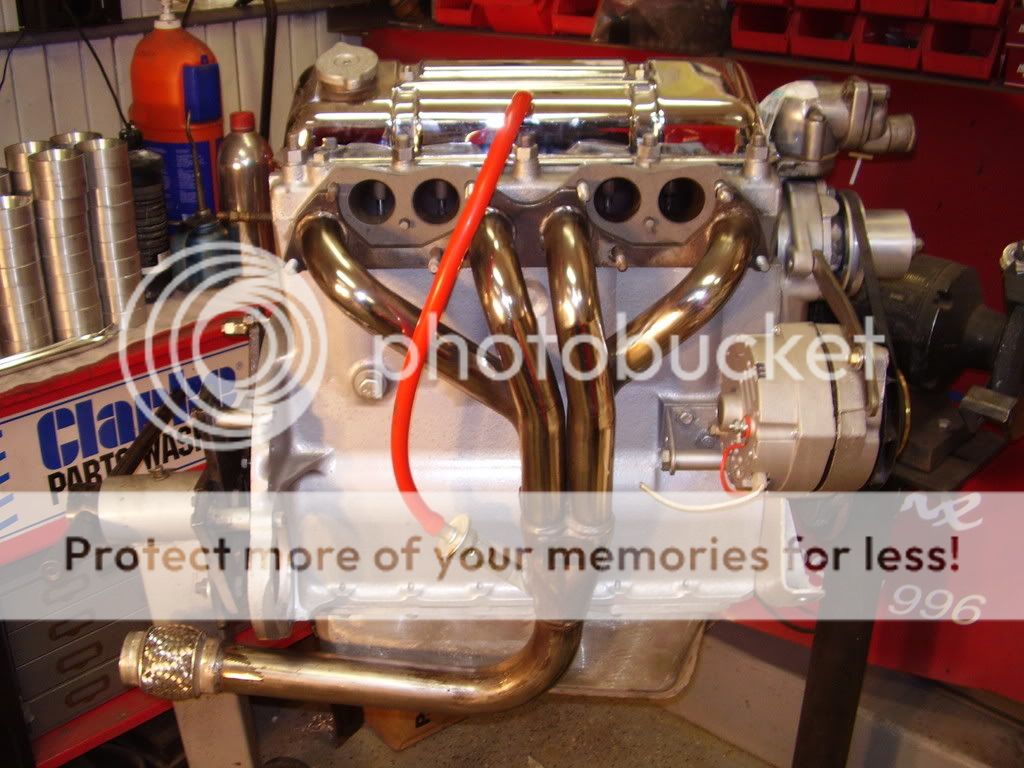
There is another solution, which some of the racers use. Basically you stick a fitting into the exhaust so the passage of the exhaust gases pulls a slight vacuum, and use that to evacuate the (otherwise sealed) crankcase. The advantage is that the exhaust vacuum is always there, even at full throttle, and so it is not necessary to provide an alternate path. And any oil that finds its way into the system gets burned harmlessly. Here's a photo from Joe Alexander
We are doing the machining and buying parts to build two engines right now. So I was trying to plan ahead. That linik up above did not seem to indicate that the exhaust vent worked well, but I could have read it wrong. We are planning new pistons and liners, new rear oil seal (TRF). I am trying to plan ahead druing the process. Perhaps a bung in the exhaust can also be used to tune the carbs. But how do you keep the vent pressure down if you are using it to vent the crankcase?
Jerry
Jerry
TR3driver
Great Pumpkin - R.I.P
Offline
I'm not sure I understand the question, Jerry. The fitting welded to the header includes a check valve, so that air only passes into the exhaust during the negative pressure pulse after a cylinder fires. How well that works may depend on how restrictive the rest of the exhaust is; but many cars use a similar system to inject fresh air into the catalytic converter, so it does at least potentially work. And Joe says it works very well in his race car. The crankcase remains sealed, so the internal pressure is somewhat below ambient; which the racers think might help power output. But for sure it should cut way back on any oil leaks, since the partial vacuum is trying to pull it back into the crankcase.But how do you keep the vent pressure down if you are using it to vent the crankcase?
martx-5
Yoda
Offline
... That linik up above did not seem to indicate that the exhaust vent worked well, but I could have read it wrong...
Jerry
If you are referring to the Telgerizer link, then yes it did work, but not for long. Apparently there was too much heat for the check valve and they didn't last long. I would think that better location of the valve then he had would solve that problem. If you look at the pictures he has in the link, you will see that it is very close to the exhaust pipe, much closer then the pic posted by Randall.

PeterK
Yoda
Offline
When I used a Moroso evac system on my 71 Z-28 back in the day, we put the check valves back near the header collectors (a little bit cooler than JoeA's placement just past the4in1. Never had a problem with the valve failing from heat related failure although a bad bridge paving took off the collectors when I scraped over it at speed. Got really loud!

richie
Senior Member
Offline
Hey guys. I see nobody had mentioned it so I thought I'd bring up Tony Drew's catch can setup he sells for $125. I was thinking of incorporating this on the TR this winter - this type of setup was something I had used with great success on a 9000rpm Honda engine I had built years ago.
https://www.tonydrews.com/Jack_Parts.htm
https://www.tonydrews.com/Jack_Parts.htm