• Hey Guest!
    British Car Forum has been supporting enthusiasts for over 25 years by providing a great place to share our love for British cars. You can support our efforts by upgrading your membership for less than the dues of most car clubs. There are some perks with a member upgrade!

    **Upgrade Now**
    (PS: Upgraded members don't see this banner, nor will you see the Google ads that appear on the site.)
Tips
Tips

TR2/3/3A TR-3B Exhaust

Vaark01

Jedi Trainee
Country flag
Offline
Hi,

I've discussed the following before, but have now done a lot of reserach and would appreicate advice.

I have a '62 TR-3B with headers going into a Pacesetter, Monza exhaust. I like the look of the twin chrome extensions.

My problem is the car is not loud enough for my liking.

I went to several muffler shops and was told the following: removing the front "resonator" on the Monza system would not really make it louder as it functions like a straight pipe. The chrome tips do have resonators inside which makes it quieter.

I called Pacesetter and their new Monza system no longer has resonators inside the chrome tips. New rear muffler with twin chrome tips is $181. They couldn't say how much louder their new system would be compared to what I have.

I checked with Cherry Bomb and they have a new muffler with 2" in and out that measures 3 1/2 x 8".

The problem they said was that with only the front Monza resonator and a Cherry Bomb in the rear, I may not have enough back pressure to keep from ruining my engine.

I would appreciate advice on how to keep my front Monza resonator and what to put in the rear to make it louder. I don't really know enough to say anything about back pressure, but I don't want to ruin my engine. I would like to have twin chrome tips at the end.

Thanks.

Paul
 
I always wondered how race cars with no mufflers kept from ruining their engines......

And, how I got 300K on the last flathead V-8 with duals and ONLY Cherry Bombs.

I wonder how my 67 Cougar ran so well for so long with the resonators removed.

I know about back pressure, and I experientially know that an exhaust manifold/header, and a pipe out the back, generally gives you more than enough.

But, maybe TRactor engines are different.

I always wondered how the VW Bug crowd fared when they removed the muffler and snuffies, and put that stinger header and ONE Cherry Bomb on them.

I also wondered (aloud) how Duesenbergs worked with those exhaust cutouts (no pipes or mufflers) you opened on the highway.

See what happens when you ask questions that get me to stop contemplating my navel?
 
Hey there Paul,

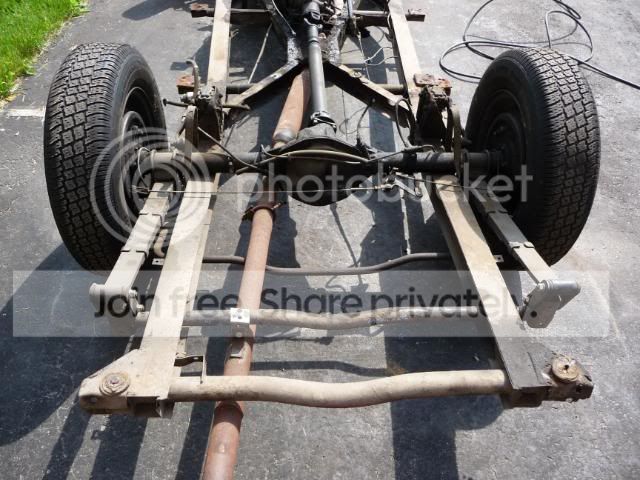
Don't have a direct reponse to your question, but I can tell you that my car when I bought it, and the way it was raced for many years, was with a straight through cherry bomb style exhaust.

You can see it in the pic below

P1050368.jpg


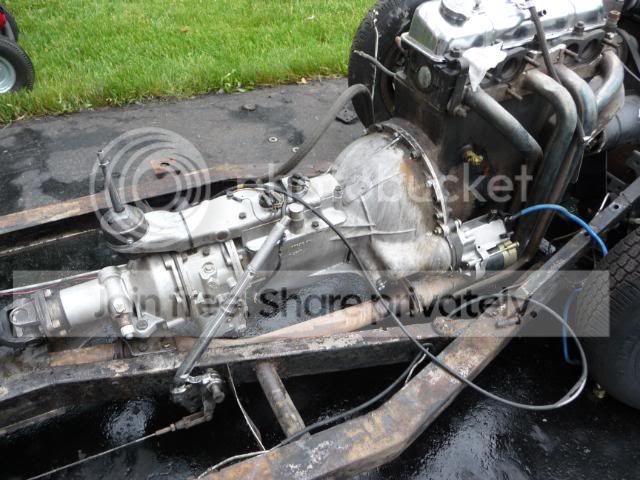
FYI, running with a header as well

P1050380.jpg


Cheers,
M. Pied Lourd
 
What about a front muffler (instead of a resonator) and then a straight pipe from that? Seems to me that's more or less what the original TR2 had. Sometime during TR2 production the muffler size was increased and an optional (later standard) resonsator added behind it due to complaints about loudness.
 
The answer to all the "ruining the engine" stuff is fairly simple : reducing exhaust backpressure will usually improve cylinder scavenging, meaning there is less exhaust left behind to become part of the next charge. Since the exhaust is inert, this means more fresh air into the cylinder (and more power). But it also means that the fuel/air mixture is effectively leaner. If not corrected, on some engines, this lean mixture can lead to excessive exhaust gas temperatures and consequent engine damage.

But the solution is simple, after any change to the exhaust, you should check the mixture at cruise and at WOT (read the plugs or whatever method you choose) and adjust accordingly.

With TRactor motors, generally it's not a problem. I believe this is because they were set up kind of rich by the factory, plus the original 'glasspack' exhaust was fairly low restriction to begin with.

I ran my TR3A for quite a few years with only a single Cherry Bomb muffler (though it was a lot longer than 8" ? ) and it worked fine. My main complaint was that it was too loud for my tastes. Setting off car alarms gets boring after awhile!

My current setup on the TR3 is two Cherry Bombs in series, very similar to the factory exhaust arrangement except the mufflers are round seamless instead of oval and crimped. The sound is just perfect, IMO, not too loud, not too quiet.

My suggestion in your case, Paul, would be to go ahead and replace the front resonator with a straight pipe. That should be a reasonably inexpensive experiment. You can then hear it for yourself, and decide how to go forward. I'm not familiar with your Monza setup, but I'll bet there is a way to remove/disable the resonators in the tips, as well. It was certainly standard practice on many motorcycle mufflers, frequently by just cutting out the web that supported the resonator tube and tearing the tube out.

More than likely, you could also 'modify' your main muffler by collapsing and removing part of the internal baffles. If you have decided you don't want it anyway, what have you got to lose?
 
I'll concur with M. Pied on his setup. I've run my 3A with stock exhaust manifold and straight though pipe with one glass pack for years.

It's nice and loud and has never given me problems... hopefully I haven't been damaging the engine.

I view the extra volume as a safety feature for the small car too; it lets people know you're there.
 
newmexTR3 said:
I've run my 3A with stock exhaust manifold and straight though pipe with one glass pack for years.
That was the factory setup for TR2 and early TR3, so no worries.
 
Straight through exhaust on race engines are tuned by pipe size (diameter) and length for the maximun extraction of the burned charge from the cylinders. Long story short, exhaust exit's the cylinder as a positive pressure pulse. When the pulse reaches the end of the pipe, or a change in pipe diameter, the pulse changes from a positive pressure pulse to a negative pressure pulse or wave and this wave reverses and travels back to the cylinder. The idea is to get the negative pulse to hit the cylinder just as the exhause valve opens and thus help extract the next positive exhaust pulse from the cylinder, thereby clearing the cylinder of more of the burned gasses than would normally be expelled, and helping to pull more fresh charge from the intake.
This pulse reversing can happen at the junction point of a 4 into 2 into 1, 4 into 1, or at the first change of pipe diameter, usually the muffler, in a 4 to 1 cast manifold system.

This is complicated, I know, and may be hard to understand. Books and tech papers have been written to explain it better than I can here. Just accept that this is what happens and back pressure occurs when the pipe crimped, the muffler is not a straight through design, or the negative pulse arrives after the positive pulse has exited the cylinder and they collide, slowing the flow of the pulse and the gasses.

Oh, by the way, this same technology is applied to the intake side of the engine, in reverse, to overfill the cylinder on the intake stroke.

The trick is to make both work in harmony to acheive the most power available. And all of this is dependent on the cam timing and lift. Gets complicated, huh? Super charging eliminates all of these problems.

Bottom line, I wouldn"t worry about ruining your engine as long as you check the mixture, as stated, above after making exhaust system changes.

Of course it's easy for me not to worry, it's not my engine. LOL
 
I remember one racer, painted his exhaust with cheap spray paint, and made a run.
Got back to the pits, saw where the line was between burned and untouched paint, took a hacksaw and cut the pipe off right there.
Poor man's exhaust tuning.
 
Back
Top