• Hey Guest!
    British Car Forum has been supporting enthusiasts for over 25 years by providing a great place to share our love for British cars. You can support our efforts by upgrading your membership for less than the dues of most car clubs. There are some perks with a member upgrade!

    **Upgrade Now**
    (PS: Upgraded members don't see this banner, nor will you see the Google ads that appear on the site.)
Tips
Tips

Tr 3 fuses

Hydroglen

Member
Country flag
Offline
Hello,
I am rewiring my early Tr3 I have a fuse block that I don't understand.
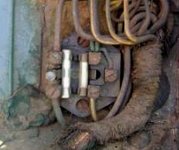
There are 5 terminals are obvious as they have a fuse connecting them. The other 3 are not connected. What to they do? Is there only one fuse in the car?
I have tried to attached a picture, but no go.
Dorien
 
Should be 5 terminals total. 2 pairs of terminals have a fuse running between them. The fifth terminal is supposed to have a small, flat metal jumper that links it to the 4th terminal. Then the 4th & 5th terminals are the ones that get multiple green wires.

Note that the fuse ratings given in the manuals use the obsolete Lucas fuse rating system. If you use modern equivalent fuses, the ratings should be 50-60% of those given in the manuals. So where it says "35 amp", either buy a reproduction Lucas 35 amp fuse (from the usual suspects), or substitute an AGC 20. AGC 25 will do in place of the "50 amp" horn fuse.

Sorry I don't have a good photo handy. But the link is visible in this blow-up of a blow-up (originally from Geo Hahn)
 

Attachments

  • 27258.jpg
    27258.jpg
    48.4 KB · Views: 263
I just noticed, that shot also shows an AGC fuse on the left, which is slightly longer and larger diameter than the original Lucas fuse on the right. That white area inside the Lucas fuse is actually a piece of paper that says something like "17.5 amp continuous" even though it's a "35 amp" fuse.

I don't know if your car would have had the 3rd fuse originally or not, but IMO it is worth adding. It's an in-line fuse, clipped inside the bottom edge of the dash just above the shifter, and protects the wiring to the tail and marker lamps in case some ugly SUV crushes a lamp with their bumper.
 
The fuses did change to both 35 amp at some later point. Might have been TS60000, as the notes I have handy indicate that the 6th edition of Practical Hints lists both as 35 amp, and I believe it was written for TS60K and later.
 
Since the fuse block is so visible I like to use the correct physical size fuse even though a 20 AGC fuse will sort of work.

FuseBlock.jpg


Also, those holes on each side with the spring in them are for holding 2 spare fuses (visible end-on in the above pic).
 
Geo Hahn said:
Since the fuse block is so visible I like to use the correct physical size fuse even though a 20 AGC fuse will sort of work.

I wasn't recommending it, just wanted to be sure everyone understood the issues in doing so. Some folks believe a 35 amp fuse is a 35 amp fuse.

Mine has a circuit breaker stuffed in it anyway, just one of the many reasons I never enter concours-type events. :laugh:

But that CB sure came in handy during the club run through Yosemite National Park. My TR3 developed an intermittant short that I wasn't able to find until we were on our way home two days later. Two fuses would not have been nearly enough!
 
Back
Top