• Hey Guest!
    British Car Forum has been supporting enthusiasts for over 25 years by providing a great place to share our love for British cars. You can support our efforts by upgrading your membership for less than the dues of most car clubs. There are some perks with a member upgrade!

    **Upgrade Now**
    (PS: Upgraded members don't see this banner, nor will you see the Google ads that appear on the site.)
Tips
Tips

TR 3 Clutch line

Hydroglen

Member
Country flag
Offline
Is the clutch line a US thread size?
I mean the one from the master cylinder to the flex hose at the frame.
Mine is leaking at the frame joint and the flaring does not that great. It was a new line that the previous owner may have got from Moss...not sure.
I was thinking of making up a new one with copper for easier bending.
Dorien
 
I think triumph clutch lines used AN fittings rather than standard fittings, but that possibly was only been the later models. It's hard to find the exact data on the flare fittings for some reason, so i dont know if it's an AN -4 or what size. My Bently manual doesn't list the size anywhere.
 
Hydroglen said:
I was thinking of making up a new one with copper for easier bending.
Dorien

I know that the clutch does not see the pressures that the brake lines see, but I still wouldn't use copper. Besides, all the brake and clutch lines that I purchased for my restoration were, if fact, fairly easy to bend. I didn't need any special bending tool and didn't get any kinks.
 
And therre is now an easy bend steel, the name of which I can't recall. Ask for it as easy bend brake line and the parts store will know what you mean. I don't know the thread info.
Bob
 
I picked up 25' of steel brake tubing from NAPA ($30 or so), and a bender from HF ($10 or so).
 
if its a short line you can fill the line with some media like baking soda and then bend it and then blow the baking soda out with air, that way you get no kinks

Hondo
 
Thanks guys,
I cleaned up the flare and it seems to be holding. The line looks new but VERY hard. I have a bender and have improved on the curving done previously. Fits the firewall a lot better.
I had considerd copper because that is what some Euopean cars used in the forties and later. Easy to bend and does not rust and handles brake pressure.
6C Alfa and Facel Vega are 2 that I had with copper lines.
Dorien
 
Years ago, they did use copper for brake lines, but they were thick walled and pretty stiff from what I've read. Copper's biggest problem was that it work hardened and became brittle. Steel doesn't have that problem, so it was widely adopted in place of copper, but suffers from corrosion. Enter Cunifer tubing which has the benefits of both, and is easy to work with. After this thread started, I think that one the brake lines that I bought for the TR3 is of this copper nickel alloy. It has a slight copper hue to it. I don't remember where I got it from.
 
Hydroglen said:
6C Alfa and Facel Vega are 2 that I had with copper lines.

Probably not pure copper, nor even what is normally sold as copper tubing. As Art said, most likely it was Cunifer (or sometimes Kunifer), which is a special alloy of copper (Cu), nickel (Ni) and iron (Fe) developed specifically for brake lines. Has a golden color similar to, but not as dark as real copper; closer to the color of a new US penny (which is also an alloy of mostly iron).

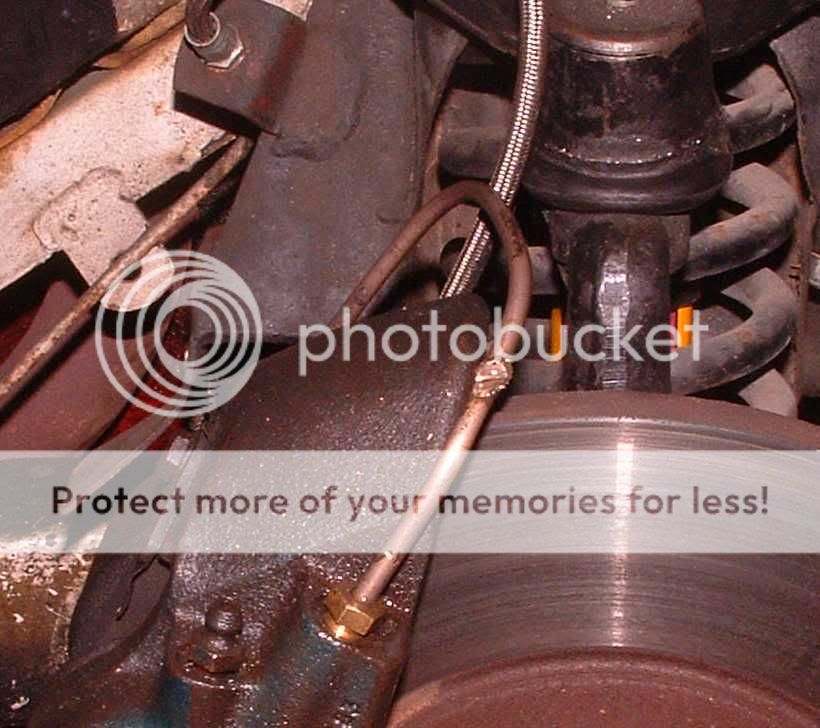
Moss sells a nice pipe set in Cunifer, or Fedhill is one source for Cunifer line and fittings in the US. One downside to Cunifer is that it has lower resistance to abrasion than steel does. This was my fault, obviously, for not dressing the line where it belongs, but I was surprised at how quickly (and silently) the Cunifer rubbed through:
Hardlineabrasion-cropped.jpg


One other note, "steel" brake lines are normally coated with a tin/zinc alloy (known as "terne") for corrosion resistance.
 
Back
Top