
• Hey Guest!
    British Car Forum has been supporting enthusiasts for over 25 years by providing a great place to share our love for British cars. You can support our efforts by upgrading your membership for less than the dues of most car clubs. There are some perks with a member upgrade!

    **Upgrade Now**
    (PS: Upgraded members don't see this banner, nor will you see the Google ads that appear on the site.)
Tips
Tips

Torque reading

T

Tinster

Guest
Guest
Offline
I went out to purchase a torgue wrench
to install the exhaust manifold and new
carbs and intake manifold to 25# .
$130 for a 5# to 50# range model!!!!

One look at it and I knew it could not reach
into some of the nuts and bolt heads.

I over torqued a nut today and stripped off a
stud. Four hours to pull off everything to extract
the stud, etc, etc.

How does one measure or geusstimate torque?
The $139. wrench would not have reached to nut
and stud I ruined today.

Thanks,

D
 
You can SWAG a torque reading by looking at how long the handle is on the wrench and then doing a quick 'in the head' estimation of how hard you need to pull on the wrench handle to get that number.
For instance; 100 ft # torque value. Using a ratchet handle that is 18 inches long (1.5 ft). You need a 75 pound pull on the ratchet. Try picking up a salt bag (50#) to get an idea of how hard to pull.
Same idea for smaller parts. Just smaller torque numbers and shorter wrenches.
One idea is to check the auction listings in your paper and at pawn shops for torque wrenchs. They show up pretty regularly and usually sell for reasonable price compared to new.
 
I have long handled SK 3/8 drive ratchet. When I can't pull anymore without causing bodily damage, it's 60 lbs.
 
Dale, if you broke off a stud in the head putting your header on, you got your hands on some either 1. really old over-stretched studs that should have been replaced, or, 2. you replaced your studs already with some really poor quality studs. Either way, you shouldn't have to torque those nuts onto the head for your two manifolds (head studs, by all means they are torqued!), for two reasons. First you aren't gonna find a torque wrench that will grip 2 or 3 of the nuts under that tube header unless you pay big bucks for a specialty torque wrench head (as mentioned above), and second, you really don't have to torque those nuts. You are or should be using all new hardware (studs and nuts and split lock washers) and should be doing it by feel, and then retightening later on down the road. I know, the book says to torque, but it doesn't mention tube headers. Just make sure that you get quality studs and the only place you will find them are TRF (or Moss sometimes) Those are SAE fine thread into the head and SAE outer threads. Essentially every auto parts store in the world will only have course/fine studs, not fine/fine threads. I have even resorted to using beveled all-metal locking bolts on 3 of the unreachable nuts with no split locks and only thin, hardened flat washers because of the access problem. I even modified (grinder) a crow's foot open spanner to fit inside this tight spot.

Always, always buy the best hardware you can get and change it as often as you change your underwear. Remember, studs stretch and are subjected to intense heat. They do not last forever.


Bill
 
Hey Bill,

I was surprised myself. Yes, if I go to the trouble to tear
something down I install new fasteners. In this case--
Victoria British. The brass nut stripped the threads off
the really miserably located center, bottom right, intake manifold stud with short clamp (new).

I should have left well enough alone. I read that torque
of 25# was critical so I went back in after I had installed
everything. Big Mistake.
 

Attachments

  • 249497-nutstarter.jpg
    249497-nutstarter.jpg
    46.8 KB · Views: 101
Hey Bill,

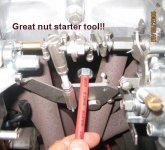
Sorry: the photo is my elegant solution to getting the
brass nut seated onto that miserable bottom stud. Spark
plug wire will snake around the pipes and carb linkage
and get you four threads onto the stud before it loses
tension and falls out.

I am usually disappointed in VB quality but TRF hardly
ever has the parts I need. Moss is in the UK?? They will
ship to PR at a reasonable cost? I tried to purchase a $14
book from Scotland and they wanted $60 for shipping.

d
 
Dale,
One thing is don't use brass nuts . These are commonly used on exhaust flanges because the brass seems to break away from the iron studs when needed after lots of heat and rust over time. Brass nuts are thick because they are brass and not that strong. Use only high quality steel nuts of the same grade as the studs. The studs that come with the head of the TR6 are just so long, certainly not long enough to hold a thick brass nut, and lock washer. Juat like putting a tire on the car, you tend to torque them down by hand, just knowing how much hand torque is enough. The manifold studs are the same, suck 'em down by feel, then re-"torque" them after running a while.


Bill
 
One trick on all exhause bolts, nuts and studs is the liberal use of antisieze lubricant. It will help a lot towards preventing the whole assembly becoming a solid, imovable monolith after a few thousand miles. Really does work.
 
Tinster:
If you cant "feel" the torque, practice on a few nuts and bolts (same size) that you can get the TW on and then feel it by hand. The worse thing to do is over torque then. No exhuast leaks (check by sound) no intake leaks (checked by pulling up and pushing down on the intake manifold(s) means the nuts are ok. Thoses particular nuts tend to back off and need to be checked from time to time.
 
Hey Bill and all!!

Wow!! Am I confused on the brass issue or what??

Why have the brass as replacement in the catalogs
if it is poor quality strength? The new studs I ordered
took the new brass nuts and new lock washers just fine.

Well, since mine is a dead crypt car; I might as well take
it apart again and install steel nuts. I was curious about
the use of brass to begin with. But since I know zip auto
mechanics I figured I was just being stupid.

Actually, I do have a decent feel for torgue. It was just
that I read somewhere that particular torque was critical.
What I had accomplished "felt" fine to me-should have left
well enough alone.

As always, thanks to everyone for the advice.

Tin
 
Dale,

The theory is that the brass nut is suppose to strip or break away leaving the stud intact. That way you don't have to drill the remains of the stud out of the manifold. Someone should have told that to my TR3. I had to drill out all three studs and re-tap the holes. I think the theory is flawed or the studs aren't hard enough. In my case thankfully they weren't that hard and drilled out easily. So maybe your studs were not hard enough and your brass was too hard or you tweaked the socket or wrench you used a little up or down. Have to keep it dead straight when tightening or the stud will snap. Thanks too a big brass nut. Little nut probably slip right off.
 
The GT6 appears to be very different in how its manifolds are secured so I'm not familiar with the studs you are dealing with.

However, on all the German cars I've owned and worked on, bronze or brass nuts are regularly used. Various people have explained their use to me and each has given a different reason (different temperature expansion rates, galvanic potential, lack of galling...). Regardless, I've never had issues with brass/bronze nuts on my German cars. However, when I put the manifolds back on those engines I also apply anti-seize compound to the studs. Perhaps that combination is why the brass manifold nuts have always worked well for me.

It's ironic that this thread started off talking about torque wrenches. Literally no more than 1/2 hour ago I was confirming the calibration of three torque wrenches in our lab at work. With torque wrenches (as with most things) you get what you pay for. $130 may sound expensive for a tool but it really isn't. My father bought some $30-40 Harbor Freight torque wrenches and when I checked them out I found their calibration to be way off and non-linear. My $100 Craftsman was out of calibration but at least it was linear. The $300 Snap-On wrench at work was spot-on within 1 lb-ft through the range we checked its calibration. That's remarkable accuracy... but you pay for it. For general information to all, remember to leave your (click-type) torque wrench set for its lowest setting when in storage to keep it in calibration longer.
 
Back
Top