• Hey Guest!
    British Car Forum has been supporting enthusiasts for over 25 years by providing a great place to share our love for British cars. You can support our efforts by upgrading your membership for less than the dues of most car clubs. There are some perks with a member upgrade!

    **Upgrade Now**
    (PS: Upgraded members don't see this banner, nor will you see the Google ads that appear on the site.)
Tips
Tips

Timing with an electronic distributor?

D

DavidS

Guest
Guest
Offline
I just bough and picked up my first 1976 Triumph TR6 over the weekend. It runs well. The old owner gave me a list of things needed and work that has been done. One thing that caught my eye was that he had advanced the timing to 32 degrees BTDC. I called him and he told me that " experts on the web suggested it because the vacuum advance has been disconnected because it using a Pertronix Electronic Distributor". It this correct??? Is this going to cause pre-ignition? This is my first British car. I have a lot to learn and any info will be greatly appreciated. Thanks
 
Welcome to BCF! First thing I'd do would be search the Triumph forum here for Pertronix threads. Lots of advice from many Pertronix users.

I'd also say ... don't change anything yet, especially if the car is running well.

I'd also say ... we'd really like to see some pictures of your new arrival!

Tom
 
A wise man told me how to time a car with a vacuum gauge. I believe on older cars, especially ones that have been modified (like removing vacuum retard) it is the only way to go. Connect the vacuum gauge to the line going to your brake booster, adjust timing to max vacuum, then back off 1.5. Worked perfect for me on my TR6, and works with or without the pertronics.
 
:iagree: on the vacuum timing method.

And 32 degrees? We're talking total advance, yes?

Also, welcome to the party!
 
You will know if it is too much timing. It will rattle when you open it up.

The Petronix obviously electronically retards the timing, or the engine would not start with 32 degrees advance...it would stop the crank if it fired that early while starting the engine.

So, I think you are good if you didn't notice any rattling when you drove it home!

John
 
Hi guys,

Thanks for your replies. I like the vacuum method. Yes we are talking total advance.

David
 
TR6banjo.jpg

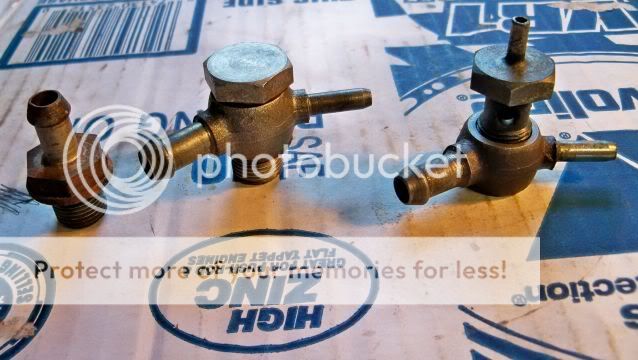
A 76 should have a "banjo" vacuum fitting on the intake manifold like the one in the right with the 3 nipples.
The Vacuum Gauge hose fits the medium size nipple on this fitting. Use the throttle stop (idle speed) screws to maintain 850-900 rpms at idle and set the timing to 17 -18 in Hg on the gauge, if the cam is still stock. Subtracting 1 in-Hg per 1000 ft above sea level.

Next up, the carbs' air fuel mixture.
 
Last edited:
32 max advance at something at or above 4k RPM is not unheard of. If you put the engine under load and do NOT hear rattling and engine knock, your advance at 32 will be OK. As others said, if it's not causing problems there is nothing wrong with leaving the timing where it is. Do retard it if you hear "bad" noises during a hard acceleration.
 
32 max advance at something at or above 4k RPM is not unheard of. If you put the engine under load and do NOT hear rattling and engine knock, your advance at 32 will be OK. As others said, if it's not causing problems there is nothing wrong with leaving the timing where it is. Do retard it if you hear "bad" noises during a hard acceleration.

Yep, and that's another good method: Advance it until it starts pinging under acceleration, then retard a tic or two.
 
The max advance will vary from engine to engine according to its state of build and the fuel being used. 36 max is certainly possible for some engines.

On a related and somewhat interesting note, I was talking to a local MGB racing team about their engine. They invested in a programmable version of the 1-2-3 distributor. Apparently the way you set that is to put the car on a chassis dyno, and move the advance up or down at various engine speeds to develop the best advance curve. What they found surprising was that for their engine the max power was actually developed at a lower degree of max advance and that the curve actually went up and down in a few places through the RPM range instead of the "smooth" climbing curve that is more or less common with traditional mechanical distributors. If I had the money and resources I would be very interested in trying this myself on my British cars.
 
Thanks for the replys! As I get a chance to drive it more it will give me a better feel on how it is acting. Idle is good and steady, it starts fine with some choke. It probably is fine just could not believe it was advanced that far. It's good to get your thoughts and comments. I will have many questions coming thanks again!
 
Keep those questions coming! That's what BCF is here for.

Tom
 
Back
Top