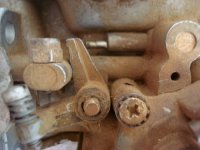
The plunger spring for the float chamber vent is broke so the plunger goes where it wants to instead of opening and closing when you give the car gas. Questions are. Will this cause hard starting when the car is warm, and poor performance? What do you have to do to get the plunger and spring out? Any help on how to get this apart, and what problems it will cause would help greatly. The picture is from one of my extra carbs.


-
 Hey Guest!
British Car Forum has been supporting enthusiasts for over 25 years by providing a great place to share our love for British cars. You can support our efforts by upgrading your membership for less than the dues of most car clubs. There are some perks with a member upgrade!**Upgrade Now**
(PS: Upgraded members don't see this banner, nor will you see the Google ads that appear on the site.)
You are using an out of date browser. It may not display this or other websites correctly.
You should upgrade or use an alternative browser.
You should upgrade or use an alternative browser.
TR6 This is something I should know,but don't TR6
- Thread starter mallard
- Start date

poolboy
Yoda
Offline
Yeah it will cause all kind of problems if it's not working right and it needs the spring to work properly.
The "L" shaped lever with the idle speed screw should push the spring loaded plunger forward when the engine is at idle. In that position the float chamber is being vented thru the nipple on the left side of the carb, pointing toward the cockpit.
The position shown in the picture is the position that it would be in when the engine is running faster than idle speed and in that position the float chamber would be vented thru the brass lined hole on the carb's air box mounting flange.
The transition of the vents was needed to provide a port for the Anti Run-on Valve to open manifold vacuum to the float chamber when the engine was killed.
The plunger is supposed to be spring loaded. At idle The "L" lever engages the plunger, compresses the spring, closing the flange vent, opening the "ARV" vent.
As the throttle opens the "L" lever disengages the plunger,the spring expands opens and keeps open the vent on the flange and closes the ARV vent.
You can take the valve apart. There's directions in the Buckeye article. I believe they call it emission vent or something to that effect.
The "L" shaped lever with the idle speed screw should push the spring loaded plunger forward when the engine is at idle. In that position the float chamber is being vented thru the nipple on the left side of the carb, pointing toward the cockpit.
The position shown in the picture is the position that it would be in when the engine is running faster than idle speed and in that position the float chamber would be vented thru the brass lined hole on the carb's air box mounting flange.
The transition of the vents was needed to provide a port for the Anti Run-on Valve to open manifold vacuum to the float chamber when the engine was killed.
The plunger is supposed to be spring loaded. At idle The "L" lever engages the plunger, compresses the spring, closing the flange vent, opening the "ARV" vent.
As the throttle opens the "L" lever disengages the plunger,the spring expands opens and keeps open the vent on the flange and closes the ARV vent.
You can take the valve apart. There's directions in the Buckeye article. I believe they call it emission vent or something to that effect.

TR3driver
Great Pumpkin - R.I.P
Offline
I don't think it would affect starting, but might upset the mixture while you are underway, which might lead to poor power and overheating. Most likely though, it would have no effect at all on running. If the pressure in the line to the carbon canister goes below the pressure at the carb face, it will try to pull the valve open.
Never tried to remove one, but my method would be to find a short length of pipe large enough for the brass tube to fit inside, then turn a suitable tap into the opening in the tube 2-3 turns. Slide the pipe over the tap, plus a flat washer and nut, then tighten the nut to pull out the brass tube.
The threads cut into the tube won't hurt anything (reuse the tube), but be sure to clean up the swarf so it doesn't get into the engine.
Never tried to remove one, but my method would be to find a short length of pipe large enough for the brass tube to fit inside, then turn a suitable tap into the opening in the tube 2-3 turns. Slide the pipe over the tap, plus a flat washer and nut, then tighten the nut to pull out the brass tube.
The threads cut into the tube won't hurt anything (reuse the tube), but be sure to clean up the swarf so it doesn't get into the engine.

TR6oldtimer
Darth Vader
Offline
I removed mine during a rebuild. To get it out, I tapped the hole, put in a bolt, and was able to extract it.
When I had it apart, I considered setting it permanently in the "vent to the atmosphere" position (valve stem fully extended), but said, what the heck, I have come this far, why not make it work as designed.
BTY, the internal parts for the valve are no longer available from any sources I could find.
When I had it apart, I considered setting it permanently in the "vent to the atmosphere" position (valve stem fully extended), but said, what the heck, I have come this far, why not make it work as designed.
BTY, the internal parts for the valve are no longer available from any sources I could find.
I tried Ray, and Randall's idea on how to remove the valve and it worked perfectly. And also thanks P B for the info that Buckeye Triumph's has. I have not done the replacement yet on the car so I don't know about any running improvements. The car developed a few problems over the winter and I may just park it for the summer and make all the repairs. Everybody else get out enjoy your driving season.