• Hey Guest!
    British Car Forum has been supporting enthusiasts for over 25 years by providing a great place to share our love for British cars. You can support our efforts by upgrading your membership for less than the dues of most car clubs. There are some perks with a member upgrade!

    **Upgrade Now**
    (PS: Upgraded members don't see this banner, nor will you see the Google ads that appear on the site.)
Tips
Tips

Stuck Valve

doughairfield said:
I opened the coolant valve on the side of the engine block this morning just to see if coolant had started filling the water jacket, but it was empty. I poured 2 gallons of coolant into the radiator before I started the motor for the first time
Has to mean that either the port is blocked, or you have a huge leak somewhere. The capacity of the entire system is only a freckle over two (US) gallons, and the drain tap is way down low. Unless your shoes are wet, or the crankcase is full of coolant; the drain port is blocked.

Happens all the time, mine is almost always blocked every time I do my semi-annual coolant flush & change. The crud blocking it didn't necessarily come from the engine, it might have been lurking in the heater (for example). The drain is located at the lowest point of the water jacket, where coolant flow is slowest, so that is where any sediment will settle.
 
Thanks Randall, that's reassuring to know. I'll check out that valve when I pull the head this weekend.

Just for the record, from the consensus here, the only cause of that valve sticking in the open position is an improperly reamed/installed valve guide.
 
doughairfield said:
Just for the record, from the consensus here, the only cause of that valve sticking in the open position is an improperly reamed/installed valve guide.
Could also be a chunk of something that found its way between the stem & guide; or possibly even a bent or damaged valve stem or guide. Given that they are cast iron guides, I'd think the FOD theory is most likely (the cast iron guides usually don't need to be reamed after installation, though it's still a good idea to take a pass with a reamer just to be safe).

But it's going to be something that made the valve bind in the guide.
 
When the engine ran for 5 minutes, the engine and the valve became hot and it expanded in diameter and jammed in that valve guide because it hadn't been reamed to specification. When the engine cooled down, the diameter of the valve stem reduced in diameter and when you tapped it, you released where it had become seized and it popped back up into place.

MAKE SURE THEY REMOVE ALL THE VALVES AND CHECK ALL THE VALVE GUIDES AND REAM ALL WHICH ARE OUT OF SPEC.

As I wrote above, #7 valve just happened to be the first one to seize. If they only fix this one, let's have a contest to guess which of the remaining valves will be the next one to seize.
 
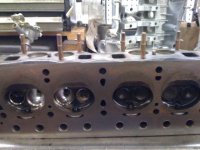
Got the head off Friday and ran it back up the machine shop. The valve turned out to be bent a little and the intake guide had a mark on it where the bent part of the valve had scored it, so both will have to be replaced. Oddly the piston didn't show any signs of an impact with the valve that I could see. Possibly the valve had a slight bend in it to begin with?

I stood there while they checked the clearance of the intake guide and it was .002, which is right in the middle of the spec, I didn't expect that. The exhaust guide however was also .002, which is not within the .003-.005 spec, which they will of course fix.

Their reasoning for the stuck valve was that I had old fuel in the tank and some varnish from that had caused the valve to stick. There was a very slight brownish tint to the valve but I think that was a bit of a stretch. That fuel is maybe 5 months old and I put stabilizer in it when I parked it . Plus those are some heavy duty springs. And it didn't have that varnish smell.

At this point they are going to check and re-ream all the guides and replace the bad valve and guide.

There was a surprising amount of blackish oil in all of the combustion chambers for such a short amount of time running. I assume the carb mixture is way rich and maybe was burning off some assembly lube to cause that?
 

Attachments

  • 21259.jpg
    21259.jpg
    52.9 KB · Views: 271
doughairfield said:
Their reasoning for the stuck valve was that I had old fuel in the tank and some varnish from that had caused the valve to stick.

Sounds like a WAG to me... :nonod:
 
WAG? Not familier with that one.

Regardless, I think they are really reaching there.
 
<span style="font-weight: bold">W</span>ild <span style="font-weight: bold">A</span>** <span style="font-weight: bold">G</span>uess...
 
doughairfield said:
Their reasoning for the stuck valve was that I had old fuel in the tank and some varnish from that had caused the valve to stick.
That's er, ... creative!

Not to mention closely related to round, brown things found in cow pastures.
 
A knowledgeable machinist would have lapped the valve with either lapping compound and checked face print all around OR used Prussian Blue to insure complete contact.

I think it hit the piston, even if it left no mark.
Doesn't take much.

Now, if it was an old engine, with lots of carbon on top of the pistons, you'd have seen it for sure.

Oh, and I know for an absolute fact that some TR engines DO have piston to valve clearance issues, but I won't tell you how I know that.
 
Yeah, I think the whole varnish from the gas tank is a bit of a stretch.

I had not heard about using the Prussian Blue, i'll see if they did that, thanks for the tip.

What do you guys generally recommend for the clearance on the intake valve guides? As I said earlier, they were all within the .001-.003 tolerance. Do you find that to be correct?
 
TOC said:
Oh, and I know for an absolute fact that some TR engines DO have piston to valve clearance issues, but I won't tell you how I know that.
Oh no doubt about that. One of them even had piston/head issues! Left a rather interesting two-tone effect on the piston tops; but I unfortunately don't have any photos to share. Going back to a stock gasket rather than the "shim steel" one gave just enough clearance to squeak by.
 
Went to pickup my head at the machine shop Friday and they were still swearing old gas, I said thanks for the advice.

They changed out the bent valve and guide and re-reamed everything at no charge. Got the head on over the weekend and so far everything is running great. Took it for a drive around the neighborhood for the first time in 6 months, best feeling. Hopefully, I'll have the bonnet back on and all the carpet and seats back in by the end of the weekend.

I read the WSM about breaking in a new engine, but this one isn't entirely new, just new pistons and sleeves, head was redone with new springs and guides, everything else is pretty much original but has been cleaned and polished. What advice can you guys offer for the first 500 miles on my rebuilt engine?
 
I'd call that new enough to treat as new. Especially since you also got new rings and likely at least new rod bearings.
 
Back
Top