• Hi Guest!
    If you appreciate British Car Forum and our 25 years of supporting British car enthusiasts with technical and anicdotal information, collected from our thousands of great members, please support us with a low-cost subscription. You can become a supporting member for less than the dues of most car clubs.

    There are some perks with a member upgrade!
    **Upgrade Now**
    (PS: Subscribers don't see this gawd-aweful banner
Tips
Tips

TR2/3/3A Speedometer Error Again

karls59tr

Obi Wan
Bronze
Country flag
Offline
Here is a Speedo test I had done in when I got 3 speeding tickets in 2010....guess I had a lead foot back then. The test didn't help with the tickets:fat:
Road Speed To Be When Speedometer Reads
16 mph 20 mph
23 30
30 40
38 50
45 60
I read the old posts about holding the "drag cup" and gently lifting off the speedo needle and moving it back from 40 to 30. I would rather do this than get the speedo recalibrated at a shop. What exactly is the drag cup and how much disassembly of the speed is required?
If I did this I wonder what my actual speed would be when the speedo read 60mph?
 
Your errors are roughly proportional to speed, so just moving the needle won't work. You need to change the amount of pointer motion per mph, and that's a lot more difficult to do. Do you have a stock rear-end ratio?

The "drag cup" is that shallow aluminum cup that is attached to the pointer shaft. The cable turns a magnet in the cup, which creates eddy currents in the cup, and their magnetic field interacts with that of the magnet to turn the cup, and thus the pointer. The amount it turns depends on the magnetic field from the magnet, the spacing of the magnet in the cup, and the force of the return spring. Changing any of these is tricky.

If I interpret your table correctly, the speedometer is reading high. You might open the speedometer and check to see if anything is (perhaps) loose, causing the magnet to be too far into the cup. I doubt that the spring is loose; if it were, the pointer wouldn't return at all. The magnet's field strength isn't going to increase all by itself.
 
Yeah, the magnet doesn't get stronger by itself, but it seems that the spring does get weaker by itself. Anyway, I've had several of them that read high, some extremely high (indicate 120 mph at 75 actual). Complete teardown failed to show any other problems, and I was able to calibrate it very closely by weakening the magnet a bit.

Disassembly is limited to removing the mechanism from the case (which isn't a simple task). Be very careful pulling the needle off the shaft, they are often very tight and there's one in my junk bin where the shaft snapped before the needle came off. It's best if you can use a fork-like tool to pry under the needle and force it straight away from the face, so no side force is applied to the shaft. Of course be sure to mark the relationship between the needle and the cup before you take the needle off!

You can pick any one speed to make accurate, so you could make it accurate at 60 mph if you want. But it will still read low below that speed (probably no indication at all until you get to 30 mph or so), and high above that speed.

Check the calibration number printed on the face under the odometer window. Numbers around 1180-1200 indicate the speedo is for a 3.7 axle; 1300-1350 is for a 4.1 rear axle. If your car was originally fitted with a 3.7 and someone has changed to 4.1, that would explain part of the error (but not all of it).
 
As long as the clock spring is not broken, by it’s nature it will always have the correct rate. In other words, the spring will work correctly so long as it is not broken or mangled. To locate the starting tension you install the needle pointing to the small dot below the “0” peg in the speedo. Then, without turning the needle in relation to its post, lift it over the stop to the “0” position, so the spring keeps it against the stop.

Once the spring is set, you will have to strenthen the magnet as I show you in my “instrument thread” about 5 years ago. If you do this correctly, the speedo will be within 1% from 0 to 100mph...probably higher, but I have never checked past 100!?!

If you merely move the needle on the post, as you are considering doing, the starting tension of the spring will be off. Then you will have the correct speed showing at only one speed. All other speeds will be off AND the needle will likely never return to “)” when you stop. My thread goes into a lot more detail. There is no short cut if you want the speedo to work properly.
 
Here it is:

https://www.britishcarforum.com/bcf/showthread.php?94885-Instrument-Faces

It covers everything from disassembly to painting to calibration of all the gages. Post #72 starts the speedo calibration. You will need one decent rare earth magnet to re-magnetize the rotor. Mine were only 1/16” x 1/4” x 1” off amazon.

The thread also mentions a much older article about gages, which is really worth reading...but ignore the part on glueing magnets to the rotor. Remagnetizing is just a matter of sliding a good magnet along the rotor. My calibration is still spot on 6 years later.
 
Depending on polarity, you can strengthen or weaken the magnet. This is handy, since it's likely that you'll have to do multiple passes to zero in on the right strength.

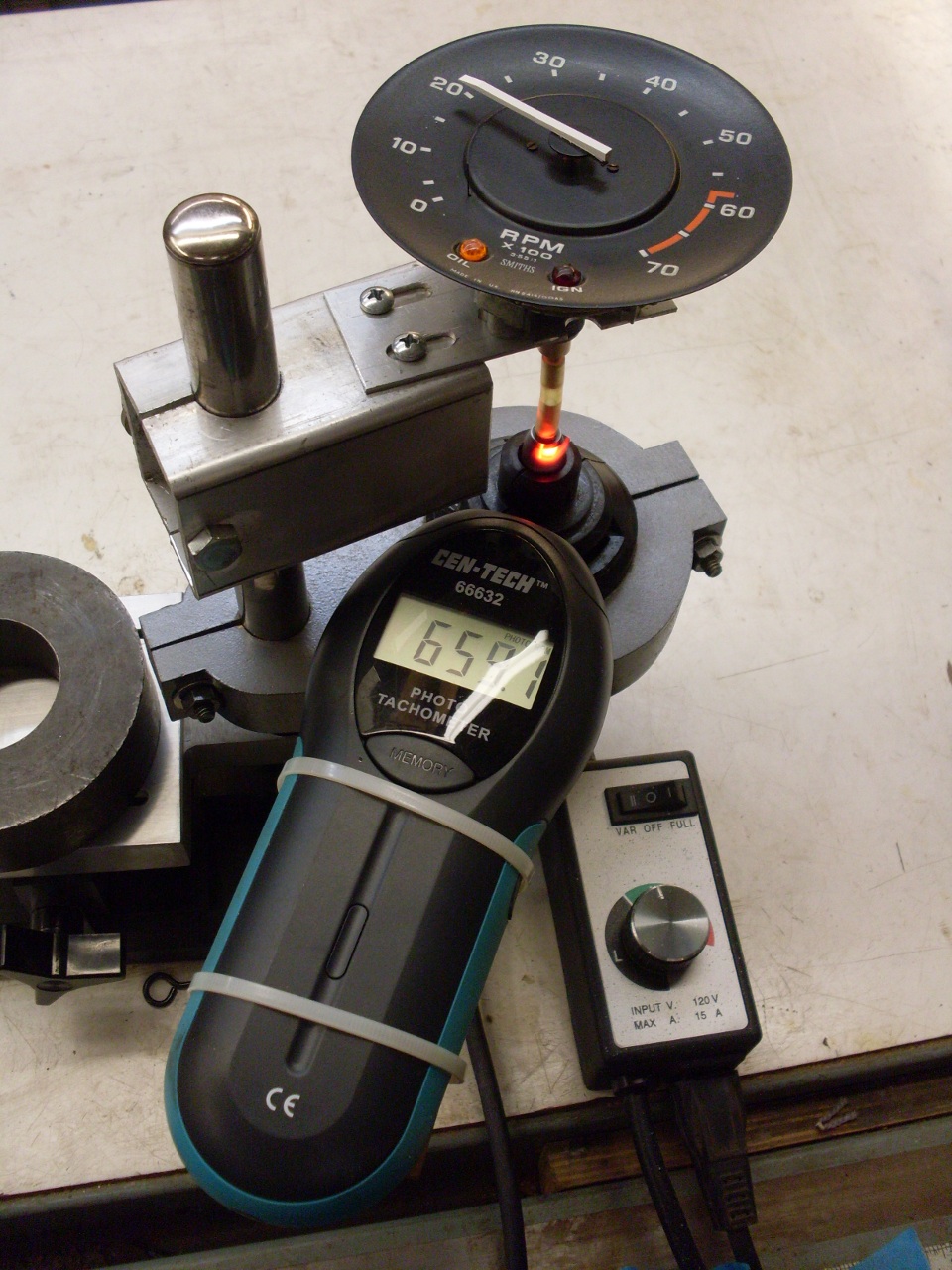
This is a simple testing setup using an electric chainsaw sharpener with a speed controller, and an optical tachometer.

Ed

SDC12116a.JPG
 
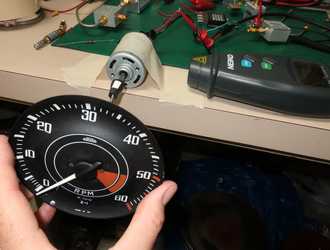
That's similar to what I do. I have a small electric motor, powered from a laboratory dc power supply, and I use an optical tach to measure the speed. My setup is a little sloppier than yours, but it still works.

tach_cal_2229_sm.jpg
 
Back
Top