• Hey Guest!
    British Car Forum has been supporting enthusiasts for over 25 years by providing a great place to share our love for British cars. You can support our efforts by upgrading your membership for less than the dues of most car clubs. There are some perks with a member upgrade!

    **Upgrade Now**
    (PS: Upgraded members don't see this banner, nor will you see the Google ads that appear on the site.)
Tips
Tips

Speedo Internals

jjbunn

Jedi Knight
Offline
My TR6 is a CP series originally delivered to a customer in West Germany in 1971, so it has a KPH speedometer, which I quite like.

However, it had a problem: the odometer wasn't working. I dismantled it and found a pawl spring had come loose from the mechanism. Despite re-attaching it, it failed again, so I decided to buy a used speedo on Ebay, which came with a bunch of other used gauges, and replace the internals. This speedo is an MPH version.

Some of the differences between the two speedos are interesting. Alright, maybe I've just had too much coffee :yesnod:

Speedo on the left is the KPH version, SN 6409/05A 580. On the right, the MPH version (year unknown), SN 6409/08 1120

2508038176_c5d4afc975.jpg


Notice that the inside of the trim ring is white on the KPH, grey on the MPH ... white would seem to be a better reflective choice, given the already dim nature of the illumination.

Inside:

2507212249_13acf8183f.jpg


Big version here: https://farm3.static.flickr.com/2030/2507212249_2785954818_o.jpg

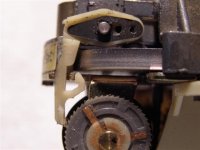
The red arrows point to the pawls mentioned above - on the KPH unit (left) the oval springy metal piece kept dropping off due to wear on the fixing hole, which had enlarged it.

The MPH speedo looks altogether more robust, with metal parts rather than plastic, although there are more springs.

A view from the other side:

2508037866_cc8637ee95.jpg


Big version here: https://farm4.static.flickr.com/3232/2508037866_79704c1662_o.jpg

The rubber cups (red arrows) that isolate the Main Beam and Trafficator lights from one another are larger in the KPH speedo, and thus fit much more snugly against the speedo case (the MPH speedo has one cup missing). The blue arrows point to the tripmeter reset mechanism ... quite different between the two.

My guess, based on the larger amount of plastic, is that the KPH speedo is the more recent device, and perhaps the more generous rubber cups were used after complaints that the high beam indicator light appeared to be flashing along with the trafficator light :smile:

Anyway, the upshot of this is that I was able to transplant the MPH speedo internals into the KPH case, and use the nicer rubber cups from the KPH unit. Hopefully the pawl in this will stay put! Unfortunately I now have the MPH dial. I suppose if I was very adventurous I could remove the dials and swap them!
 
Thanks for sharing and for posting the pictures. According to what I've seen with Smiths gauges in general, you're correct that they used more and more plastic as the years went by. This is consistent with what Anthony Rhodes says in his speedo repair PDF.

I have seen pawls wear where they engage the ratchet wheel but never to the point that they no longer drove the odo wheels. Regardless, I'm sure you're happy to have this sorted out.

However, you said the KPH unit was labeled "580" and the MPH unit was "1120". Your car needs the MPH equivalent of 580 turns/kilometer. That would be about 934 turns/mile. That 1120 turns/mile MPH speedo should be reading about 17% low. Keep an eye on the odometer and see how it compares to the distances you know you're driving and see if it's way off.
 
dklawson said:
However, you said the KPH unit was labeled "580" and the MPH unit was "1120". Your car needs the MPH equivalent of 580 turns/kilometer. That would be about 934 turns/mile. That 1120 turns/mile MPH speedo should be reading about 17% low. Keep an eye on the odometer and see how it compares to the distances you know you're driving and see if it's way off.

Thanks for the info! Hmmm ... I will keep an eye on that: 17% is quite a difference :frown:
 
If the error is too great, you could always look for other donor speedometers for the worn pawl. Perhaps some of the late MGB speedometer would have what you need.
 
I may have one on an extra spare speedo. It's been taken apart, so I'm not sure, but I'll check tonight for you.
 
Brosky said:
I may have one on an extra spare speedo. It's been taken apart, so I'm not sure, but I'll check tonight for you.

Thanks Paul: that would be great if you do. I'd be happy to send you mine in exchange, if wanted.
 
Julian, I looked through my notes at home and then Googled for a copy of Anthony Rhode's document on Jaeger & Smiths speedometers. If you don't already have this document its well worth downloading and keeping on hand. I'm posting links below to both his PDF and an online text version of it. The document is freely circulated (not copyrighted) so I'm also including some text from it.

Succinctly, he says your analog pointer should be OK while the odometer gearing will need to change as I suggested above.

****************
Full PDF:
https://mywebpages.comcast.net/rhodes/speedo.pdf

Online copy of document:
https://www.triumphowners.com/resources.cgi?articleID=111194&parentID=111193

Excerpt about KPH to MPH conversion:
<span style="font-weight: bold"><span style="font-style: italic">"KPH and MPH speedometers are essentially the same and parts exchange guidelines apply here as well. As far as I can tell, the actual speedometer function is exactly the same. Only the printing on the dial face is different. The odometers are also essentially the same. The KPH units have 62% fewer teeth on the gear mounted on with the odometer wheels so there will be more turns of the odometer for the same number of miles. It is easily possible to convert a KPH speedometer to an MPH unit. All you need to do is exchange the dial face and install the proper odometer gear to set the desired calibration. If you have a KPH speedometer and want to convert to MPH, you can calculate the desired calibration by multiplying the calibration printed on the dial of the KPH speedometer by 1.609. The reverse calculation may be made by dividing by the same number. This number will usually not correspond to an actual calibration. You need to round to the nearest 20,25,or 32 (depending on the number of teeth on your worm gear). For example, a common TR6 KPH speedometer has a calibration of 740. This corresponds to an MPH calibration of 1190.6. This is just about centered between the two possible calibrations of 1180 and 1200. To settle the issue of the what calibration you REALLY should have, you ought to calculate your ideal calibration as described later in this manual, then translate that a MPH/KPH calibration and then look for the best possible calibration available."</span></span>
 
Might want to resolve the ratio issue first, before going too far with either speedo. I find it hard to believe that 580 is correct.
 
Julian,

If this is what you need, I'll send you the speedometer assembly with it on tomorrow morning. Just PM me with your mailing address and I'll drop it off at the Post Office.

Keep yours for spares.
 

Attachments

  • 11538.jpg
    11538.jpg
    40 KB · Views: 337
TR3driver said:
Might want to resolve the ratio issue first, before going too far with either speedo. I find it hard to believe that 580 is correct.

Randall: I took another look: it's *680*, not 580 ... doh!

Doug: Many thanks, I will now read Rhode's document.

Paul: I think that, if I'm going to simply repair the KPH speedo, then all I would need is the plastic pawl and the small oval metal securing spring on your spare. They detach easily by moving the spring to the side. I will PM you: thanks!


Update: 680 x 1.609 = 1094, which is only a 2% error from 1120, so it looks like the MPH unit will work fine, right?
 
That 680 number sure sounds better to me! I think you'll be fine now. Just remember the odo will be reading in miles, not km.
 
Julian,

Since you have just been inside of one of these, I would like to pick your brain. I have an 1120 speedometer that the odometer and trip is not working on, would you believe the likely point of failure would be the little arm that drops down to the gears, or a spring that might have come off? Any input would be appreciated.

Thanks,
 
BJones said:
Julian,

Since you have just been inside of one of these, I would like to pick your brain. I have an 1120 speedometer that the odometer and trip is not working on, would you believe the likely point of failure would be the little arm that drops down to the gears, or a spring that might have come off? Any input would be appreciated.

Thanks,

What happened to mine was that the small oval metal springy clip that secures the pawl had dropped off, so the pawl was not pushing the odometer wheels around. Perhaps that is what has happened to yours? Have you taken it apart to look at the internals and compare with the photos in the document pointed to earlier in this thread?
 
The last time this type of problem surfaced on the board I wrote Anthony Rhodes about it. The speedos I had worked on all had a spring attached to the hook on the pawl. Anthony confirmed that the later Smiths speedos no longer used the spring but relied only on the friction of the spring clip to hold the pawl in the right position to advance the ratchet wheel. In the case of a pawl that no longer engages the ratchet... does it look like you could add a very light spring to pull it into position to drive the odometer?
 
dklawson said:
The last time this type of problem surfaced on the board I wrote Anthony Rhodes about it. The speedos I had worked on all had a spring attached to the hook on the pawl. Anthony confirmed that the later Smiths speedos no longer used the spring but relied only on the friction of the spring clip to hold the pawl in the right position to advance the ratchet wheel. In the case of a pawl that no longer engages the ratchet... does it look like you could add a very light spring to pull it into position to drive the odometer?

I remember that earlier thread, and some discussion about whether the spring was needed or not. The shape of the pawl indeed has a convenient place to hook a spring: I originally assumed mine had dropped off and gone missing (although I don't know how I imagined it could have wriggled out of the case!).
 
I have not taken mine apart to take a look at it. To be honest I am a little scared to get in there. I haven't even looked to see what is required to remove the speedo. I am sure it isn't that hard to do, but I haven't made it a priority. I guess that will be the next step.

Thanks,
 
not too hard to get apart, I find it best to buy a spare and rip it to shreds before working on one you plan on trying to put back together with the hopes of it working

seems to work for me
 
Back
Top