• Hey Guest!
    British Car Forum has been supporting enthusiasts for over 25 years by providing a great place to share our love for British cars. You can support our efforts by upgrading your membership for less than the dues of most car clubs. There are some perks with a member upgrade!

    **Upgrade Now**
    (PS: Upgraded members don't see this banner, nor will you see the Google ads that appear on the site.)
Tips
Tips

Slow idle drop

TRclassic3

Jedi Trainee
Country flag
Offline
I recently installed professionally rebuilt ZS carbs on late TR6 engine. I'm having an issue I hope to get some advice on. After running at speed, say 2500 to 3000 rpm, and then coming to a stop, the rpm is very slow to drop to normal idle. I would say it takes about 10 seconds to settle down. The problem is also evident when up shifting, as the rpm stays high between gears. I have inspected the linkage and don't find that it is hanging up anywhere. Is it possible though that it could be something with the way I reinstalled the linkage? Or could it be that the vacumn advance is not functioning properly, or????
I have tried ATF and 20w in the dash pots. no difference.
 
I'll take a stab and say it may be a vacuum issue, if the linkage is OK. Check all your vacuum lines and make sure you're not sucking air somewhere.

Let us know what you find, in any event.

:cheers:
Mickey
 
TRclassic3 said:
Or could it be that the vacumn advance is not functioning properly,

That seems likely to me, given that a late TR6 would not have had vacuum advance originally. Both the carb port and the vacuum module are different, depending on whether it is advance or retard.

What does the timing mark do (under a timing light of course) when you rev to 3000 and then close the throttle?
 
Depending on what rpms it's hanging up at, it may be the Throttle Bypass Valve(s) remaining open or floating. If it hangs up around 11 -1300 I'd almost bet on it being the TBV.
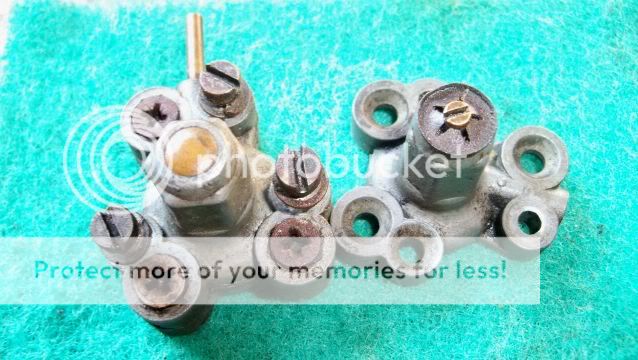
Which version of the TBV do you have, the one on the right with the exposed adjustment screw or the one on the left with a tamper proof cap over the screw ?
TR6TBVAdjust.jpg
 
Thanks for the thoughts guys. I'll look into the suggestions. Poolboy, it isn't that it sticks in one spot. If down shifting for example, coming to a stop, and you depress the clutch and take foot off throttle at say 2000 rpm, then the rpm just slowly drops over maybe 10 seconds and ends up at 900 to 1000.

The TBV is the adjustable type.
 
Good,.. then hop out of the car when that happens again and with your index fingers push inward on the head of the adjusting screw.
Don't expect much movement, but if the idle drops, you've literally put your finger on the problem.
To fix it, turn the adjustment screws Counterclockwise 2 rotations or more if needed.
 
I finally got a chance to spend a bit of time on this. After eliminating the simple things like linkage hanging up or pistons not falling as they should, or vacuum leak, I focused on the TBV. Removing the tube and plugging resulted in 300 increase in rpm, so based on that it seemed the retard unit was working OK. I then followed the adjustment technique I found on the Buckeye Triumph site. With the hose plugged I backed out the screw until idle hit about 2500. I then turned it in until it was back at 1300. Put the hose back on the retard unit and the idle dropped to 900. Went for a short spin and it seemed to have resolved the problem.

One remaining question. I only adjusted the front carb. The rear carb has no vacuum feed to anything, and thus I did not know if the same technique would work for the rear carb or do I just back out the adjustment a bit anyway?

Thanks for the help in resolving this issue.
 
I like to keep the TBV's adjusted the same or close to it.
If you want to count rotations clockwise on the front carb until the TBV adjustment screw comes to a stop, then turn it back that number CCW, to the starting point, then go to the rear TBV and once at full CW go back CCW the same number as the front TBV adjustment.
There are 22 rotations (threads) so you should have found a sweet spot on the front carb between 8 and 14 CCW. If much more than that your TBV diaphram is getting old and brittle and could stand replacing so that it functions properly in the middle of it's adjustment range.
 
Thanks, I'll give that a go. The TBVs are new, as replacement was part of the professional rebuild. Interestingly, the instructions from the rebuilder stated that the bypass valves would not need adjustment.
 
Back
Top