• Hey Guest!
    British Car Forum has been supporting enthusiasts for over 25 years by providing a great place to share our love for British cars. You can support our efforts by upgrading your membership for less than the dues of most car clubs. There are some perks with a member upgrade!

    **Upgrade Now**
    (PS: Upgraded members don't see this banner, nor will you see the Google ads that appear on the site.)
Tips
Tips

TR2/3/3A Setting Valve Lash

mgedit

Jedi Knight
Country flag
Offline
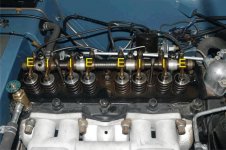
My cam is a non-standard grind. Exhaust valves are supposed to be .016 and intake .014. Made up this simple guide as a reference to keep things straight. What is the best/recommended way to turn engine over till valves are "on the point of rock"? Unfortunately, no longer have hand crank hole in rad as I assume that might be the easy way to do this. Cheers, Mike

attachment.php
 

Attachments

  • Intake_Exhaust_Valves.jpg
    Intake_Exhaust_Valves.jpg
    68.9 KB · Views: 196
Mike-

i always use the "rule of 9" to set lash. Watch any valve and when it bottoms out and starts to return (1st valve for example) adjust the valve that sums to 9 with it (in this case, valve 8)

Macys Garage has an alternative that looks pretty good but I think the rule of 9 is easy:
https://www.macysgarage.com/myweb6/valve_adjustment.htm
 
I think he's asking about how to turn the engine. I generally just use the starter, with the rubber pushbutton on the back of the solenoid. The position doesn't have to be precise when setting the valves. But if you want finer control, another good method is to put the gearbox in 4th gear and roll the car a bit to turn the engine. I can usually just push against the body, but you can get more leverage by pushing on the top of a front tire. If you run out of room in the garage, shift to neutral and push the car back then back to 4th.

I prefer the "on rock" method myself, which works for all 4 and 6 cylinder Triumphs (plus almost every car engine made).
 
Thanks Randall ... was asking about how to turn engine, but input on actually adjusting is useful as well. Does the direction of engine turning matter when moving between cylinders or either direction until both valves are on rock? Cheers, Mike
 
On a TR6, using the rule of 13, which is the same principle as rule of 9, turning the crankshaft the opposite direction of the direction the engine runs, involves much less turning.
 
On a TR6, using the rule of 13, which is the same principle as rule of 9, turning the crankshaft the opposite direction of the direction the engine runs, involves much less turning.
I'd like to hear how that works. Seems to me that the engine has to go slightly under 2 full revolutions to get every valve into position, no matter which way you turn it or how you check valve position.

So, for example, on a 4 banger using the "on rock" method, you start by turning the engine either forward or backwards less than 1/2 revolution, until a cylinder comes "on rock" (meaning it is at TDC between exhaust and intake stroke). That means the opposite cylinder is at TDC between compression and exhaust, where the valves are fully closed and can be adjusted. Then you turn the same direction exactly 1/2 revolution, so the next cylinder is on rock, and set valves on the opposite cylinder. Repeat twice more and you're done. Only 1.5 revolutions, plus however far you had to turn initially.

6 banger is the same, except you go 1/3 revolution at each step and do it 6 times.

But the way most people do the "rule of 9" or "rule of 13" goes many more revolutions, because you do the valves in numerical order. For example, the Macy article says to turn until valve #1 is fully open, which may take almost 2 turns by itself. It also takes twice as many movements (one per valve instead of one per cylinder).

There's no reason they have to be done in order of course, but not doing them in order makes it much harder to keep track of where you are. Just ask yourself "If valve #4 is fully open now, which valve is fully open next?" and I think you'll see what I mean. I find remembering the firing order to be much easier (and if you don't remember, just look at the plug wires on the cap).

 
If you have a straight 6, use the rule of 13 and give it a try, Randall.
I've done it, on both 4 and 6. But as I explained, it takes more turning, not less. And turning the opposite direction makes no difference at all.
 
Take the plugs out and turn it by hand. I use "exhaust open and close, intake open and close, plus almost 90", then set both valves for the cylinder involved.
Bob
 
I've done it, on both 4 and 6. But as I explained, it takes more turning, not less. And turning the opposite direction makes no difference at all.
I think you have missed the point, Randall...what I am trying to communicate is that if a person is doing the Rule of 13 method on a straight 6, there is less rotation of the crankshaft required if one turns it counter clockwise as opposed to using the rule of 13 in the clockwise rotation.
My reply was in regard to the question 'mgedit" asked about whether the direction mattered. It does, under the conditions I described.
It may even work that way using the rule of 9 on a straight 4.
If you doubt it, just try it..but please report your discovery.
 
I found this method on, IIRC, a VTR publication many years ago: Turn engine to #1 firing position with timing mark aligned with pointer and distributor rotor aligned with #1 contact. Set lash on both #1 valves, #2 intake and #3 exhaust. Turn engine one complete revolution. Set lash on #2 exhaust, #3 intake and both #4 valves.
 
All, As regards to the first question, put it in 3rd gear and push or pull the car a little at the time, much easier to get the valves in position. If you run out of room put it in neutral and go back to where you started.
The rule of 9 works fine.

Wayne
 
Yes, used the push the car in high gear trick to position valves. Worked well. Cheers, Mike
 
Last edited:
I think you have missed the point, Randall...what I am trying to communicate is that if a person is doing the Rule of 13 method on a straight 6, there is less rotation of the crankshaft required if one turns it counter clockwise as opposed to using the rule of 13 in the clockwise rotation.
But still more than using the other method, regardless of direction.
 
Back
Top