• Hi Guest!
    If you appreciate British Car Forum and our 25 years of supporting British car enthusiasts with technical and anicdotal information, collected from our thousands of great members, please support us with a low-cost subscription. You can become a supporting member for less than the dues of most car clubs.

    There are some perks with a member upgrade!
    **Upgrade Now**
    (PS: Subscribers don't see this gawd-aweful banner
Tips
Tips

Rubber vs Polyurethane bushings.

doughairfield

Jedi Trainee
Offline
When I replace the brake rotors on my TR4, I am also going to replace the busted suspension bushings on the front. I'm not planning on racing this car but the Polyurethane bushings seem more durable and might tighten up the steering, anyone have a preference of one over the other?
 
Doug, it's a bit of a toss-up as to which is "better"! One major factor seems to be that recently made OEM-style rubber bushings simply are not very durable: either the rubber is poorer quality or our air is still dirty enough to attack them, or maybe both! On the other hand, I've still got original rubber bushings on my 47-year-old Herald, and most of them are just fine. And I've still a small supply of NOS replacement bushings (Metalistik[?] brand) when a replacement might be needed.

As for poly bushings, they arguably are more durable. Note that, in some cases, there are several varieties of poly bushings available, some of which are very close to OEM spec. in terms of softness, while others are much firmer.

 
My oppinion is that the differences are NIGHT and DAY. When I rebuilt my TR6 suspension I installed new rubber bushings all around. Two years later with less than 500 miles on the rubber bushings they were trash.
The polyurethane has improve my ride measurably... stiffer over uneven road surfaces, and it doesn't bottom out.
My vote is to go polyurethand and don't look back.
 
Andrew Mace said:
One major factor seems to be that recently made OEM-style rubber bushings simply are not very durable
:iagree: with the proviso that "recently made" started over 30 years ago :laugh:

I got tired of changing those dang bushings every couple of years, so I switched to Nylatron bushings on the 3A, which are considerably firmer than the poly bushings I've seen. Very happy with the results; and they are still in such good condition after perhaps 10 years and 50,000 miles that I'm actually moving them to the project TR3. Since the lower inner bushings are already nylon (even the factory couldn't get rubber to live for long in that location), changing the upper bushings doesn't seem to make much difference to ride quality.

However, the Nylatron is a bit more of a hassle to fit. They are a light press fit into the arms, to force them to turn on the supplied SS sleeves instead of against the arm. Easy enough to push in (I used the bench vise as a press) but then they need to be reamed to fit over the sleeves (as the holes in the arms aren't consistent). And since they also mean less fore/aft compliance, you need to check for binding after assembly.
 
the problem with the aftermarket rubber is the wrong compound and they are not vuclanize properly, which means the part is put in a heated press for hours to days
 
Great, I ordered the Ploy's from Moss today at lunch, thanx for the help.
 
Doug - Why do you want to replace your front rotors ? After 80,250 miles on my 1958 TR3A from new, my neighbour cleaned up the faces of my original rotors on his 10" diameter lathe. He skimmed off about 0.002" from each face and they have been clean, smooth and rust-free for the past 19 summers of mostly dry weather driving and over 101,000 miles since he did that for me.

Someone above mentioned squeaky front suspension with poly bushes. I think I've suffered from squeaks for over 45 years - first with the rubber bushes and then for the last 10 to 15 years with all poly bushes. Peter in Maine even sent me some special grease to try to help with the squeaks.

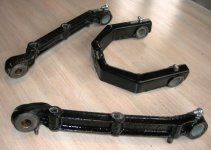
Till this year that is. This past spring, I took apart my front suspension and drilled and tapped the inner ends of the upper and lower wish-bones ("A" arms) and put in zert fittings. Then my trusty neighbour turned a small "V" groove inside all of the 8 poly bushes and I inserted the bushes with a 3/16" diameter drill hole lined up with the inlet for the zerts. (I replaced 4 of the old poly bushes with new ones) Then I reassembled it all and used Amsoil red synthetic grease and my grease gun to lubricate all the grease fittings including the 8 new ones for the inner ends of the wish-bones.

It's so quiet now, I can't believe it ! ! !

Now you know the rest of the story - but don't tell any TRA or VTR judges what I've done.
 

Attachments

  • 17940.jpg
    17940.jpg
    53.8 KB · Views: 236
I have discovered that I have the wrong size rotor on the passenger side, 11" instead of 10 3/4" so I have a really annoying clicking sound from that side. I also figured I would need to replace the driver side one so I would get equal wear and braking. I figured that while I had the wheels off, I'd replace all the worn bushings too. Sorry, I should have mentioned that earlier but i had another thread going on about the clicking that turned out to be the wrong size rotor.
 
Too bad you don't have a neighbour with a lathe to turn down the outside diameter and face them all so they are like new again and it might save you some big dollars. Maybe you know a machine shop or a NAPA type store where they might give you a good deal.
 
Just a thought; for a lot less than new rotors, you could buy one of those cheap angle grinders at Horrible Freight and take 1/4" off your existing rotor. With the rotor still on the car, and the caliper out of the way, you should be able to angle the grinding wheel so it spins the rotor as well as taking metal off the rim.
 
Horrible Freight, I love it.
 
Back
Top