
under hard acceleration going thru the gears. TR6 gearbox. Anyone know what causes this? Is this the reason a weighted ball and bracket was added to the back of the gearbox on the 4A models? I read somewhere that some people complained back in the day about some kind of buzzing vibration from that area so Triumph added that weight to prevent it.


-
 Hey Guest!
British Car Forum has been supporting enthusiasts for over 25 years by providing a great place to share our love for British cars. You can support our efforts by upgrading your membership for less than the dues of most car clubs. There are some perks with a member upgrade!**Upgrade Now**
(PS: Upgraded members don't see this banner, nor will you see the Google ads that appear on the site.)
You are using an out of date browser. It may not display this or other websites correctly.
You should upgrade or use an alternative browser.
You should upgrade or use an alternative browser.
TR2/3/3A Rattling from the gearshift or that end of the gearbox....
- Thread starter karls59tr
- Start date


dklawson
Yoda
Offline
Vaguely related:
When I put our GT6 back on the road it developed a rattle/buzz at certain speeds. I thought I did something wrong rebuilding the transmission since the sound went away when I put my hand on the shift knob. It turned out that while there was vibration in the shift lever, it was mild. The sound was coming from a loose cloisonne badge in the aftermarket wooden shift knob. I removed the badge, cleaned it up, used RTV to re-glue it to the knob, and my car's noise was gone.
This probably isn't the case with your car but it is food for thought that other sources of the sound may be vibrating.
When I put our GT6 back on the road it developed a rattle/buzz at certain speeds. I thought I did something wrong rebuilding the transmission since the sound went away when I put my hand on the shift knob. It turned out that while there was vibration in the shift lever, it was mild. The sound was coming from a loose cloisonne badge in the aftermarket wooden shift knob. I removed the badge, cleaned it up, used RTV to re-glue it to the knob, and my car's noise was gone.
This probably isn't the case with your car but it is food for thought that other sources of the sound may be vibrating.


CJD
Yoda
Offline
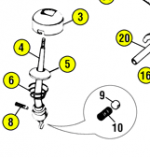
My TR3A was bone stock, and it vibrated so my key chain would rattle and shifter buzz. The factory did install a little spring and plunger to reduce the shifter vibration. My TR2 was balanced during the engine build. Being my anal self, I took every part, including the rod nuts and bolts, down to less than 1/10 gram. I have no sound or noticeable vibration at all...even though the TR2 does not have a spring and plunger.
The balancer on a TR4 is a bit of a joke. The tranny has to physically move some for it to work. If it moves at all, you have vibration, so all the balancer could do is reduce the level of vibration.
On utube I found an interesting video showing the standard factory while they were building our TR's. It even showed the balancing operations and told the standards they balanced to. They were trying to impress the watchers with the level of detail, but I was not thrilled...the parts tolerance was often more than an ounce per part. They DID match the rods and pistons into sets to try and reduce the overall imbalance, which was better.
The shaking is due to imbalance of the engine and/or flywheel. If you have ever had the wheel faced when replacing the clutch, then it needs to be re-balanced. Few...almost none...ever bother with that, but that is where most tranny vibration originates.
The balancer on a TR4 is a bit of a joke. The tranny has to physically move some for it to work. If it moves at all, you have vibration, so all the balancer could do is reduce the level of vibration.
On utube I found an interesting video showing the standard factory while they were building our TR's. It even showed the balancing operations and told the standards they balanced to. They were trying to impress the watchers with the level of detail, but I was not thrilled...the parts tolerance was often more than an ounce per part. They DID match the rods and pistons into sets to try and reduce the overall imbalance, which was better.
The shaking is due to imbalance of the engine and/or flywheel. If you have ever had the wheel faced when replacing the clutch, then it needs to be re-balanced. Few...almost none...ever bother with that, but that is where most tranny vibration originates.
Last edited:

groupdeville
Jedi Hopeful
Offline
My TR2 was balanced during the engine build. Being my anal self, I took every part, including the rod nuts and bolts, down to less than 1/10 gram. I have no sound or noticeable vibration at all...even though the TR2 does not have a spring and plunger.
I'm glad there's somebody else out there who did this! I did the exact same thing, also to within .10 gram, over 20 years ago on my kitchen table with the TR4 engine that's in my '58 3A. Had excellent assistance from my two cats, with only an occasional paw upon the scale. Used a regular Ohaus chemistry scale and very basic tools to match up component weights.
Now the big dilemma is that the entire '58 TR3A except for the engine is a mess and should be done away with or massively restored, but I can't bring myself to part with an engine that runs so well and has carried me so many miles in 42 years. (One of those silly mental games we play with ourselves about our cars...guess I need to find a TR2, small-mouth TR3, or solid-axle TR4 with a pooped-out motor!)
CJD
Yoda
Offline
For years GM balanced their truck motors to 1/10th the tolerance they balanced the car motors. They knew 50 years ago that balanced motors run better and last longer. It's just too time consuming to do it during high volume production. I use the same O Haus scale and I made a handful of fixtures that I have used on 2-3 dozen motors. Well worth the investment! Then, when you tip the shop that spins the crank, they'll put the same amount of detail into the crank and flywheel as you do into the rest of the parts.