• Hi Guest!
    If you appreciate British Car Forum and our 25 years of supporting British car enthusiasts with technical and anicdotal information, collected from our thousands of great members, please support us with a low-cost subscription. You can become a supporting member for less than the dues of most car clubs.

    There are some perks with a member upgrade!
    **Upgrade Now**
    (PS: Subscribers don't see this gawd-aweful banner
Tips
Tips

Questions about rear brake drum removal

nevets

Jedi Knight
Country flag
Offline
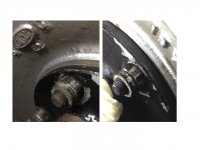
The attached photo shows the stud nuts that fasten the rear brake drum to the hub. There appears to be a lock fastener outboard of each nut. I assume these must be removed before the nut can be loosened? If so, how are these loosened? Is a special tool required? The car has wire wheels, which I believe is a conversion from disc wheels that was done be a PO.

Thanks
 

Attachments

  • rear drum nuts.jpg
    rear drum nuts.jpg
    65.3 KB · Views: 218
That's a type of locknut (the original, 'old-fashioned' type). They can be removed along with the nut (note the diameter of the locking part is less than the distance across the flats of the nut). Next question will be 'can/should I reuse these?' and the answer--from a purely technical standpoint--is no, no locknut (or lockwasher) should ever be reused. The practical answer is yes, but use some threadlocker (blue, not red, else they have to be heated to remove--not good for the tensile strength of the stud). Those nuts are beveled on one side--like wheel stud nuts--and are expensive to replace (about $3-4 each IIRC). All the modern replacements I've seen use nylon insert locknuts, and they REALLY shouldn't be reused however I've done it for years using threadlocker ('Locktite') with never any problems. I only install new when the nut gets buggered-up.

When you fasten the hub back up, use a 'star pattern' sequence to tighten the nuts, preferably in a couple of torque steps--60ft-lbs then 100 ft-lbs, for example--like you do when you fasten a (non-knockoff) road wheel back to its hub.

 
Last edited:
The picture shows the correct fastener for your hub/brakedrum assy. The circular part is integral with the nut and is the actual locking device. Just unscrew them as you would unscrew a regular nut.
 
Bob
Thanks for the detailed reply. I am aware that lock washers/ fastenres should not be reused, but as you said, sometimes practicality trumps protocol.

So if those lock fasteners can be removed with the nut, do they serve any purpose? I thought they were a kind of jam-nut. On a related note, according to the manual, the rear drums are mounted to the hubs with screws, but mine are not. I assume this is because my setup is a disc-to-wire wheel conversion. Is this a correct assumption? And one more thing, I suspect that I'm in for a heck of a time, trying to loosen those nuts...any tips? Thanks
 
Lock the e-brake up tight, and you might still need someone to hold the brake pedal. They were probably installed with somewhere between 60 and 100lb-ft of torque, and it looks like your threads are a bit rusted (maybe soak with a good penetrating oil beforehand). They'll come off easy enough if you use a breaker bar or snipe on your wrench.

The drums are held on the axle hub with the 5 large studs and nuts, underneath the hub will be one or two--I forget which--quarter-inch (I think) Posidrive screws that keep the drum from falling off before you're ready for it. Those might be a little hard to get out since they may be rusted in--be sure to use a Posidrive screwdriver so you get the best grip. There's also another screw or two that holds the axle to the axle hub as the axle is a 'three-quarter floating' type that is held in the diff with the 5 big studs (there's no C-clip in the diff that has to be remove making axle removal a snap).

The purpose of the locknuts is to keep the hub attached to the drum/axle.
 
OK sounds good. Maybe use an impact wrench? Also, After I remove the 5 studs, the drum should be free for removal, yes? I assume I do not need to remove the hub, just the drum?
 
FWIW you can still buy all-metal lock nuts reasonably cheap. I prefer the ones that MMC calls "oval lock with conical top". They hold a lot better than the nylon insert nuts in my experience; especially in locations that can get hot (like brake drums). They also seem to retain their holding power much better than nylocs, I've reused them many times with no problems (and no Loctite).

Not sure what size you need, but a box of 100 in 3/8-24 is under $15.
https://www.mcmaster.com/#catalog/119/3173
 
Some folks have had trouble with these nuts rounding off due to the limited amount of "hex" grip area standing out from the drum. A suggestion is to make sure the wrench fits snugly and grind the face of the wrench flat to get the maximum grip on the nut.
 
steveg - it appears to be 11/16. I was planning to use a socket, so not sure what I would need to grind to improve grip. I have read about smearing the nut with a thick lube containing an abrasive grit? Toothpaste?

After these 5 nuts are removed, does the drum pull off with the hub attached? My objective is to replace the wheel cylinders.

Thanks
 
Some sockets are scalloped a little around the inside edges, which can reduce the grip area on the nuts so some guys grind the socket end flat against the side of a grinding wheel to remove the scalloped area.
The reason I mention this is if these nuts get rounded you'll have a devil of a time getting them off.

After removing the hub, the drum should be attached to the axle by a couple of countersunk flathead screws. Once these are removed and possibly the brake adjustment backed off, you can pull the drum off the studs toward you, exposing the shoes etc. I replaced the screws with 1/4-28 Allen screws for easy future removal.
 
steveg, thanks... I tested them with my socket wrench and they are on very tight. I would really like to avoid rounding off the nuts. Any thoughts whether an impact wrench would be a safer/better option than a long breaker bar?
 
I'd spray them with Kroil or PBBlaster, then use a 6-point socket on them for better grip. I don't have an impact wrench so don't know whether the hammering action of the impact wrench is better than a breaker bar with cheater.
If I recall, the 4-up lug wrenches sold by Harbor Freight are 6-point.
 
When he re-installs the nuts what are the torque specs. Due to the difficulty everyone seems to have removing these nuts is ok to use anti seize?
 
steveg, thanks... I tested them with my socket wrench and they are on very tight. I would really like to avoid rounding off the nuts. Any thoughts whether an impact wrench would be a safer/better option than a long breaker bar?

Either could potentially shear off the lug, but if it were me, I would soak them in penetrating oil for a while and use an impact wrench and a 6 point socket. They're probably not all that tight, just rusty. In my experience an impact wrench will free a rusted nut better than a breaker bar.

Keith
 
Ditto on the 6-point socket with the tip ground flat; and soaking with PB Blaster or Kroil. Anti-seize on reassembly should be fine; I prefer the copper-based stuff as it seems to work better for me than the other varieties.

I wouldn't use an air impact hammer as they are more apt to round the nut, IMO. A hand impact might be OK if you have one; but my preference is for a long breaker bar so you can pull with one hand and hold things in line with the other. Letting the socket **** on the nut is a sure recipe for rounding.
 
Thanks for the suggestions. I usually use the 6-point sockets, but haven't ground the tip on any, which will require a grinding wheel due to the steel hardness. I am probably wrong, but I was under the impression that an impact wrench is less prone to rounding the nut because it delivers micro-blasts of energy rather than the sustained leverage achieved with a cheater bar...sort of like the difference between trying to slide a heavy piece of furniture into position in one motion vs giving it lots of little nudges.
 
Back
Top