Hey Guest!

 Hey - did you know if you click on the title of a thread it will take you to the first unread post since you last visited that thread?
 but were afraid to ask:
  STOP!! Never post your email address in open forums. Bots can "harvest" your email! If you must share your email use a Private Message or use the
  smilie in place of the real @
 Pretty Please - add it to our Events forum(s) and add to the calendar! >>

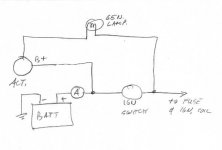
I have installed a Denso 8162 alternator on my TR3 and I currently have the "B" post connected directly to the solenoid with an 8 gauge wire, thus bypassing the original wiring and ammeter. The question I have is can I connect a wire from the "B" post of the alternator to one side of the ammeter and then run a similar size wire from the other post of the ammeter to the solenoid, i.e. battery cable connection? Will that allow my ammeter to work correctly with the Denso alternator?
Another question, I was previously using a GM alternator and for that I put a 3.5 inch 16 gauge wire shunt between the posts of the ammeter as per a BCF forum posting. Will that shunt be sufficient for the Denso alternator charging the battery through the ammeter?
Thanks,
Bob
Another question, I was previously using a GM alternator and for that I put a 3.5 inch 16 gauge wire shunt between the posts of the ammeter as per a BCF forum posting. Will that shunt be sufficient for the Denso alternator charging the battery through the ammeter?
Thanks,
Bob