• Hi Guest!
    If you appreciate British Car Forum and our 25 years of supporting British car enthusiasts with technical and anicdotal information, collected from our thousands of great members, please support us with a low-cost subscription. You can become a supporting member for less than the dues of most car clubs.

    There are some perks with a member upgrade!
    **Upgrade Now**
    (PS: Subscribers don't see this gawd-aweful banner
Tips
Tips

TR2/3/3A Patching, versus replacing floors?

DonP

Member
Country flag
Offline
Lots of good stuff on replacing floors here. Not much on patching them it seems.

My 3B has pretty solid floors (thankfully!), ... except for some small flaking rust holes right around a couple of the driver's side seat track mounting holes. None more than an inch or two across.

I don't plan to take this to Pebble Beach any time soon, just a good looking cruisin' machine.

I could just cut out all the loose rust, treat the lighter surface rust with POR15 or Eastwood Rust Encapsulator and weld some sheet metal over the bad parts and drill new mounting holes? Or cut out 6 inch square sections and replace them with a couple of welded in patches?

Anybody else have to patch their floors instead of replacing them?

(Now I have to start looking for a set of seat mounts and tracks for it that I can clean up in my bead blasting cabinet.)
 
Patching is what we would have done before the "frame off" restoration became the norm and since patching is temporary and reversible, there is absolutely no reason not to do it. Changing the floors is not a simple operation and although I know some people have done it with the body on, I don't think it is possible without literally cutting a couple of corners. For what it's worth,
Tom
 
I've got a bunch of old seat tracks if you need. Patch away.
 

Attachments

  • IMG_1341.jpg
    IMG_1341.jpg
    44.1 KB · Views: 155
I would go the patching route as well if the holes/area is limited. I always start of by saying that I'm going to just patch, but once you get into prepping the entire floor for painting, you will probably find areas that need more attention....

Cheers
Tush
 
+1 to patching. I've been running this around in my head some as my floors could use a little attention. I'm thinking of buying the "cheap" floor pan and cut out the patches I need. Mine are mostly stress cracked areas rather than rust. The patches can be metal finished and you maintain as much of the original factory work as possible....which I like. Plus, when was the last time you went to a local car show and everyone was sitting around in lawn chairs, with the carpet pulled back, gazing at the highly polished and waxed floors?
 
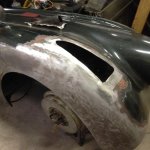
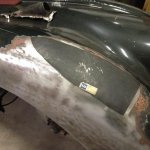
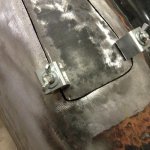
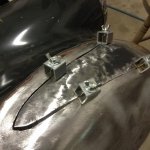
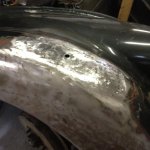
IMG_1342.jpgIMG_1345.jpgIMG_1346.jpgIMG_1347.jpgThe RH side marker lamp pod on an XK 120 front wing is a catch for mud and had rusted the pod and base metal badly. I dug up a new Austin Healey rear fender repair panel that I had no use for and carefully trimmed , rolled , and hammered it into the proper compound curve of the Jag. Welding small beads around the perimeter allowed the panel to grow into the Jaguar as it was welded . Final work with a hammer and dolly and I'm ready to place the new side marker lamp pod. About 10 hours but who's counting?
 
Very nicely done, Brinkerhoff, and I'd call 10 hours on it rather speedy. Also reminded me that panels with a bit of shape to them are easier to weld since they distort less than flat ones. Might be easier for DonP to make the welds away from the tracks and use the tracks themselves as stabilizers.
Tom
 
I patch whenever I can. Just be sure to cut all rust out or you will doing it again ain a couple of years. I acid bath the spot over night then epoxy prime next day.
Marv
 
Thanks for all the moral reinforcement guys. Patching it will be.

I've had this car since 1967, when I bought it out of Calumet Auto Wreckers and over the years I've done more than my share of "patching" on it; from "Beer Can" Tailpipe repairs in College to swapping out the entire front valance after a front end hit in a parking lot.

I'll get some appropriate gauge steel, dig out my nibblers and check underneath to be sure how far the rust holes might extend down there and start cuttin' and weldin'. I'll be using the Eastwood Rust Encapsulator to stop the light surface rust and protect the new steel, once it's all done.

(Anybody know what gauge steel the floors are?)

I will also be using all stainless bolts if I can get them for re-mounting the seat tracks.
 
Oh, I have some original floor sections in the garage..ill go an measure them and report back if no one else beats me to it :smile:. I'm going to guess about 18 gauge.

Cheers
Tush
 
Most of the bodywork, floors included, were originally 18 gauge. Reproduction parts vary. The last floors I got were 18 as original. Tom
 
Hi Don,

I used the stainless kits from Maceys on mine. It says he will sell individual hardware not just kits so if you have trouble finding something local there is an option for you..

https://www.macysgarage.com/myweb6/Parts/tr2_3_hdwe.htm

Cheers
Tush

Now that's ironic timing. I'm doing a frame on restoration/clean up, since most of my panels are in decent shape (and I'm way too lazy to do a Frame Off, just to be able to say I did it). But I'm taking them off one at a time to clean up, get rid of any Bondo I find then prep and prime.

In my mailbox today were the stainless kits I ordered from Macy's for the front valance and both front fenders as well as 20 of their cage nuts to fix any (or many) of the ones that "spin" coming off.

Don
 
I dont remember the proper guage for the floors, but I know the sheet metal they have at the hardware stores (at least the ones local to me) are too thick or too thin. I went to a local industrial metal shop, when I told him how much I needed the guy just gave me a scrap for free. 18 guage maybe.

These days I usually make my patch panels out of spare body panels I have.
 
The old articles call the body 20 gage. When I measure it comes in about midway between 18 and 20 gage. Of course repro parts could be anything!?! Most hardware stores sell 16 and 22 gage.
 
Lots of good stuff on replacing floors here. Not much on patching them it seems.

My 3B has pretty solid floors (thankfully!), ... except for some small flaking rust holes right around a couple of the driver's side seat track mounting holes. None more than an inch or two across.

<snip>

Sounds like my old TR. Some surface rust in the floorwells, with a couple of "pin *****" holes and one hole about 3/4" in diameter.

I sanded the surface, then sprayed with phosphoric acid.

https://i224.photobucket.com/albums/dd23/freemangarden/TeeYah50th/5811-5801-phosphoric.jpg

Washed, dried, then painted with POR15.

https://i224.photobucket.com/albums/dd23/freemangarden/TeeYah50th/5812-FirstCoat1.jpg

As the POR15 dried, I laid a square of fiberglass across it, then let dry.

https://i224.photobucket.com/albums/dd23/freemangarden/TeeYah50th/5813-Fiber1.jpg

Then painted one more coat of POR15.

https://i224.photobucket.com/albums/dd23/freemangarden/TeeYah50th/5814-SecondCoat1.jpg

(I also put POR15 on the underside, to cover the former holes.)

I was *very* happy with the result.

Tom M.

Edit: where you see "pin ***** holes" you should see "pin p r i c k holes".
 
Back
Top