
-
 Hi Guest!
If you appreciate British Car Forum and our 25 years of supporting British car enthusiasts with technical and anicdotal information, collected from our thousands of great members, please support us with a low-cost subscription. You can become a supporting member for less than the dues of most car clubs.
There are some perks with a member upgrade!**Upgrade Now**
(PS: Subscribers don't see this gawd-aweful banner

Tips
- We have a special forum called "Member Articles" where you can submit actual articles for consideration for publication. Learn More
- Don't have an Avatar? If not, your avatar will default to the 1st character in your username. Go into "Account Details" to change your Avatar.
- Some basic forum navigation info: click
 Hey - did you know if you click on the title of a thread it will take you to the first unread post since you last visited that thread?
- Hey Guest - Is your British Car Club in our Clubs database? If not, send me a PM - Basil

- Looking for a local club? Click the "Clubs" tab above and browse hundreds of clubs world-wide.
- Add Android or iPhone APP: click
- Did you know - any picture or video you add in your posts in any marque-specific forum will also get added to the Media Gallery automatically.
- A few more tips about posting and replying: click
- Hey there Guest - be sure to keep your profile page up to date with interesting info about yourself: learn more
- More tips and tricks on Posting and Replying: click
 but were afraid to ask:
  STOP!! Never post your email address in open forums. Bots can "harvest" your email! If you must share your email use a Private Message or use the
  smilie in place of the real @
- Want to mention another member in a post & get their attention? WATCH THIS

- So, you created a "Group" here at BCF and would like to invite other members to join? Watch this!
- Hey Guest - A post a day keeps Basil from visiting you in the small hours and putting a bat up your nightdress!
- Hey Guest - do you know of an upcoming British car event?
 Pretty Please - add it to our Events forum(s) and add to the calendar! >> Here's How <<
- Hey Guest - you be stylin' Change the look and feel of the forum to fit your taste. Check it out
- If you run across an inappropriate post, for example a post that breaks our rules or looks like it might be spam, you can report the post to the moderators: Learn More
- If you would like to try some different "looks" or styles for the site, scroll to the very bottom, on the left and click the Style Selector.
You are using an out of date browser. It may not display this or other websites correctly.
You should upgrade or use an alternative browser.
You should upgrade or use an alternative browser.
TR6 Oiling the carbs in a TR6
- Thread starter bricktop
- Start date
G
Guest
Guest
Guest
Offline
I buy the little can of 3-in-1 20wt. motor oil (comes in the blue can, not the red one). Fits perfectly in any little small slot in the trunk, has a reseal cap and is ready when I need it. The blue can is true 20wt., the red one is a mixture and not really thick enough for your carbs.
Bill
Bill
D
DougF
Guest
Guest
Offline
This is a question that will receive almost as many different answers as there are oils.
I use a lighter weight oil because the carbs seem to respond quicker to the pedal. I carry one can of Marvel Mystery Oil with me all the time, as a gasoline additive and for the carbs.
I use a lighter weight oil because the carbs seem to respond quicker to the pedal. I carry one can of Marvel Mystery Oil with me all the time, as a gasoline additive and for the carbs.

kindofblue
Jedi Warrior
Offline
[ QUOTE ]
Remember to try not to overfill them. (You don't go all the way to the top, otherwise when the piston moves up, the oil will ooze out the top and down the sides!)
[/ QUOTE ]
What do you use to prevent overfilling? I poured right from the bottle and it was a mess in a second.
Remember to try not to overfill them. (You don't go all the way to the top, otherwise when the piston moves up, the oil will ooze out the top and down the sides!)
[/ QUOTE ]
What do you use to prevent overfilling? I poured right from the bottle and it was a mess in a second.

Brosky
Great Pumpkin
Offline
Defining overfilling is as broad as the oil to use. Most manuals say .25" from the top of the shaft, but that makes it hard to push the damper back in, so I always try to stay level at the bottom of the shaft, which may be a bit low? I never could figure it out, but my car runs ok, so I leave it at that level.


Geo Hahn
Yoda

Offline
[ QUOTE ]
I thought the thicker the oil the richer you are on acceleration...
[/ QUOTE ]
Wouldn't the opposite be true? A thicker oil would mean that the piston would rise slower, keeping the needle in the jet longer, keeping the mixture leaner until everything catches up.
A thin oil will permit a faster piston rise... richer sooner.
That's how I have always visualized it.
I thought the thicker the oil the richer you are on acceleration...
[/ QUOTE ]
Wouldn't the opposite be true? A thicker oil would mean that the piston would rise slower, keeping the needle in the jet longer, keeping the mixture leaner until everything catches up.
A thin oil will permit a faster piston rise... richer sooner.
That's how I have always visualized it.
Brosky
Great Pumpkin
Offline
I'll answer my own question with a quote from the VTR database on Stromberg carbs, by Scott Suhring:
"Fill up air valve guide with appropriate oil to the point that when you insert the damper cap, you will feel resistance when the base of the damper cap thread is 1/4" from the top of the cover cap opening."
With that being said, it doesn't take much to fill these up, so go very slowly and remember that the 1/4" measurement is taken with the damper piston inserted in the shaft contacting the oil at the bottom and from the top of the carb housing to the bottom of the damper cap threads.
"Fill up air valve guide with appropriate oil to the point that when you insert the damper cap, you will feel resistance when the base of the damper cap thread is 1/4" from the top of the cover cap opening."
With that being said, it doesn't take much to fill these up, so go very slowly and remember that the 1/4" measurement is taken with the damper piston inserted in the shaft contacting the oil at the bottom and from the top of the carb housing to the bottom of the damper cap threads.


Offline
[ QUOTE ]
[ QUOTE ]
I thought the thicker the oil the richer you are on acceleration...
[/ QUOTE ]
Wouldn't the opposite be true? A thicker oil would mean that the piston would rise slower, keeping the needle in the jet longer, keeping the mixture leaner until everything catches up.
A thin oil will permit a faster piston rise... richer sooner.
That's how I have always visualized it.
[/ QUOTE ]
If the throttle blades are opened with the slides held down by the damper, a much higher vacuum will be applied to the jets & more fuel drawn out. Thicker oil.
If the throttle blades are opened & the slides rise immediately there is less vacuum applied to the jets. Thinner oil.
The momentary enrichment is needed because air flow can increase more rapidly than can fuel flow.
True, the needles are at a leaner position, but the increased vacuum at the jet more than compensates for it.
D
[ QUOTE ]
I thought the thicker the oil the richer you are on acceleration...
[/ QUOTE ]
Wouldn't the opposite be true? A thicker oil would mean that the piston would rise slower, keeping the needle in the jet longer, keeping the mixture leaner until everything catches up.
A thin oil will permit a faster piston rise... richer sooner.
That's how I have always visualized it.
[/ QUOTE ]
If the throttle blades are opened with the slides held down by the damper, a much higher vacuum will be applied to the jets & more fuel drawn out. Thicker oil.
If the throttle blades are opened & the slides rise immediately there is less vacuum applied to the jets. Thinner oil.
The momentary enrichment is needed because air flow can increase more rapidly than can fuel flow.
True, the needles are at a leaner position, but the increased vacuum at the jet more than compensates for it.
D

dklawson
Yoda
Offline
Whenever carb oil comes up there are a multitude of opinions. There really isn't a right answer. If the car drives the way you want it to... for the way you drive... it's the right oil. Fortunately, changing your mind and changing the dashpot oil is easy.
Kindofblue commented above about making a mess very quickly filling the dashpots. A simple method around this involves your finger or a screwdriver (depending on how you feel about oily hands). Remove the dashpots and place either a clean screwdriver or your finger into the top of the carb. Take your oil can/bottle and slowly poor the oil down your finger (or screwdriver). You'll have a lot more control and the oil will go where you want it to.
Kindofblue commented above about making a mess very quickly filling the dashpots. A simple method around this involves your finger or a screwdriver (depending on how you feel about oily hands). Remove the dashpots and place either a clean screwdriver or your finger into the top of the carb. Take your oil can/bottle and slowly poor the oil down your finger (or screwdriver). You'll have a lot more control and the oil will go where you want it to.

MGTF1250Dave
Jedi Knight
Offline
I concur with Dave Russell's comments on the purpose of the carburetor piston damper and the oil. A very concise and clear explanation.
Concerning adding oil to the piston shaft, I have been using a plastic glue applicator which is similar to a hypodermic syringe. You can add a short length of clear tubing to the end to make it easier to suck oil into the applicator. It can also be used to suck any excess oil out of the carburetor. The applicator is also good for adding oil to oil filled shock absorbers.
Concerning adding oil to the piston shaft, I have been using a plastic glue applicator which is similar to a hypodermic syringe. You can add a short length of clear tubing to the end to make it easier to suck oil into the applicator. It can also be used to suck any excess oil out of the carburetor. The applicator is also good for adding oil to oil filled shock absorbers.

Harry_Ward
Jedi Knight
Offline
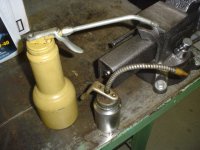
See attached I use the large oil can for the tranny and the small one for filling the carbs. When the small oil can is empty and I'm in a rush I just pour 10wt non-detergent oil right out of the quart bottle and into a funnel with a 2 inch inlet and a 1/4 inch outlet. With the funnel sometimes it overfills but most of the time I'm good to go. Bill, now you know what the small oil can is for.
Attachments

SpannerMan
Jedi Trainee
Offline
A related question is - how often do people find topping off to be necessary? I've never really found that it goes away, on the SU H6's I have on my car anyway. May be more of an issue with the Strombergs, since I think these use an O-ring seal around the needle which might leak.
Another vote for 20W50 here.
Pete
Another vote for 20W50 here.
Pete
dklawson
Yoda
Offline
O-ring seals? Perhaps it's the age of the carbs I've worked on, but the only o-ring seals I'm familiar with are on the outside of the jet tubes (SU or Strombergs). I've never seen o-rings on the vacuum piston or the dashpot. As far as topping off, I typically over-fill at the start and the excess gets sucked by the piston and burned. After that I think I probably loose oil only from checking the level.

swift6
Yoda
Offline
[ QUOTE ]
I've never seen o-rings on the vacuum piston or the dashpot. As far as topping off, I typically over-fill at the start and the excess gets sucked by the piston and burned. After that I think I probably loose oil only from checking the level.
[/ QUOTE ]
DK, the Oring they are discussing is around the adjuster screw for the needle.
Moss page
It's part #11 on the blow up of the adjustable needle area.
I've never seen o-rings on the vacuum piston or the dashpot. As far as topping off, I typically over-fill at the start and the excess gets sucked by the piston and burned. After that I think I probably loose oil only from checking the level.
[/ QUOTE ]
DK, the Oring they are discussing is around the adjuster screw for the needle.
Moss page
It's part #11 on the blow up of the adjustable needle area.