• Hi Guest!
    If you appreciate British Car Forum and our 25 years of supporting British car enthusiasts with technical and anicdotal information, collected from our thousands of great members, please support us with a low-cost subscription. You can become a supporting member for less than the dues of most car clubs.

    There are some perks with a member upgrade!
    **Upgrade Now**
    (PS: Subscribers don't see this gawd-aweful banner
Tips
Tips

TR6 OEM Connecting Rod surprise

hohmanj

Freshman Member
Offline
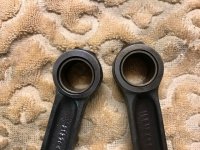
In the process of rebuilding a 69 vintage tr6 motor for a winter project.....After removing the pistons from the connecting rods, i found several of the connecting rod holes where the piston pin goes through were mis-aligned.....? The attached photo shows one of the extreme examples but measuring the others with a caliper, they too were slightly off....Is this something I should worry about??

 

Attachments

  • IMG_0158.JPG
    IMG_0158.JPG
    127.4 KB · Views: 186
I would check the lengths of the rods. Could be the difference was made up on the big end.
 
That is common and not really a problem. The center to center distance will still be correct, assuming the rods are not bent or otherwise damaged. The tooling that aligns the piston pin hole occasionally reads the flash or slight rod twist, and then compensates with a hole that is slightly off center. Frequently the hole will be centered on one side, but off on the other.

When I used to build high performance engines I would go through many rods to find enough to use that were closely centered. On a street engine it will not be a problem. One old head put it to me this way, "Once the piston is at the top, a rubber band will pull it back down"! That's a little exaggerated, but his point was that most of the load on the rod is compression. At the top, even on the exhaust to intake stroke, the air being pumped makes the tension load on the rod very small. Only at racing RPM will the centering be a concern. Power doesn't really change the tension on the rods, but increased RPM will. So stock RPM should not overload even a slightly off-centered rod.

I would frequently find stock rods that had cracks almost completely across one of the pin sides on some of the rods that were severely off center. I realized they were likely running like that for a very, very long time.
 
I confirmed the hypothesis that the rod length between small end to big end were identical 4.330 for all of the rods...thanks for the feedback! On to the next step!
 
That is common and not really a problem. The center to center distance will still be correct, assuming the rods are not bent or otherwise damaged. The tooling that aligns the piston pin hole occasionally reads the flash or slight rod twist, and then compensates with a hole that is slightly off center. Frequently the hole will be centered on one side, but off on the other.

When I used to build high performance engines I would go through many rods to find enough to use that were closely centered. On a street engine it will not be a problem. One old head put it to me this way, "Once the piston is at the top, a rubber band will pull it back down"! That's a little exaggerated, but his point was that most of the load on the rod is compression. At the top, even on the exhaust to intake stroke, the air being pumped makes the tension load on the rod very small. Only at racing RPM will the centering be a concern. Power doesn't really change the tension on the rods, but increased RPM will. So stock RPM should not overload even a slightly off-centered rod.

I would frequently find stock rods that had cracks almost completely across one of the pin sides on some of the rods that were severely off center. I realized they were likely running like that for a very, very long time.

Back many years ago, looking for a new machine shop after a move for my Flathead Fords, I recall a tear down, and transporting all the bits to the machine shop for tanking, inspecting and machining.
This shop did a lot of big engines....including a lot of early Hemi Chryslers primarily for race purposes.
The guy looked in the box, and asked where the rest of my rods were.
I asked why, as there were 8 of them in the box.
His experience was he needed a minimum of 24 rods to find maybe 8 usable ones on Hemis.
I told him to just check the 8 I had.

He was amazed....none bent, twisted, stretched, mis-machined, offset.....nothing.
And in 50 + years of Flathead work, I have yet to have a bad rod.

Knock Wood.
 
Back
Top