
-
 Hi Guest!
If you appreciate British Car Forum and our 25 years of supporting British car enthusiasts with technical and anicdotal information, collected from our thousands of great members, please support us with a low-cost subscription. You can become a supporting member for less than the dues of most car clubs.
There are some perks with a member upgrade!**Upgrade Now**
(PS: Subscribers don't see this gawd-aweful banner

Tips
- We have a special forum called "Member Articles" where you can submit actual articles for consideration for publication. Learn More
- Don't have an Avatar? If not, your avatar will default to the 1st character in your username. Go into "Account Details" to change your Avatar.
- Some basic forum navigation info: click
 Hey - did you know if you click on the title of a thread it will take you to the first unread post since you last visited that thread?
- Hey Guest - Is your British Car Club in our Clubs database? If not, send me a PM - Basil

- Looking for a local club? Click the "Clubs" tab above and browse hundreds of clubs world-wide.
- Add Android or iPhone APP: click
- Did you know - any picture or video you add in your posts in any marque-specific forum will also get added to the Media Gallery automatically.
- A few more tips about posting and replying: click
- Hey there Guest - be sure to keep your profile page up to date with interesting info about yourself: learn more
- More tips and tricks on Posting and Replying: click
 but were afraid to ask:
  STOP!! Never post your email address in open forums. Bots can "harvest" your email! If you must share your email use a Private Message or use the
  smilie in place of the real @
- Want to mention another member in a post & get their attention? WATCH THIS

- So, you created a "Group" here at BCF and would like to invite other members to join? Watch this!
- Hey Guest - A post a day keeps Basil from visiting you in the small hours and putting a bat up your nightdress!
- Hey Guest - do you know of an upcoming British car event?
 Pretty Please - add it to our Events forum(s) and add to the calendar! >> Here's How <<
- Hey Guest - you be stylin' Change the look and feel of the forum to fit your taste. Check it out
- If you run across an inappropriate post, for example a post that breaks our rules or looks like it might be spam, you can report the post to the moderators: Learn More
- If you would like to try some different "looks" or styles for the site, scroll to the very bottom, on the left and click the Style Selector.
You are using an out of date browser. It may not display this or other websites correctly.
You should upgrade or use an alternative browser.
You should upgrade or use an alternative browser.
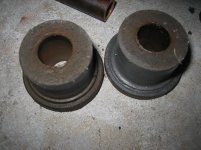
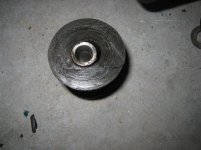
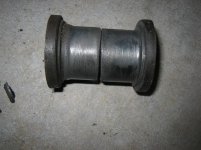
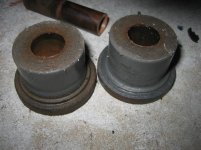
TR6 Nylatron trailing arm bushings.
- Thread starter tomshobby
- Start date

TR3driver
Great Pumpkin - R.I.P
Offline
Wow.
The Nylatron bushings I have in the front of my TR3 held up much better than that, but they also look quite a bit different. Most obvious, the steel sleeve in the center is much larger, so the bushing is correspondingly thinner. They also appear to have been originally machined from extruded billet, while yours look to have been cast to shape. Not sure what difference any of that makes.
I can't quite recall how old they are at this point; seems like I installed them around 1995 or so in my previous TR3A. Then after it got wrecked, I checked them for wear and distortion before moving them to the current TR3. They did show some wear, but nothing like what shows in your photos.
The Nylatron bushings I have in the front of my TR3 held up much better than that, but they also look quite a bit different. Most obvious, the steel sleeve in the center is much larger, so the bushing is correspondingly thinner. They also appear to have been originally machined from extruded billet, while yours look to have been cast to shape. Not sure what difference any of that makes.
I can't quite recall how old they are at this point; seems like I installed them around 1995 or so in my previous TR3A. Then after it got wrecked, I checked them for wear and distortion before moving them to the current TR3. They did show some wear, but nothing like what shows in your photos.
OP

tomshobby
Yoda
Offline
Hi Randall, I am disappointed in them but to be fair they do have a lot of miles. They have been coast to coast through many states and into western Canada. The original rubber ones had many more years service and looked as good when I replaced them. I am wondering what to replace them with.
Keith, there was a faint clunk sound and it may have been from them but I have not dropped the diff yet.
Keith, there was a faint clunk sound and it may have been from them but I have not dropped the diff yet.


Offline
I had one polyurethane bushing fail on my TR250, the results were quite pronounced, it deformed under pressure when I was autocrossing and the handling got quite squirrely for a short time, I informed the vendor (BPNW) of the problem, and they sent more of same, I was skeptical, but it was free, and installation isn't too hard, so I put the replacement on and have had no trouble since, About 4 years of use, not as many miles probably as you put on. When I had the problem my next choice was to try the extra hard rubber ones from the roadster factory, but since the polyurethanes have been OK, I haven't pursued it.
P.S. I thought the bushings didn't move relative to the arm, and any friction/wear was supposed to be between the retaining bolt and the metal sleeve in the bushing.
P.S. I thought the bushings didn't move relative to the arm, and any friction/wear was supposed to be between the retaining bolt and the metal sleeve in the bushing.

KVH
Obi Wan
Offline
I'm not able to see they're all that worn, at least from what I know, but here's my main question: Isn't is a hassle to replace those bushings due to the necessity to assure that the rear wheel is then properly aligned? I have an alignment bar from Moss that I use on the front wheels but how to you align the rear after removing and replacing the trailing arms?

Tybalt
Jedi Warrior
Offline
.... but how to you align the rear after removing and replacing the trailing arms?
I assume that you are talking about a gauge for checking the toe in/out. You can use the same piece of kit and then add or subtract shims at the trailing arm pivot brackets to adjust toe. If you kept track of the shims and reinstall same as before disassembly you should be at a good starting point for toe adjustment. Another option would be to use the "String method" discussed here:
https://www.britishcarforum.com/bcf/showthread.php?99484-Shims
Adjusting camber is another matter. Here there are two approaches. One is playing mix and match with the pivot brackets (one, two and three notch) and orienting them up or down accordingly to add or subtract camber, all in all a royal pain that is somewhat removed from the neck (I have first hand data on this). The other is to contact Richard Good ( https://goodparts.com/shop/index.php?categoryID=13 ) and get a set of his adjustable rear trailing arm brackets, your life (or the life of whoever is doing your alignment) will be much easier.
Here's a link that explains the rear camber adjustment using the bracket mix and match method:
https://buckeyetriumphs.org/technical/Suspension/AdjRS/AdjRS.htm
OP
tomshobby
Yoda
Offline
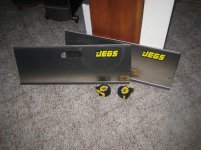
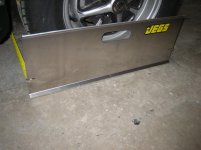
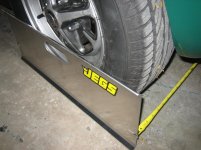
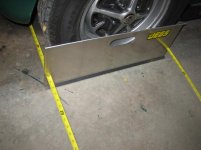
When I did the toe-in on my Midget I used this tool that I purchased from Jeg's. It was easy to use and having driven a few hundred miles since it seems to have done a fine job. BTW - toe-in of the front wheels is the only wheel alignment adjustment that a Midget has.
When I do my trailing arms on the TR6 I will also use the "string" method to check the alignment of the rear wheels with the front wheels.
When I do my trailing arms on the TR6 I will also use the "string" method to check the alignment of the rear wheels with the front wheels.