• Hi Guest!
    If you appreciate British Car Forum and our 25 years of supporting British car enthusiasts with technical and anicdotal information, collected from our thousands of great members, please support us with a low-cost subscription. You can become a supporting member for less than the dues of most car clubs.

    There are some perks with a member upgrade!
    **Upgrade Now**
    (PS: Subscribers don't see this gawd-aweful banner
Tips
Tips

TR2/3/3A More questions about rebuilding my steering box

Lukens

Jedi Warrior
Offline
I continually read that there should be a "tight spot" on the center of the worm. I can't follow the logic. Was it originally machined high in the center to accommodate the wear that the worm will experience there? That would indicate that as the peg moved off center, it would encounter more slop ( unless the rocker shaft were spring loaded).
And is that tight spot created by increasing the OD of the worm, or is the groove depth shallower.

Enlighten me oh wise ones.
Russ
 
Russ,

The worm gear has a groove in it where the peg fits. The sides of the groove are sloped (machined) to match the sides of the peg. The groove is narrower at the very center of the worm -the tight spot. It is "tighter" in the center to allow the steering to also be "tighter" in the center -where the worm would be positioned if the driver were going straight. This "tight" spot allows less play at this point, and less wonder at speed. It also allows the wheel to be turned easier either side of the "tight" spot (straight).

The steering wheel rotates the worm, the peg causes the wheels to turn. Too much play (or looseness) anywhere, will allow the car to wander while the driver plays catch-up with the steering wheel. The play doesn't matter too much while turning because turns are short lived and constantly adjusted anyway. The "straight" position is the "tight" spot.

Clearer?
 
Tex, Your statement that it turns easier on either side of center is plausible, but...
I tend to think they engineered the tighter center to accommodate the inevitable wear there. Then, when you lower the rocker shaft to take up the slop, it won't get tighter, bind, as you move off center. Does that make sense?
Here I am telling you how it's designed, when I asked the question. :confusion: Forgive me.
 
Forgive me? Please. Since I too can ask questions, you would not need to request forgiveness for the same.

I think it was engineered tighter for the reasons I mentioned earlier. The wear was engineered to be in the peg, as it is much easier to replace, than the worm. Lowering the rocker shaft will not bind, because the bushing is a very tight fit (of course the tighter the peg is in the slot, the more difficult to rotate the worm/steering). The rocker should only be able to rotate. Also, the worm, being locked by the bearings at either end, should only be able to rotate. Any movement other than rotational, will be "slop" in the steering. That is why the "end float" and "tight spot" are important.

The "peg spring" I think is counter effective. At first it seems plausible that the spring would keep the peg in constant tension to the groove, and hence eliminate "steering slop". But, as we all know, the roads traveled are not always perfectly smooth. The sudden bump in the road would be transferred to more tension at the peg, and the spring would allow movement, and slop.

-Then again, I did not engineer any of this and could be completely mistaken. These are simply the ideas I came to accept, and think they helped me achieve great steering out of 50 year old parts.

Incidentally, I took at least 6 boxes apart. At least 4 of these boxes had chipped worms. 1 had a shaft with the other end destroyed, probably due to incorrectly aligned shafts, or a loose coupler. The chips were probably a result of the lack of oil. In my opinion, "wear" was not detrimental to these boxes. They were not maintained properly.

 
Hmm, well, it certainly doesn't prove anything; but I did find one period reference to the taper being to allow for wear:
https://austin-somerset.org/PDFs/A4...D3 GD5 Workshop Manual/Section J Steering.pdf

That's an Austin manual dated 1957, although the steering box itself is remarkably similar.

Here's another mention of wear being the reason for the high spot
https://lagondaforum.com/attachments.php?action=attachment&id=806

PS, I'm surprised too. I always thought it was to reduce friction, and no doubt have said so. It appears I was wrong.

 
I can't imagine wear being the factor for the tight center, as more modern boxes with all roller bearings are still designed that way. It seems the goal is zero play at center, since that is where the box spends 99% of the time. It would also reduce the tendency to bump steer when you are tracking straight and would notice it. Finally, it should also reduce the tendency for the car to drift downhill on a crowned road, since it will hold its center better.

Once the wheel is off center during a turn, the steering tends to straighten itself, so it will naturally ride on one side of the peg, even though there is play between the peg and the worm. So the play is not noticeable in a turn.
 
Not that my vote always counts, but I do recall taking delivery of a brand new TR3B in 1962. The first time I turned, I very nearly hit a parked car because I thought the steering wheel would center it,s self. It was probably 1000 or so miles later before there was enough "wear" in the box that the steering would self center. Therefore I would vote for the wear factor entering the design decisions.
 
Not that my vote always counts, but I do recall taking delivery of a brand new TR3B in 1962. The first time I turned, I very nearly hit a parked car because I thought the steering wheel would center it,s self. It was probably 1000 or so miles later before there was enough "wear" in the box that the steering would self center. Therefore I would vote for the wear factor entering the design decisions.

But...just imagine how bad the first turn would have been if the gear was tight away from center and you had to force it back straight. When a car is going straight, you want it to stay going straight. When you are turning, it's only temporary and never constant.
 
Remember also these cars competed against MG that had fantastic rack and pinion steering , often they sat on the same sales lot together. If you drove a new MGA and walked over to a TR3 and the steering were loose while you sat behind the wheel , you'd think the steering were bad. The TR needed as tight a feel to the steering as possible. When at speed and turning you wouldn't notice the steering loosening slightly. Just a thought but a lot of things cleverly engineered were done just to sell the car.
 
I don't think intent or history is something we can vote on, and I'm not trying to pick sides. But... The 1,000 miles of wear until the steering straightens out by itself is evidence of what wear? The entire length of the steering groove in the worm, or just the peg? The narrow spot would only apply to "straight ahead" and would not have much to do with the wheel returning to center.

I imagine the worm wears more in the center that at either end. I imagine the peg wearing more than the worm. I also imagine much more steering slop when the worm end float or peg adjustment are not in the "sweet spot".
 
That's interesting, Phil. Did you take it back to the dealer and complain? It was obviously mis-adjusted. Perhaps deliberately so, but still not by the book.

S-T didn't even build the steering box, and the design was unchanged since well before the MGA even came out, so I really doubt it was altered just to compete with MGA. When the TR2 came out (with the same steering), all MG had to offer was the T-series and they steered even worse than the TR.
 
Randall, as a 19 year old goof, I was too excited about having that car I wouldn't have complained about anything.
 
The "tightness" at center would have made it easier to find the center of travel and adjust the box before it was installed in the car's chassis. The MG TC's box ( also a Bishop , but a little lighter duty) is made the same way. When did the first TR2 get built? I think it was '52 or so, by then the TC had long been replaced by the TD ( in 1950) which had rack and pinion with a much lighter action than the TR. No , the TRs steering wasn't "altered" to compete with the MGAs but it would have needed to be adjusted as well as the design allowed and as efficiently as possible in order to compete.
 
I think there is a point not being made here about the position of the peg in the slot of the worm. That is, its travel is an arc and as such it doesn't ride in the slot at a constant depth. The parts blowup Randall posted shows it quite well with the cut away at center. At the center position of the steering travel the peg actually sits past the center-line of the worm (the "loose point"). The peg crosses the center of the worm as the steering wheel turns and as the arc goes to the end of travel it is over the inside of the worm relative to the shaft (distance from the peg to the shaft being the radius for the arc) The worm slot is not different anywhere in its spiral path. The peg wears on the sides where it contacts the slot, but starts new as pretty much conical to match the angles of the worm slot.
 
Give that man a cigar. I never considered that the peg follows the arc of the rocker shaft... pulling away from the worm on both sides of center.
Like a light when on. :encouragement:
 
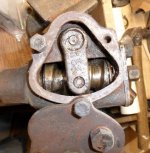
That is a great explanation, it makes all the sense in the world, except it is not accurate. As soon as I read it, I went out to the garage and had a look, and took this picture.

As you can see in the picture, when the peg is in the straight ahead (center of cam) position, the peg center is outside the center line of the cam. The cam is actually closer to centered just before the end of travel in each direction. The peg never crosses the center of the worm.

-Still, I could be completely wrong, but I'm sticking to the concept that it is was machined that way.
 

Attachments

  • cam_centered.jpg
    cam_centered.jpg
    192.7 KB · Views: 183
Hi Lukens,

Lots of interesting info about the TR3 steering box here in this thread.
I replaced the adjuster in mine with a bolt that has matching thread to the original. Do not try to drill the adjuster as the steel is too hard.
Drilled centre part of bolt part way out. Got a good friend with lathe to turn a T shaped piece and installed it with a stiff coil spring. I removed a lot of, but not all, play.
In my opinion it does not substitute a rebuild, but it is a worthwhile improvement.
I think this piece can also be purchased from a supplier in England.
I think I mentioned this to you at Devereaux-Kaiser.

Bob
 
Back
Top