• Hey Guest!
    British Car Forum has been supporting enthusiasts for over 25 years by providing a great place to share our love for British cars. You can support our efforts by upgrading your membership for less than the dues of most car clubs. There are some perks with a member upgrade!

    **Upgrade Now**
    (PS: Upgraded members don't see this banner, nor will you see the Google ads that appear on the site.)
Tips
Tips

TR4/4A Looks like I need a new ring and pinion...

Sarastro

Yoda
Silver
Country flag
Offline
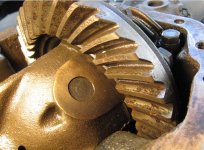
I finally took a close look at the differential, and the picture below shows what I found. Looks like there's a new ring and pinion in my future.

I had planned to rebuild the diff anyway, since it only had a dribble of oil in it when I opened it, and I don't trust that the bearings are OK. They feel smooth, but the backlash is a bit out of spec, and I need to pull it apart to inspect them, anyway.

New ring and pinion sets are available, but cost a bit under $500. I would like to get a good used set, and it seems the easiest way to do that is just to find a used differential. Maybe a 4A IRS one (my car is a 4A solid axle) as I understand the internals are the same, and it's easy to ship. So, two questions;

1. Am I right in thinking the IRS and solid-axle internals are the same?

2. What's a going price for a used TR4A IRS differential?

Thanks for your help!
diff.jpg
 
Steve,
If the 4a irs diff guts are the same as a solid axle, you should be able to use TR6 as well.
Rut
 
Ah, good point. I noticed that VB lists the same part no. for ring and pinion sets for the TR2 through TR6! But I'm not sure about other parts. If all I get is the R&P, that's fine, but it might be good if I could salvage some small parts, too.
 
I'm pretty sure the internals of all the TR series diffs are the same so buying a used ring and pinion should be no problem. Call Scott at Team Triumph in Warren Oh and he can help you with some good parts.
 
There were some differences; one being the center block that is only used in "Girling" solid axle diffs (and is essential to their correct operation). IRS diffs and the TR2-early TR3 "Lockheed" diffs don't use it. There were some other differences between the "Lockheed" (1/2 floating) and "Girling" (3/4 floating) diffs; I don't know offhand if they can be interchanged by adding the block or not (but I suspect not).

Early TR2 had smaller bolts in the ring gear (but the later R&P plus carrier is a factory recommended upgrade).

Also, later TR6 used a crush collar instead of shims to set the pinion preload. I don't know how different they are, but the P/N for the R&P changed. However, I believe they interchange as long as the matching spacer/collar is used (so most vendors supply the shim type even for units that originally had the crush collar).

One thing to look for in a used diff is whether the carrier bearing inner races are still a snug fit onto the carrier. I've found several where one or both bearings has apparently spun on the carrier and worn it undersize. Or maybe it's just a manufacturing defect?

Steve, I've got a couple of later TR3/A axles laying around. I'm not really interested in pulling them apart myself for inspection; but you're welcome to come over and have a look if you like. I'm in Lakewood, so no shipping charges :smile: PM or email if you're interested.
 
I know its hard to tell from pics but I think I would disassemble clean and inspect what you have because I think you could run that matched original gear set that seems to show some pitting but almost no wear.
Tom
 
But what do the inner bearings look like??? Hopefully they do not look like the gears.
Charley
 
I know its hard to tell from pics but I think I would disassemble clean and inspect what you have because I think you could run that matched original gear set that seems to show some pitting but almost no wear.
Tom

That was kind of my thought also.
 
Hmmmm....interesting points, guys.

The background: This car was owned by one guy for the last 30 years or so, but I don't think he drove it much, maybe not at all for the past however many years. I don't think the oil was checked, let alone changed, for all that time. So, there was almost no oil in it, and the little oil remaining was olive, indicating oxidation. I suspect the corrosion came from the oxidized oil, or maybe just moisture condensation.

I thought about using it as is, and if there is a consensus here, I could still do that. My worry is that a crack could develop and a tooth could break--but maybe I'm worrying too much (again). My feeling is that the pitting is a little too much for comfort, and if it needs to be replaced, I'd rather do it now.

I plan to replace the bearings, and the inner differential gears look good, so my main concern is the ring and pinion.
 
Undoubtedly it would work, for awhile. But with a hypoid gear set, the gear teeth wipe against each other as they turn, under a whole lot of force especially when you're accelerating. That's why they need "extreme pressure" oils, to withstand that wiping action.
My opinion, those gears are going to wear rapidly, until something finally breaks.
 
I thought about using it as is, and if there is a consensus here, I could still do that. My worry is that a crack could develop and a tooth could break--but maybe I'm worrying too much (again). My feeling is that the pitting is a little too much for comfort, and if it needs to be replaced, I'd rather do it now.

It's unlikely that this type of pitting would cause a tooth to break. A crack would start in the root of the tooth and I don't see anything on these that would make them more or less likely to crack. Your second point is well taken, though.

I also do not think the pitting is likely to cause noise. Noise in a gearset is almost always caused by motion variation, which is basically the idea that as the gears mesh with each other, they are deviating in tiny ways from their "ideal" positions as they rotate. These deviations are partly by design, and partly due to manufacturing variations in new gears. As gears collect miles, wear will also cause these variations. The rust pits in these gears are not large enough to change the angular positions of the gears and cause noise. Keep in mind that you usually have at least two gear teeth in contact with each other at any given moment.

How quickly the gears would wear out I don't know.

If you can get a new gearset or find a good, low mileage used set, by all means use them. But personally, given the choice between a high mileage but undamaged gearset and this (presumably low mileage) one, I would chose this one.

Source: I worked as an engineer for an axle company for 12 years, including 6 years in the gear plant, where we manufactured about 9000 ring and pinion sets per day. But obviously we only dealt with problems and failure modes of new gears, not old ones.

-- Jon
 
Last edited:
Undoubtedly it would work, for awhile. But with a hypoid gear set, the gear teeth wipe against each other as they turn, under a whole lot of force especially when you're accelerating. That's why they need "extreme pressure" oils, to withstand that wiping action.
My opinion, those gears are going to wear rapidly, until something finally breaks.

+1

They will work for a short while, but will wear extremely fast...soon you would get the dreaded rear end whine. It won't hurt anything to run them, but unless the car is a trailer queen you'll be back into the rear end within a few thousand miles.
 
I'd be very, very tempted to run the diff for a while as-is, just for a science experiment. You'd want to think of the unit as being "in hospice", and change the lubricant frequently to keep the patient happy.

My own science experiment is that I'm about 25 years into using a TR3 rear axle with 1.5 teeth off the ring gear. The pieces were removed and the housing carefully flushed multiple times as soon as the teeth broke. It's been thousands of miles since then and is a little noisier than it should be, but not annoyingly so. I change the rear axle oil every year or two, and am now using synthetic GL5 in it.
 
I am no rear axle guy, but my thoughts are to run it a while also. It probably got water in from being on the beach and you said it only had a little fluid, so perhaps some new fluid would quite it down. I would fill it up with stock fluid and drive it for a while to see what happens to the bearings. If it starts howling I would change my plan.

My kids live in Long Beach and I hate the traffic there; the freeway traffic is worse than Seattle at rush hour all the time, but in town I can handle it, and again my driving there in town was short and choppy, so unless you plan to drive to Mexico or the desert what the heck drive it while you can.
Steve
 
Back
Top