• Hi Guest!
    If you appreciate British Car Forum and our 25 years of supporting British car enthusiasts with technical and anicdotal information, collected from our thousands of great members, please support us with a low-cost subscription. You can become a supporting member for less than the dues of most car clubs.

    There are some perks with a member upgrade!
    **Upgrade Now**
    (PS: Subscribers don't see this gawd-aweful banner
Tips
Tips

Learned Something New

60TR3A

Jedi Trainee
Country flag
Offline
A couple of days ago as I returned from a short trip to the supermarket I heard my fuel pump clacking away and the sound got louder and louder until it sounded like a jack hammer, all within the space of maybe a block or two. The engine sputtered and died. I assumed that my fuel pump had failed so I called Hagerty roadside assistance and after a long wait (1.5 hours), got my car flatbedded home.

That night I had an epiphany: maybe the pump was making noise because it was starved of fuel, i.e., I had run out of gas. Went out the next day and bought a gas can and put in 4 gallons and voila! The noise went away and the car started right up!

As a kid I used to run out of gas all the time but never had a noisy fuel pump so it didn't occur to me that I'd simply run out of gas. Now I know better and from now on will refill once the gauge gets to the halfway mark, not to the quarter mark as the gauge isn't very accurate.

Never too old to learn something new!
 
Gauge showed a quarter tank (+/-) so I'll just refill whenever I get to halfway and not rely on its accuracy.
 
Some folks watch the milage. Fill it up every 300? miles depending on the type of driving.
 
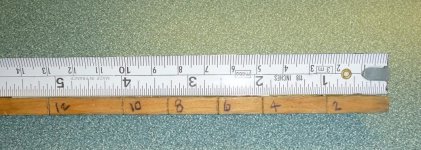
Like Bob from UK suggested, make an official Healey gas gauge out of a small diameter piece of wood, mark it off when inserted into the tank when full for your full mark, guess on the half full, etc and there you go, a back up to the Smiths fuel gauge. Get more comments on my "Official Austin Healey Petrol Gauge" ( as I have marked the stick with a black sharpie) then I do about my original tool kit in the boot ! I know there are many ways to make the gauges work properly and have done them all but still check with my trusty gauge !
Regards,
Mike
 
Mike,

I'm intrigued by your "Official AH Petrol Gauge". Do you fill it up to the top of the tank itself or do you come up the filler tube as well? I usually just guesstimate the amount and then call a tow truck to follow me around.


Cheers
Dave
 
I watch my odometer. My gauge is iffy at best. Currently not working. It's either full or empty. Husband is going to check and see what the problem is. I think my odometer is more reliable.
 
I must confess, I too have used the official AH Petrol Gauge, but with a disturbing result. Keep in mind that after using this wooden stick time after time you are essentially carrying around a Tiki Torch. Well, to make a short story long, I some how figured out how to create a scenario wherein a carelessly placed tonneau support rod grounded my battery to the bolt that attaches the block that holds in the spare tire. The rod welded itself to the bolt causing the wood block to smolder, igniting the adjacent official AH Petrol Gauge. YIKES.
Flames and general excitment immediately followed. I won't go into the virtues of carrying a fire extinquisher, but needless to say I was pleased to have one on hand. Now I carry two extinquishers and "0" official AH Petrol Guages/ Tiki Torches.
 
Once I tap the face of mine to get it unstuck, it seems to be "reasonably" accurate.

I watch my odometer. My gauge is iffy at best. Currently not working. It's either full or empty. Husband is going to check and see what the problem is. I think my odometer is more reliable.

Possibly I'm speaking out of turn here, as I've never owned a AH. But both of those symptoms sound exactly like what a TR3 fuel gauge does when it isn't getting a good ground connection through the metal plate that it mounts on. Adding a ground wire from the mounting post to the ground tie point on the dash made it a whole lot more consistent. Still not terribly accurate, but I know that when it first reaches 'E', there are only a couple of gallons left and it's time to look for fuel.

I'm not at all certain, but I think BN1 through BJ7 used a similar gauge. Unfortunately, Barney Gaylord's website seems to be down at the moment, but there used to be an excellent article on how to repair and calibrate the early "balanced" gauge movements.
 
I must confess, I too have used the official AH Petrol Gauge, but with a disturbing result. Keep in mind that after using this wooden stick time after time you are essentially carrying around a Tiki Torch. Well, to make a short story long, I some how figured out how to create a scenario wherein a carelessly placed tonneau support rod grounded my battery to the bolt that attaches the block that holds in the spare tire. The rod welded itself to the bolt causing the wood block to smolder, igniting the adjacent official AH Petrol Gauge. YIKES.
Flames and general excitment immediately followed. I won't go into the virtues of carrying a fire extinquisher, but needless to say I was pleased to have one on hand. Now I carry two extinquishers and "0" official AH Petrol Guages/ Tiki Torches.
Sounds like your fuel level stick would come in very handy when exploring some of the caves and caverns along my vacation route this summer!:rolleye:
 
Steve

I'm trying to understand those scales. Initially I imagined the marks should be in linear increments however the tank is curved at the bottom and the top so the first and last marks should, I think, be slighter wider than the others. Not sure though about the marks you both have for the 12 gallon levels, they don't look right.

The tank holds 12 imperial gallons I think, and I assume this excludes all of the filler tube.
 
Steve

I'm trying to understand those scales. Initially I imagined the marks should be in linear increments however the tank is curved at the bottom and the top so the first and last marks should, I think, be slighter wider than the others. Not sure though about the marks you both have for the 12 gallon levels, they don't look right.

The tank holds 12 imperial gallons I think, and I assume this excludes all of the filler tube.

The two scales are in US gallons. The difference between the two is Bruce puts the dipstick in the well in the bottom of the tank and I put it along the filler tube so it seats on the shelf just above the well.
In my case, the marks were established with a straight tank, mounted on sawhorses, levelled, by adding water a gallon at a time. The procedure was performed twice. Bruce got his measurements in situ.

DipstickUSgals.jpg
 
Back
Top