• Hi Guest!
    If you appreciate British Car Forum and our 25 years of supporting British car enthusiasts with technical and anicdotal information, collected from our thousands of great members, please support us with a low-cost subscription. You can become a supporting member for less than the dues of most car clubs.

    There are some perks with a member upgrade!
    **Upgrade Now**
    (PS: Subscribers don't see this gawd-aweful banner
Tips
Tips

TR5/TR250 It Blew Up

glemon

Yoda
Bronze
Country flag
Offline
I blew up my differential today on my TR250. Drove up to Omaha for a small local show, and then come back on the interstate to Lincoln thinking how good the car was running. Then I pulled onto the off ramp and noticed a bad noise as I slowed down. Noticed grooves or ridges in the tarmac, figured it was tire noise.

But it didn't go away when the road smoothed out, and the throttle worked like an on/off switch, the noise going away when I gave it power. About a mile further and still 6-7 miles from home it is getting worse, and even getting some resistance from the wheels. Stopped, hoping it was a brake or u joint or something. No such luck and diff is definitely oozing oil from the front pinion area.

Call a tow truck. Second tow in 35 years of driving British cars, ****. Anyhow must now fix or replace, options appear to by fix, replace with hopefully good used, or Nissan R200. Recommendations?
 
On a 250 I would fix or replace. It is a 250, I would not put a Nissan part in a 250. With that said I do have a Toyota trans in my TR3. But it is a TR3 one of some 60,000. 250 is one of 8600.
 
I would at least pull it apart and take a look. If the gears are OK, changing the bearings isn't too bad. But if the gears are damaged, it's probably worth looking for a used replacement. As I recall, the diff itself is same as early TR6 (and late TR6 will fit), you just need to reuse your old back cover/mount.

Probably worth checking inside the replacement as well. This is what I found in the "rebuilt" diff I bought for the Stag (which turned out to not be from a Stag at all):
 
Thanks Marv, if I go in that direction and can't find anything local will give you a buzz. I do appreciate the thoughts about originality, but my car has already gone down that road, I have a later J type overdrive, and TR4 carbs, and I just put front calipers from a Toyota on the car.

I will probably take it out and take a look at it, whatever was going on was not food, rear wheels locked up when it was being pulled up on the tow rig.
 
Probably started with the upper pinion bearing. On trailing throttle the cut of the gears makes the ring gear pull the pinion toward the center of the axle. Same thing if you are pulling the car- the ring is driving the pinion and pulling it toward center, so the base of the pinion engages the "flat" part of the carrier (the opening for installation of the spiders). = lockup. I had a Toyota P/U do this to me and was able to reuse the ring and pinion. Good luck.
Bob
 
I have it out, I think Randal has it right appears to be pinion bearings, the outer is clearly shot. The nut holding the outer piece that connects to the driveshaft whose name escapes me now, output flange, anyway nut was loose, no cotter pin, don't know if it came loose and caused the problem or problem caused it to come loose.

Question now is farm out or try to fix it myself.
 
The nut holding the outer piece that connects to the driveshaft whose name escapes me now, output flange, anyway nut was loose, no cotter pin, don't know if it came loose and caused the problem or problem caused it to come loose.
My guess would be the former. There is a lot of force involved, both the housing and the pinion deform slightly under load (which is why the preload is important). And the gear set won't work right if the pinion is just a little bit out of place. If the angles are off by very much, the teeth start breaking.

I prefer to do the work myself, if I can. But without the pinion depth tool, getting the shims just right can be a tedious process. If you can save the old gear set and buy good Timken bearings, then the old shim packs should be very close. But new gears are expensive and it can take many iterations to get the pattern just right. That's why I said it might be better to find a good used unit if the gears are damaged. Which, from your description, I think probably are ruined.

But by all means, pull it apart before making a decision.

PS, building a spreader tool might be worth the effort; but it definitely is not required. A couple of big pry bars will scoot it right out

 
I had a similar experience-Replaced a pinion seal and for some reason the pinion nut wasn't returned to its original home. On deceleration or reverse there would be a very destructive sounding noise. An autopsy revealed that the pinion was moving to the rear enough to contact the carrier. The end of the pinion acted like an end mill and carved some impressive gouges in the carrier, but not deep enough to cause any serious damage. The rear face of the pinion wasn't damaged, so I just replaced the bearings because of the large amount of metal shavings in the oil.
I wouldn't worry about not having the pinion setting gauge (although I made one). It just establishes the thickness of the shims necessary to install the pinion to the same dimension (3.4375" from the rear face of the pinion to the centerline of the ring gear). This dimension was used at the factory when the ring&pinion were lapped together. The size of the shim pack determined by the gauge is a starting point, but the contact picture may it to be changed. The bottom line is to use the old shim pack to start with and adjust as the contact picture ditates. A more coherent explanation can be found in the big red TR3 factory service manual.

Berry
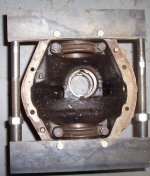
Here is a homemade spreader, if you decide to go that route- 000_1371.jpg000_1371.jpg
 
Thanks all, particularly for the advice on fixing, I will tackle almost anything, never tried a differential though, other than replacing seals, which is probably why this one went out, after the fact I don't think the torqued it on right, hence the problem.

I have found a good used being sold to me at a "club buddy" price, so I think I will trust the factory build however old, more than my repair efforts.
 
Replacement diff installed, not only works fine but the worrying and annoying clunk from the rear end is gone, and the diff is much quieter, but as it turns out the replacement was probably rebuilt at some point unless the factory used blue silicone gasket sealant, but still good outcome so far...
 
Back
Top