• Hi Guest!
    If you appreciate British Car Forum and our 25 years of supporting British car enthusiasts with technical and anicdotal information, collected from our thousands of great members, please support us with a low-cost subscription. You can become a supporting member for less than the dues of most car clubs.

    There are some perks with a member upgrade!
    **Upgrade Now**
    (PS: Subscribers don't see this gawd-aweful banner
Tips
Tips

Issue with Distributor

Gadwhite

Senior Member
Offline
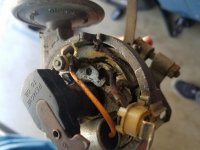
Need help with wiring of coil, and coil to distributor, on a positive ground car. ( 64 AH 3000 mkiii) Well looks like I cooked my distributor wiring. 20180203_142932.jpg Burning smell while cranking and the wiring disintegrated. Car was disassembled when I got it so I think I wired it wrong. White wire to Coil Negative terminal. Distributor wired to Coil Positive terminal. I also have a white wire with a black stripe and need to know where that goes.
 
Last edited:
WOW!
Well look at the dizzy and make sure there is a plastic washer at the top and bottom of the post where the points spring connects.

Failure to do this properly can cause a problem like you described as the low voltage circuit will be shorted to ground, just a thought.
 
screenshot.1161.jpg

Illustrating Keoke's point: the wires from the side connector and the condenser electrically connect to the contact spring, but are insulated from the post (ground) by the plastic "hat" washers.

screenshot.1162.jpg


Notes on above: the black ground jumper above must be ultra-flexible (doesn't have to be insulated as this is) - standard wire won't work, as it'll prevent the breaker plate from advancing and retarding.

Gadwhite - in your picture above, you have one of the older riveted rotors. These are considered unreliable. The red rotor I've shown above is available from Moss or Jeff Schlemmer/Advanced Distributors. Your condenser looks to be possibly one of the problematic ones. Distributor Doctor in the UK claims to be making condensers to the original Lucas spec.
 
Last edited:
To answer part of your question, the white wire with the black tracer goes to the battery disconnect switch in the boot. It's an anti-theft item, not required for the car to run.
 
To answer part of your question, the white wire with the black tracer goes to the battery disconnect switch in the boot. It's an anti-theft item,

not required for the car to run.

OH Yes it is required:

If this switch breaks down and they are known to do it , or is left in the "ON " position it grounds your low voltage cicuit to the Dizzy. Just another thought
 
OH Yes it is required:

If this switch breaks down and they are known to do it , or is left in the "ON " position it grounds your low voltage cicuit to the Dizzy. Just another thought

Keoke, not sure what you mean - I have never run with either the trunk switch or black & white wire connected.

Always considered a failure from the switch to be more likely than my car either being stolen or the switch preventing it from being stolen.
 
Well Steve:

I was just trying to point out that -that switch if connected can influence whether the car runs or not.

Mine shorted out the spring was destroyed ? I rebuilt it and have had no further trouble from it.

Because I traveled all over I thought it was a fairly good theft deterent, of course you could always just take the rotor out when you leave the car unattended .
 
Mine shorted out in the boot intermittently when I first owned the car. Caused some head scratching. Way before the advent of the Internet
 
I have a friend with a 100M - for the longest time, she couldn't drive it more than a mile or two before it would start to run really rough. Another friend eventually figured out the problem was heat-related in the boot switch. It's been a while, so I don't recall if we replaced the switch, but disconnecting it solved the problem.

Saw a Moss presentation at Healey Week last September - their rep claimed they've engineered a new high-quality replacement which will greatly increase the reliability.

Plenty of people in the room had had failures of the switch.
 
Hi Guys
Thanks for the responses. I decided to go with Pentronix electronic distributor, and just by pass the problems. Hopefully I can wire it properly
 
Hi Guys
Thanks for the responses. I decided to go with Pentronix electronic distributor, and just by pass the problems. Hopefully I can wire it properly


You bein one smart fella:encouragement:

OH!:

Work ah lot better N easier to wire up if you change car over to Negative ground.
 
Last edited:
Issues of Concours Correctness aside I advocate either doing away with the original boot switches and the coil grounding circuit altogether or replacing the switch with a modern equivalent of which there are plenty.

If you want to keep the APPEARANCE of correctness and can do without the anti-theft protection simply cut and tape off the white/black wire in an inconspicuous place on its route back to the switch.

If the theft prevention offered by such a switch is important then keep the circuit and get a modern switch to ground the coil or alternatively disconnect the BATTERY ground connection--or both, and the ones sold by Pegasus will also ground an alternator if fitted to prevent damage to it in the event of a "hot" shut-off, but that is another story....

I purchased a marine-grade (Hella) "Make or Break" switch with plated internal and external terminals and use it to disconnect the battery ground if I am feeling particularly paranoid. It has a removable key for double security just in case someone breaks into the locked boot with the intention of turning a switch on and stealing the car!

There are lots of articles on how to disassemble and rebuild the Lucas switches but they are simply prone to failure as evidenced by the number of times they cause trouble. That's my story....
 
Last edited:
Theft protection? Nowadays, they can have your car on a flatbed tow truck faster than you could open the boot, turn the switch off and close/lock the lid afterwards.

I mean, who here wouldn't HEAR someone starting up our Healeys to drive off? That's assuming they even know the starting sequence on the first try!

(personally, I'm more in favor of keeping track of it, and having the police meet them there: https://rmtracking.com/vehicle_recovery/smart-racker/
 
Randy--

I was of course referring to theft protection against amateurs and only then if they are under 12 years of age. A hair pin behind the ignition switch or a simple jump from the fuse block and one is up and running unless the battery is cut off. That's why I like a switch with a removable key--it would take at least an additional five minutes to pull out the spare tire and then gain access to the battery in order to jump it to ground.

My last tier of theft prevention is an "On-Off-On" selector switch for the Lucas double-headed fuel pump mounted in an inconspicuous spot. Assuming the thief got the car started he would probably only get a 100 yards or so before running out of fuel.
 
Hi All,

Gadwhite,
Although I contend you can not go wrong with an electronic ignition conversion, they can fail. Although I have had a Crane (now Fast) electronic ignition since the late 1990s without a fault, I carry a full points ignition as a replacement...just in case Keep in mind that when an electronic ignition fails, it just stops working and the engine shuts off and does not start. Concerning, as this is, I have never experienced it and over the years have forgotten and now carry printed directions to remind me how to refit and set the points if ever needed.

CutOff Switch
Although there is no argument with any of the reasoning to replace or eliminate the boot grounding switch, I have used mine continuously since the car was NEW (nearly 54 years). Although theft security may be one aspect of its presence, I mostly use the switch when parked in the garage to isolate the battery and connecting a battery maintainer.

I must admit that back in 1970 when the Healey was used as our only family car, the engine began to stop randomly and without warning. Spending all hours one weekend looking for the fault and finally resorting to call a friend for a ride to work, my wife past by pushing my son and commented sarcastically "Did you look in the Trunk?". While blowing off her comment and packing up and very frustrated, I happened to look behind the switch as I was preparing to turn it off and noticed the white/black wire loose. Then and there I recognized that my problem was the result of a grounded coil caused by the untethered whit/black wire able to bounce around and ground through the battery frame. Problem solved but could not admit to my wife that her sarcasm proved to provide the key to inding the answer.

Although I have had no issue since, in the 1990s, listening to others present their switch issues, I easily dismantled the switch, cleaned all parts and packed it with dielectric grease before reassembly. After cleaning and lubricating, the switch operated easily and without issue. To help keep the white/black wire connected, I applied a good amount of solder to the contact end for the screw to grab and used a locking fluid to secure the small bolt.

No problems, worries since, no thoughts of elimination,
Ray(64BJ8P1)

 
Last edited:
Side note: If you install a Pertronix Ignitor, you can still use the white/black wire for whatever anti-theft qualities it has. Points open or close a circuit to ground through the distributor to the block, but Ignitors switch current to the coil ('upstream' if you like). So, the Ignitor requires a circuit from the coil to chassis ground to work; some just run a wire from the coil to a convenient screw, but the white/black wire can be used. You have to move the terminal on the w/b wire to the same terminal that makes or breaks the battery ground circuit, so you'll need a larger, loop-type terminal to fit on the copper stud.
 
I keep my spare points system in the garage :wall:

I think that I would be better off keeping it in a little box in the boot. :congratulatory:

:cheers:

Bob
 
Ray--

If you have a Lucas switch in the car it certainly is good to go inside it and clean up the terminals, and while you are at it make it easier to dismantle in the future. One of the problems with the switch is that the terminals/connectors are not plated and thus invite corrosion. A good disconnect switch--marine or other--has plating on all conductive pieces.

I also do not understand the logic behind carrying onboard a points set to back up a Pertronix or other electronic ignition. Though the failure mode is usually total and sudden (I had one on my Courier fail partially/intermittently) I don't think they can easily be repaired. So, if replacement is the remedy and if one has made the previous decision to go Electronic why not simply carry the spare electronic unit you will have to eventually buy anyway and forget about using a points set as a backup? I appreciate that a spare module costs more than a set of points but look at the cost as an investment in your enjoyment if not safety.

BTW when I am travelling I carry a spare distributor complete with wires in a sealed storage bag with drive dog attached--it is too easy to screw up the installation of a module (much less points) alongside a dark road, and besides more can go wrong than just the module when there are wires, boots, rotors, caps, hold-down springs and drive dogs just waiting to sabotage the trip.
 
Back
Top