• Hey Guest!
    British Car Forum has been supporting enthusiasts for over 25 years by providing a great place to share our love for British cars. You can support our efforts by upgrading your membership for less than the dues of most car clubs. There are some perks with a member upgrade!

    **Upgrade Now**
    (PS: Upgraded members don't see this banner, nor will you see the Google ads that appear on the site.)
Tips
Tips

IRS Rear Axles

RagTopMan

Senior Member
Offline
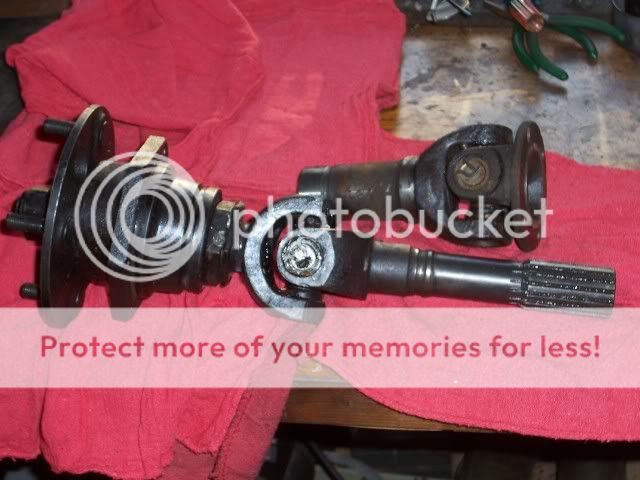
I'm trying to remove the rear axles on my TR250 to replace U-joints, boots, and install a pair of rebuilt hubs.

So I've got the flange disconnected from the differential (which is actually off the car already as it is about to have new seals and bearings installed) and the 6 nuts on the trailing arm end have been removed.

Now I didn't expect them to just pull through with ease but these things seem like thery're not going to budge!

I really don't want to mangle the flanges by banging on them, which I can do failrly easily with the diff out of the way, so any hints, ideas, solutions, or prayers are welcomed!
 
Are you saying that you can't pull the hub and outer section of the splined shaft thru the TA ?
100_1233.jpg
 
Make sure the half-shaft isn't hanging, without the end attached to the diff it could hang up in the trailing arm. Also, the mount for the parking brake cable (if the TR250 is like the 4A) can catch.

If that isn't the problem, maybe put the wheel back on, and use the extra leverage to rock it back and forth a bit?
 
Exactly. I'm trying to pull the whole thing, hub, half-shaft, flange through the TA. Didn't want to seperate the splines if I can avoid it.

Tire back on sounds like a plan.
 
Some light tapping with a rubber mallet on the brake backing plate may break things loose. You won't hurt anything and it should not take much tapping.
 
RagTopMan said:
Didn't want to seperate the splines if I can avoid it.

Why?? There's one of the splines that's fatter then the others, so it's impossible to put it back incorrectly where the joints would be out of phase.

Besides, you can then clean off all the old grease and slather on some new stuff.
 
I found that curious too.
Here's the spline alignment that Art was talking about.
TR6AXLESPLINES.jpg
 
heck go for the CV up grades from goodparts, its makes driving sooooo much more fun and no TR Twitch, and when I get my nissan 200 differential installed (see my post) I here no more CLUNKING from the rear end, and would be nice to put that 200 HP I have now to good use.

Hondo
 
Thanks everyone, especially for the heads up on seperating the splines. I'll be sure to clean and grease them now.

The axles took some tapping with a screwdriver, replacing the tire, laying under the car and stomping on the tires, pushing outward (yes, the car is 4 jack stands placed on a level concrete slab) and they finally broke lose. Fun morning!
 
OK. So I am cleaning up the first of the axle assemblies. U-joints, flange, hub, boot, gaiter, etc. all removed.

Under the center gaiter, where I thought would find splines that are separated by pulling the two ends apart, I find that that the two ends are screwed together. One half has male threads the other a cap with female threads that screws the two halves together.

Presumably I can unthread the fitting and then pull them apart but I can't find a picture or diagram of this anywhere and just want to be sure I'm not going to ruin a seal or open something that shouldn't be opened. And if this assembly isn't normal, do I have a "modern" replacement axle as I've seen referred to before? If so, is it safe to open so I can clean it up and re-grease?
 
I've seen that axle shaft before on a friend's 72 car..It was like that only on one side.
The arrangememt serves as a "dust shield". Presumably to be used with out the gaiter. Once unscrewed it's the same sliding spline arrangement that you see in the manuals and my photos
 
poolboy said:
I've seen that axle shaft before on a friend's 72 car..It was like that only on one side.

Seems the same for me as well. I just cut the gaiter off of the other axle and found the "normal" splined connections without the screwed cover.

I take it there should be no harm in having the two different axles? They do indeed seem the same save for the connection point.
 
The axles with the screw caps were original to the TR4A and did still have gaiters used with them. Although they aren't pictured in the TR4A SPC, the part numbers are listed.

140750 End cups (2)
140751 Washer, steel (2)
140752 Washer, cork (2)

Fitted to outer axle shaft yoke assembly

No issues with unscrewing them and separating the shafts. Note that they are interchangeable with the TR6 ones which didn't have the caps but which did come with a boot to protect the inner u-joint.

TR6 rear axle

Scott
 
>>If so, is it safe to open so I can clean it up and re-grease?
No one has posted to this since 2012 ?
I suppose everything went as planned.
I am at the same point as RagTopMan stopped.
I have the spline seal off and removed the cork seal and metal ring.

My problem is the cork ring is just in pieces and that seal just was not working.
No one seems to have that cork seal - I should be able to make one from an o-ring. to get away from the cork.
Anyone else done this ?

Any recommendations on ...
a) modern grease to go back in the spline and under the gator.
b) interval for renewing the grease in the spline ? 12k, 24k miles ?

My 67 TR4A with 144k mi looks like it had never been rebuilt.
Is this possible or does this area need routine TLC ?


After you take them apart and clean the old grease out, check for slack in the splines. Even with lots of grease they can make a clunk sound if there is lots of play. If you deem not very much then put a good silicone grease in there and if you can find a large "O" ring that would be better than cork. Do not add too much grease, this will cause a compression problem, there much be room for a air space or it will blow the seal.
144K miles and never been apart, must have lots of metal slug in there, clean it up and wash it down a lot.

Wayne
 
Back
Top