

 Hey Guest!

 Hey - did you know if you click on the title of a thread it will take you to the first unread post since you last visited that thread?
 but were afraid to ask:
  STOP!! Never post your email address in open forums. Bots can "harvest" your email! If you must share your email use a Private Message or use the
  smilie in place of the real @
 Pretty Please - add it to our Events forum(s) and add to the calendar! >>


Offline
Back before folks doctored up their photos:
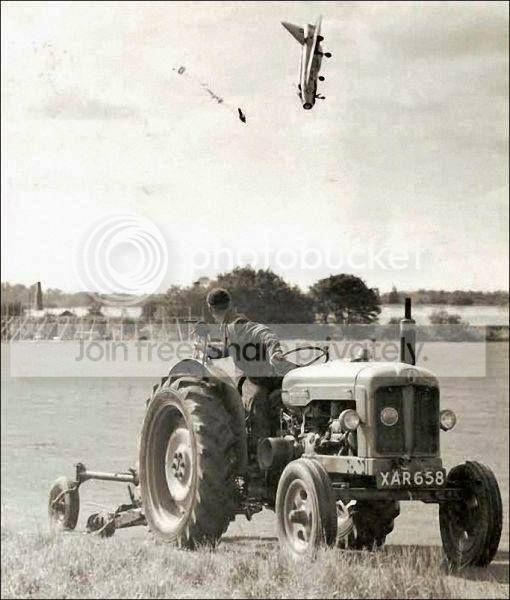
"In 1962, test pilot George Aird ejected at a very low altitude from his Lightning F1.
The tractor driver was 15-year-old Mick Sutterby, who spent that summer working on the airfield. He was telling the photographer, Jim Mead, to move on, because he shouldn’t be there. Mead saw the plane coming in and the nose pitch up. Then Aird ejected and Mead says he had just enough time to line up the shot as the Lightning came down nose first. George Aird landed on a greenhouse and fell through the roof, breaking both legs as he landed unconscious on the ground. The water from the sprinkler system for the tomatoes woke him. He’s reported to have said that his first thought was that he must be in heaven.
Years later, Sutterby sent this email describing the situation:
From: Mick Sutterby
Subject: Re: Lightning aircraft crash at Hatfield
Date: Thu, 19 May 2011 20:16:41 +0100
I followed my father into work at de Havilland, Hatfield in 1954 when I was 15. My father was the foreman in charge of the aerodrome and gardens. My job in the summer was gang-mowing the airfield and at the time of the crash in 1962 the grass had stopped growing and we were trimming round the ‘overshoot’ of the runway with a ‘side-mower’.
I stopped to talk to a chap with a camera who was walking up a ditch to the overshoot. I stopped to tell him that he shouldn’t be here, I heard a roar and turned round and he took the picture! He turned out to be a friend of the pilot and had walked up the ditch to photograph his friend in the Lightning. I saw some bits fly off the plane before it crashed but it was the photographer who told me he had ejected.
There was not a big explosion when it crashed, just a loud ‘whhooooof’. I was about 200 yards from the crash scene. I saw men running out of the greenhouses and checking the scene of the crash. The works fire brigade were on the scene within a minute. Somewhere at home I have a picture of it burning. Although the picture shows it nose diving to the ground, in fact it was slowly turning over and it hit the ground upside down nose first.
I was later told that if the pilot had ejected a split second later he would have ejected himself into the ground. I was very lucky. If I had known he was coming into land, I would have been positioned near the ILS (Instrument Landing System) aerial which was only 20 yards or so from the crash site! I believe the photographer had his photo restricted by the Air Ministry for – I think – about 3 months because the plane was secret.
He then took it to the Daily Mail who said it was a fake. The photo was eventually published by the Daily Mirror. From there it went round the world, and I remember seeing a copy in the RAF museum at Hendon. I recollect the photographer usually photographed hunting scenes for magazines like The Field. I recollect that the pilot broke his legs but really was very lucky. I hope this is interesting. All from memory!
Best wishes,
Mick Sutterby
The result of the accident investigation:
“Whilst carrying out a demonstration flight, there was a fire in the aircraft’s reheat zone. Un-burnt fuel in the rear fuselage had been ignited by a small crack in the jet pipe and had weakened the tailplane actuator anchorage. This weakened the tailplane control system which failed with the aircraft at 100 feet on final approach.”
"In 1962, test pilot George Aird ejected at a very low altitude from his Lightning F1.
The tractor driver was 15-year-old Mick Sutterby, who spent that summer working on the airfield. He was telling the photographer, Jim Mead, to move on, because he shouldn’t be there. Mead saw the plane coming in and the nose pitch up. Then Aird ejected and Mead says he had just enough time to line up the shot as the Lightning came down nose first. George Aird landed on a greenhouse and fell through the roof, breaking both legs as he landed unconscious on the ground. The water from the sprinkler system for the tomatoes woke him. He’s reported to have said that his first thought was that he must be in heaven.
Years later, Sutterby sent this email describing the situation:
From: Mick Sutterby
Subject: Re: Lightning aircraft crash at Hatfield
Date: Thu, 19 May 2011 20:16:41 +0100
I followed my father into work at de Havilland, Hatfield in 1954 when I was 15. My father was the foreman in charge of the aerodrome and gardens. My job in the summer was gang-mowing the airfield and at the time of the crash in 1962 the grass had stopped growing and we were trimming round the ‘overshoot’ of the runway with a ‘side-mower’.
I stopped to talk to a chap with a camera who was walking up a ditch to the overshoot. I stopped to tell him that he shouldn’t be here, I heard a roar and turned round and he took the picture! He turned out to be a friend of the pilot and had walked up the ditch to photograph his friend in the Lightning. I saw some bits fly off the plane before it crashed but it was the photographer who told me he had ejected.
There was not a big explosion when it crashed, just a loud ‘whhooooof’. I was about 200 yards from the crash scene. I saw men running out of the greenhouses and checking the scene of the crash. The works fire brigade were on the scene within a minute. Somewhere at home I have a picture of it burning. Although the picture shows it nose diving to the ground, in fact it was slowly turning over and it hit the ground upside down nose first.
I was later told that if the pilot had ejected a split second later he would have ejected himself into the ground. I was very lucky. If I had known he was coming into land, I would have been positioned near the ILS (Instrument Landing System) aerial which was only 20 yards or so from the crash site! I believe the photographer had his photo restricted by the Air Ministry for – I think – about 3 months because the plane was secret.
He then took it to the Daily Mail who said it was a fake. The photo was eventually published by the Daily Mirror. From there it went round the world, and I remember seeing a copy in the RAF museum at Hendon. I recollect the photographer usually photographed hunting scenes for magazines like The Field. I recollect that the pilot broke his legs but really was very lucky. I hope this is interesting. All from memory!
Best wishes,
Mick Sutterby
The result of the accident investigation:
“Whilst carrying out a demonstration flight, there was a fire in the aircraft’s reheat zone. Un-burnt fuel in the rear fuselage had been ignited by a small crack in the jet pipe and had weakened the tailplane actuator anchorage. This weakened the tailplane control system which failed with the aircraft at 100 feet on final approach.”


