• Hey Guest!
    British Car Forum has been supporting enthusiasts for over 25 years by providing a great place to share our love for British cars. You can support our efforts by upgrading your membership for less than the dues of most car clubs. There are some perks with a member upgrade!

    **Upgrade Now**
    (PS: Upgraded members don't see this banner, nor will you see the Google ads that appear on the site.)
Tips
Tips

Idle Too Fast

KVH

Obi Wan
Silver
Country flag
Offline
Now I have this pleasure, too. Suddenly 1800 RPMs at every stop light; I can lower it by flicking the throttle pedal a few times; I tried oil on the shafts; no luck.

I know there's a fix, but can't remember it. I'll check the points but it's more likely something else.

Bad capacitor? Dashpot oil?
 
KVH, bad linkage or ball sockets need adjustment and some silicone grease on them after taking them apart for cleaning.

Wayne
 
If the problem stops every time you kick the gas pedal, I sure agree it's linkage sticking somewhere.

Question: does the engine *speed up* to 1800 rpm at the stop light? Or was it already at 1800 and *sticks* there at every stop light?

Tom
 
Might be an ignition timing problem (advance sticking), but I agree throttle is more likely.

In addition to the linkage binding, it's possible for the throttle plates to bind. On my 3A I eventually traced the problem to the shaft bushings being so worn that the throttle plate was dragging on the bottom of the bore.
 
Great question and responses. I am having the same issue and was thinking it was the spring tension on the throttle shaft return springs. I was not really considering or thinking that it could also be the ball socket area. I will need to check this out and at least make sure I add some grease.

Thanks,

Steve
 
Have a friend who, every time he checks the oil on his TR3A, touches the end of the dipstick to each of those ball joints.

I did have some bad wear on mine that would allow the ball to pop out of the joint at inopportune moments (usually hard acceleration). Someone (same friend) showed me how adding a thin washer under the ball part would cause it to tighten 90° off from where it had been before -- Voila! has never popped off again.
 
...

I did have some bad wear on mine that would allow the ball to pop out of the joint at inopportune moments (usually hard acceleration). Someone (same friend) showed me how adding a thin washer under the ball part would cause it to tighten 90° off from where it had been before -- Voila! has never popped off again.

hmmm - great idea. Any possibility of seeing the modification, or a sketch of it?

Thanks.
Tom
 
The throttle plate bind is interesting. I would not have thought of that. I get a high idle at nearly 1,100 RPM and when I "snap" the throttle quickly, it will settle down to 750 RPM.

Bob
 
As it happens, I'm working on mine again. Same problem as before, the throttle shaft was drilled just slightly off, so the throttle plate cannot be centered with the idle lever firmly against the side of the body. It's hard to see the motion, but the shaft has to move a few thousandths to the rear for the throttle plate to close entirely. Who knew it was so critical! I put in a .010" shim last time, but it's looking like I should have gone to .025" instead. Oh well, back to the garage.
 
The throttle plate bind is interesting. I would not have thought of that. I get a high idle at nearly 1,100 RPM and when I "snap" the throttle quickly, it will settle down to 750 RPM.

Bob
If your carbs have a throttle bypass valve, it could be that the diaphram within it is hardened and not responding to the vacuum.
That 200 rpm difference is about what you can expect in that situation.
 
I just disassembled and reassembled with lots of care, grease and oil and the problem is unchanged. Every single time I flick my foot on the throttle the idle comes back down but I can't see where it's binding. Must be some mystery if not the butterfly off center like Randall said. Any easy things I'm missing?
 
KVH, You put a lot of work into getting all the leakage right and I feel sure it was not a waste of time, just sorry itg didn't help with the initial problem. Now, what I have in mind is a bit of work. Get the idle to stay up, cut the engine off and slowly take the four nuts of each carb, while doing this listen for a click or any movement. What we are doing is checking out the butterfly being in a bind or a piston sticking. Something is going to move, just be ready for it.

Wayne
 
KVH, You put a lot of work into getting all the leakage right

Yeah, but he should have been working on the linkage!

What happens if you push down firmly on the idle stop screws with the engine idling fast? Also, I lost track, have you checked that the timing is coming back down when it should?

Too soon to say for sure, but preliminary results with the thicker spacer seem very good. I only managed to drive a few miles before I had to tend to SWMBO, but the idle seemed rock-solid (if still a bit too fast, about 1100 on the tach). But it mostly acted up only when the engine was really hot, so I won't know for sure until the next traffic jam.
 
Pushing the idle screws down doesn't change anything. I'm wondering if the connecting shafts between the two carbs are binding in the carb housings. Not the throttle shafts but the jet lever connecting rods. I confess I didn't remove and grease those. I think the carbs have to come off to get those out. There's no space otherwise. However, if pushing the screws down doesn't change anything, I guess it can't be those either.

I had a hunch it was one of three things: a) the throttle spring catching on the long linkage rod; b) the connecting shafts binding in the carb housings; or c) carb jet needles binding and hanging up. But I guess it can't be "a" or "b" since, as stated, pushing the screws down does nothing.

That leaves "c" and I suspect you'll say it can't be that either.

What about this: None of this idle speed problem existed before I had the choke on a week ago and had left the car idling for a good 15 minutes. It didn't overheat but it was hot. Anyway this is related to the choke?

I think I need to chase this down more carefully.
 
I would confirm each carb's pistons/needles are dropping completely and smoothly with a definite click at the end of the travel.

I seem to remember have the same problem after rebuilding the carbs, I needed to center the needles again once everything bedded in.

Since the choke lever does move the jet, the cork gasket rings may have shifted.
 
That's the area I would be looking at, as well. I assume that, if pushing on the idle screws does nothing, then neither does lifting the pedal with your toe. That sure seems to eliminate the linkage as a suspect.
 
Why does it come down if he kicks the throttle, that is my concern, as with most intermittent problem, it has to be happening to find it. That is why I said what I did. Not that all these other things could not be the problem, it just doesn't fit the mold to be so easily ratified with a kick of the throttle.

Wayne
 
I've been told its far more likely that the butterfly is sticking than that the jet needle is sticking, does that sound right?
 
I would think the opposite actually. In my opinion, the jets not being centered is fairly common, every time the choke is used it moves the jet up and down. If the outer jet surface is not smooth or if the cork gaskets swell/shrink there is potential for misalignment. A slight misalignment will usually show itself at the lower end of the travel when the needle is at its largest diameter, hence the problems with idling but running ok otherwise.

Much easier to check if the pistons are falling completely, just remove the air cleaners and lift up to watch their movement as they fall. Servicing the butterflies would involve removing the carbs??

See nice how to video

https://www.youtube.com/watch?v=sxVFCY_1aSA
 
I installed my heat shield (Randall, thanks for the pic), but it was in contact with my linkage in three spots, so I took it back off. I then cleaned and adjusted everything again, including centering of the jets. The pistons drop down nicely with a metallic click.

So, after three assemblies and re-assemblies (I tried the heat shield twice), I went for a drive.

Here's what happened. The idle raced, and even seemed to accelerate between shifts. At one stop light I was idling at 2000 before kicking the throttle. Each time I kick the throttle, the idle comes back down. Over twenty hours of messing around has got me nowhere. I'm back where I started.

I've looked again at the linkage. It does appear I'm binding after all. Pushing with a long screw driver, on the same lever where the little throttle springs go, does seem to knock the speed back down. And it's both sides. Here's a picture of the lever I seem to be able to move--stock pic, not mine.
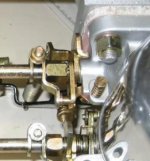
HS63.jpg

What's the deal? Why all of a sudden and all this hassle? Also, is WD40 not good enough to loosen the bind here? Some magic grease needed? I'm inclined to suspect it's more than a grease issue.

 
Last edited:
Back
Top