
• Hey Guest!
    British Car Forum has been supporting enthusiasts for over 25 years by providing a great place to share our love for British cars. You can support our efforts by upgrading your membership for less than the dues of most car clubs. There are some perks with a member upgrade!

    **Upgrade Now**
    (PS: Upgraded members don't see this banner, nor will you see the Google ads that appear on the site.)
Tips
Tips

I Hate FRACKING Brake Fluid!!!

angelfj1

Yoda
Country flag
Offline
Spring tune-up day. Where the frack did all the brake fluid go?
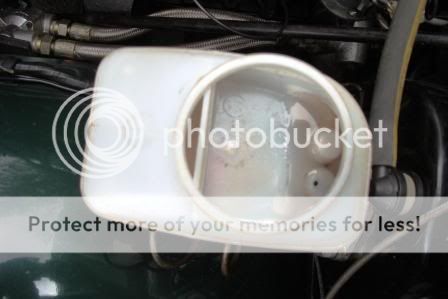
DSC02067-sml.jpg


Oh! This might be it. Looks like the fluid has leaked out around the base of the switch. I really hate brake fluid!
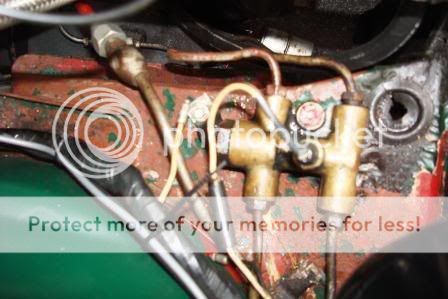
DSC02068-sml.jpg


Is this a common problem? Can I just plug this off? Anyone know the thread size?

Argh! I HATE BRAKE FLUID!!!
 
Sorry to see that.

No, you can't just plug it off. Well, not if you want to maintain a dual circuit brake system anyway. The issue is not the switch, it is a set of tiny seals on either end of a shuttlecock inside the body. If the switch nose is wet, your seals are shot and it is not doing what it is supposed to (keep the circuits split in the event one side fails).

This is precisely why I've switched to silicone fluid. I had a similar issue with one of these PDWA thingies. There was a burr on the brass seat face and it would not seal against the flare.

I threw it as far as I could, then cut it in half with a bandsaw for good measure. :smile:
 
Fix it,not hard. Send it to Paul and have it Blingized!
 
The PDWA is only a warning device. You can loose fluid thru the electrical switch as you have found. However it is not a portioning valve.
I do not recommend disabling the warning switch because it will warn you by the light on your dash if you have a front or rear loss of brake fluid.
The shuttle inside the PDWA has the O-rings that are supposed to keep the brake fluid out of the switch.
Your brakes will still work properly without the shuttle or the actual switch, but you will no longer have the warning if you should loose fluid.
 
Frank - Why not send them to the expert of all experts? His name is Petro and he lives in Puerto Rico. Dale can tell you haw to contact him !
 
Frank,

It's also why I switched to silicone fluid in the clutch and brake system.
 
Don Elliott said:
Frank - Why not send them to the expert of all experts? His name is Petro and he lives in Puerto Rico. Dale can tell you haw to contact him !

Don,
I believe his name is "Pedro" and after he sold Dale the TR6, he moved to NJ to sell sub prime mortgages. He's now retired and living on the big island of Hawaii, drinking Pina Coladas and smoking Cuban cigars.

.
 
poolboy said:
The PDWA is only a warning device. You can loose fluid thru the electrical switch as you have found. However it is not a portioning valve.

Never said it was a proportioning valve. It is not just a warning device; it also keeps the circuits separate in the event of pressure loss on one half, so you maintain fluid. The warning light tells you there is a problem, but the shuttle inside also keeps the circuits separate.

If fact, it is a crude valve, you either get 50/50 or 100/0 between the circuits.
 
Tom: Maybe I'm getting thick in the head. The master was full of fluid in October when the 250 went into hibernation. The engine was not started until this weekend when I noticed the fluid loss. So, when the seals (o-rings) go bad the switch cavity is at the same pressure as the hydraulics. Is that correct? So without touching the brakes, over several months, all of this fluid flowed out of the master by gravity?
 
The seals in the PDWA valve are notorious for leaking but so also is the seal between the master cylinder and the brake servo unit. Perhaps some of that fluid worked its way back into the servo and will soon be oozing down your brake pedal.
 
Scott_Hower said:
Never said it was a proportioning valve. It is not just a warning device; it also keeps the circuits separate in the event of pressure loss on one half, so you maintain fluid. The warning light tells you there is a problem, but the shuttle inside also keeps the circuits separate.

If fact, it is a crude valve, you either get 50/50 or 100/0 between the circuits.
Sorry, no! Search out, on this Forum, the thread entitled "Gonzo PDWA valve" starting 4/11/07.
 
huh?

The seal between the master cylinder and the servo?


Did you intend to mean the seal inside the master cylinder, which if left to leak long term, the fluid will enter the servo?

There is NO seal between the master cylinder and booster(servo) that is intended to keep brake fluid out. If there is a seal(models and years may vary) it is designed for vacuum retention purposes, not fluid impentration.
 
You are correct Ron, my comments were in regard to a leaky master cylinder.
 
Andrew Mace said:
Scott_Hower said:
Never said it was a proportioning valve. It is not just a warning device; it also keeps the circuits separate in the event of pressure loss on one half, so you maintain fluid. The warning light tells you there is a problem, but the shuttle inside also keeps the circuits separate.

If fact, it is a crude valve, you either get 50/50 or 100/0 between the circuits.
Sorry, no! Search out, on this Forum, the thread entitled "Gonzo PDWA valve" starting 4/11/07.

Andy - I'll have a look and I respect your knowledge.

But I have personally sectioned one of these valves lenghwise on a band saw and measured the distance the shuttle travels relative to the seals, the ports and the end stop with a micrometer. The shuttle seals the side leaking fluid from the one that does not in the event of failure, triggering the switch in the process. The valve body limits the shuttle end travel and the seals keep the ports split. Its purpose it to both warn of a failure (pressure differential) and keep the MC circuits separate.
 
One word of caution about refurbishing the PDWA on a TR-250, as opposed to a TR6.

Yes, the brass housing on a PDWA on a 250 and a 6 are identical and interchangeable. HOWEVER, Triumph used two types of shuttles inside the PDWA. The early shuttles did not use o-rings. Rather, they used a little cup-shaped rubber plug on each end of the shuttle itself. These are sadly not available. On later cars, the shuttle used nice plain vanilla o-rings. My car had an early type, and I was unable to find replacements for the cup-shaped plugs. I simply ended up getting a PDWA from a TR6, taking the shuttle out of it, confirming that it had o-rings instead of the cup seals, and then replaced the o-rings. Problem solved.
 
Scott_Hower said:
The valve body limits the shuttle end travel and the seals keep the ports split. Its purpose it to both warn of a failure (pressure differential) and keep the MC circuits separate.
FWIW, I think you're both right. The two circuits are always kept separate (assuming the seals aren't bad); but the failed outlet is left open to it's respective inlet.

That way, you still get 4-wheel brakes if it was just a momentary condition that caused the shuttle to move (like someone pushed a caliper piston back).
 
Back
Top
