• Hey Guest!
    British Car Forum has been supporting enthusiasts for over 25 years by providing a great place to share our love for British cars. You can support our efforts by upgrading your membership for less than the dues of most car clubs. There are some perks with a member upgrade!

    **Upgrade Now**
    (PS: Upgraded members don't see this banner, nor will you see the Google ads that appear on the site.)
Tips
Tips

TR2/3/3A How much is to much fretting?

GTP1960

Jedi Knight
Offline
Continuation from my Moss crank pulley problem.

the back of the crank shaft (undamaged) measured 28.53mm

the front, where the fretting is, measured 28.44mm

0.09mm shaved off.

I'm no engineer & don't have a feel for acceptable tolerances.
So I would appreciate your input.

i do know I'm going to try and find a better narrowbelt pulley solution to this problem though.
 
The answer is related to the inside diameter of the extension/hub you plan to put on it. Normally the OD of the crank should be .001 to .003" larger than the ID of the hub. You can get away with even sizes, though. The other issue with fretting is that it makes an irregular surface. In other words, when you measure the diameter, the mic is riding on the "highs" on the metal that were left as the old balancer rubbed back and forth. You get a larger than actual reading.

The best answer is that you need to try the new hub you plan to use on the crank. If it fits without being able to wobble it at an angle, then you should be alright. If you can easily slide it on the crank, and then grab the hub and rock it back and forth...then you have too much fretting to use the crank. If the hub is loose enough to rock after installation, then loctite is not going to fill in that much space.
 
If the hub is loose enough to rock after installation, then loctite is not going to fill in that much space.

John, I don't know if you read about the early Miata crank nose fix I posted in the other thread about this problem, but the Loctite 660 that's used in that repair is made to to take up large spaces of mauled up metal. It has worked well on many early Miata crank noses with fretting much worse than Guy's. I'm not saying that it's a sure fire repair, but if it were my car, I'd certainly give it a try.
 
The answer is related to the inside diameter of the extension/hub you plan to put on it. Normally the OD of the crank should be .001 to .003" larger than the ID of the hub. You can get away with even sizes, though. The other issue with fretting is that it makes an irregular surface. In other words, when you measure the diameter, the mic is riding on the "highs" on the metal that were left as the old balancer rubbed back and forth. You get a larger than actual reading.

Would that not make it an interference fit?

David
 
John, I don't know if you read about the early Miata crank nose fix I posted in the other thread about this problem, but the Loctite 660 that's used in that repair is made to to take up large spaces of mauled up metal. It has worked well on many early Miata crank noses with fretting much worse than Guy's. I'm not saying that it's a sure fire repair, but if it were my car, I'd certainly give it a try.

I've never had luck with fillers, but I also know the polymer technology progresses rapidly. I'd be game to try it if it saves both a crank and a full rebuild!

David, all the TR hubs I've played with have had a light interference fit. I could be wrong, in that only a slip fit was original. I'll study the manual to see if they list the dimensions...
 
I have always assumed that the balancing tabs were for the fan assembly, and not the hub. I say that since the hubs I have have balancing holes drilled in them. So...I personally don't think removing the fan will have any affect on the engine balance at all. I also doubt many of our fans are properly balanced, so I would even bet it would improve the overall balance.

The only thing you will loose is a bit of damping from the rubber mounts for the fan. I have read a lot of posts of owners running the hub with no fan and not experiencing any crank breakages...so I don;t think that amount of damping is significant either. I think you will be golden!
 
Guy,
I'm currently using the BPNW narrowbelt conversion.
It works well, but you need the fan extension to mount it or you will have no way to secure the crank pulley/hub to the crank nose.
I guess you could come up with some kludge using a huge thick hardened washer and a short bolt, etc, etc. But you will give up any dampening.
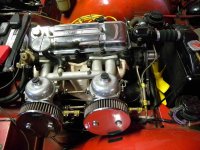
Here's the kit on a Tr4.

M.
 

Attachments

  • Tr4 narrow belt kit.jpg
    Tr4 narrow belt kit.jpg
    81.4 KB · Views: 144
I have always assumed that the balancing tabs were for the fan assembly, and not the hub. I say that since the hubs I have have balancing holes drilled in them. So...I personally don't think removing the fan will have any affect on the engine balance at all. I also doubt many of our fans are properly balanced, so I would even bet it would improve the overall balance.

The only thing you will loose is a bit of damping from the rubber mounts for the fan. I have read a lot of posts of owners running the hub with no fan and not experiencing any crank breakages...so I don;t think that amount of damping is significant either. I think you will be golden!

Just an FYI:, John,
here's a quote from Neil Revington that supports your reasoning re : harmonic dampening.


"A word about Harmonic dampers versus solid machined crank pullets
We don t usually use Harmonic dampers on the crank. If one is fitted to an engine we are working on and it is not giving problems we will leave it there.
I have raced my TR2 for over 30 years with a standard type crank without a rubber mounted pulley. I recon I have done 200,000 miles in the car a lot of which would be racing, hill climbs, sprints, rallies as well as fast road work and I haven t had a problem yet. The issue as I see it is that engine manufacturers go to a lot of trouble to design a harmonic balancer when an engine is designed to get rid of unwanted harmonics. Here is the clue; harmonics are frequency dependent so the damper has to eliminate specific frequencies. Obviously not all engines produce the same harmonics and therefor one damper does not fit all. In fact you could put a damper on and introduce unwanted harmonics! Who knows what if anything is right for a TR? I certainly don t, so I leave them alone.
Neil Revington"
 
Guy,
I'm currently using the BPNW narrowbelt conversion.
It works well, but you need the fan extension to mount it or you will have no way to secure the crank pulley/hub to the crank nose.
I guess you could come up with some kludge using a huge thick hardened washer and a short bolt, etc, etc. But you will give up any dampening.
Here's the kit on a Tr4.

M.

Merlin,

thanks for your input.
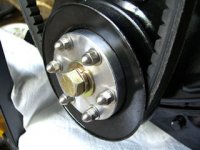
BPNW happened to have an orphaned narrow belt crank pulley (kit missing parts) I'm going to try with no dampening.
Also I found a site, "Patton Machine". That appears to make a quality fan eliminator kit.

D79E983B-D6C9-4792-BBEC-F771C4C800F2-544-0000013B08AA7C15.jpeg

so it only remains to be seen if my other narrow belt pulleys will line up.
 
Guy,
Just be aware that with the BPNW narrow belt crank pulley you must use the factory crank hub.
In your case that is probably a good thing.

M.
 
Back
Top