• Hey Guest!
    British Car Forum has been supporting enthusiasts for over 25 years by providing a great place to share our love for British cars. You can support our efforts by upgrading your membership for less than the dues of most car clubs. There are some perks with a member upgrade!

    **Upgrade Now**
    (PS: Upgraded members don't see this banner, nor will you see the Google ads that appear on the site.)
Tips
Tips

TR2/3/3A How is selector fork detent positioned relative to top cover overdrive svitch?

TuffTR250

Jedi Warrior
Country flag
Offline
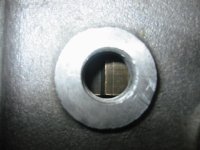
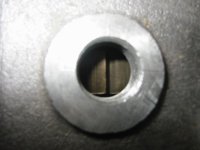
For the TR4 transmission in my TR3 I just got the transmission top cover drilled and threaded for the overdrive switches. The machine shop used the diagram from the TR4 manual for placement of the holes, and they are perfectly placed. The problem/question I have is that the "detent" in the 3rd/4th gear selector fork for the overdrive switch is almost 3/4 inch wide. (It is a Stanpart selector fork p/n 137387 with an AB2 below the part number.) As can be seen from the attached pictures the raised area that is supposed to turn the overdrive on in each of 3rd and 4th gear ends up positioned where the switch ball just barely gets pushed up, i.e. it rests on the very edge of the raised area. This seems as though it could cause intermittent overdrive switch problems after a bit of wear. Has anyone experienced this with the 3rd/4th gear selector fork? Is it possible, (or wise) to have the machine shop braze and machine the selector fork to make the detent about 1/8 inch shorter on each end of the detent?

BTW, the second gear switch is exactly over the top of the raised area on that selector fork and the detent moves correctly under the switch when shifted out of 2nd gear.
Regards, Bob
IMG_6448.jpgIMG_6449.jpg
 
Somewhere in one of the manuals, it talks about the point where the switch closes being important (and gives the method for shimming the switch to get just the right engagement point). Makes sense to me that you wouldn't want the OD changing the main shaft speed while the synchro rings are trying to match the input shaft to the main shaft.

Only time I've had a problem is when the switch starts to fail. To me, replacing the switch is a lot safer than trying to re-engineer the design.
 
Last edited:
Thanks Randall! I see your point about not having the switch turn on too soon in the gear change process. And that could possibly happen if I added 1/8 inch material to each of the raised areas. But it sure seems that the ball of the switch should end up a bit more up on the raised area once the gear change is finalized, not just right on the edge of the raised area. Can you recall which manual addresses how to shim the switches to get just the right engagement point? I have seen discussion of using fiber washers to get the right height for the switch to ensure it turns on, but I don't recall seeing any discussion in my manuals about the correct point of engagement. Thanks!

I noticed in the Buckeye Triumph's article "Adding OD Isolator Switches to Gearbox Top Cover" that he mentions that "building up the top of the fork is the best solution for us users if we get the hole for the switch slightly off center or the switch become erratic due to wear". However, he says his fit was ok so he took no action. His article showed measurement of the detents in the shifter rod but did not show where the raised area of the fork fell within the siteline of the switch hole in the top cover.
Regards, Bob
 
Found it. TR3 workshop manual, in the section on enabling OD in 2nd gear.

 
Thanks Randall! This morning I adjusted new OD switches as per the manual page you sent. As mentioned before, the middle of the ball of the switch is setting just on the edge of the raised area for both 3rd and 4th gears. In 3rd gear a very very slight more of the ball is up on the edge than when in 4th gear. In 4th gear I can wiggle the gear shift handle forward slightly and the continuity tester drops. In 3rd gear I can not shut off continuity by wiggling the gear shift handle unless I completely take it out of gear. I have tried setting the switches lower in the holes, and I've tried increasing the pressure on the detent screws, but neither helped the situation. So I've concluded that 3rd is marginally ok, whereas 4th is not. I believe I have to do something with the selector fork to get both 3rd and 4th working reliably.
Regards,
Bob
 
Thanks Randall! This morning I adjusted new OD switches as per the manual page you sent. As mentioned before, the middle of the ball of the switch is setting just on the edge of the raised area for both 3rd and 4th gears. In 3rd gear a very very slight more of the ball is up on the edge than when in 4th gear. In 4th gear I can wiggle the gear shift handle forward slightly and the continuity tester drops. In 3rd gear I can not shut off continuity by wiggling the gear shift handle unless I completely take it out of gear. I have tried setting the switches lower in the holes, and I've tried increasing the pressure on the detent screws, but neither helped the situation. So I've concluded that 3rd is marginally ok, whereas 4th is not. I believe I have to do something with the selector fork to get both 3rd and 4th working reliably.
Regards,
Bob
Yup, given that description, I agree. But I would add only a very small amount to the ramp for 4th gear, perhaps .030" or so. And since the forks are bronze (IIRC), maybe use a lower temperature hard solder instead of braze.
 
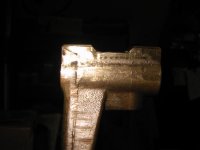
I had the machine shop add and machine a little brass on each side of the 3rd/4th gear selector fork so the overdrive isolator switch now sets just on top of the flat raised area when shifted into gear. This is a lot better than setting right on the very edge of the raised area. In bench testing I do not lose continuity in 4th or 3rd even if I strongly wiggle the gear shift. To me it seems to work as it should with the middle of the ball of the isolator switch just up on the flat of the raised area. And the switch turns off quickly when moved out of gear. See attached picture of the revised fork.
Regards, Bob

IMG_6459.jpg
 
Back
Top