• Hey Guest!
    British Car Forum has been supporting enthusiasts for over 25 years by providing a great place to share our love for British cars. You can support our efforts by upgrading your membership for less than the dues of most car clubs. There are some perks with a member upgrade!

    **Upgrade Now**
    (PS: Upgraded members don't see this banner, nor will you see the Google ads that appear on the site.)
Tips
Tips

HELP! something broke in the rear end...

I disagree to some extent. Based on advice from Hardy Prentice and others, I removed and installed my Stag's carrier without benefit of a case spreader, and it wasn't too hard at all. In my case, although the carrier bearings were fine, I replaced them (and the shim packs) anyway. It was very snug going in (as it should be), but tapped right into place (with a brass hammer). And although the details vary somewhat, the basic differential is the same.

And disturbing the shims and/or changing the bearings adds a major portion of effort, in my opinion. I spent more than four hours just working on getting the shim packs right; and I was lucky that the new pinion bearing was identical in thickness to the old one.

(I ground out the id of the old bearings and used them for selecting shim packs. Unfortunately the new head bearing was significantly thinner than the old one, so it wound up taking me 10 or 12 tries to get the preload just right.)

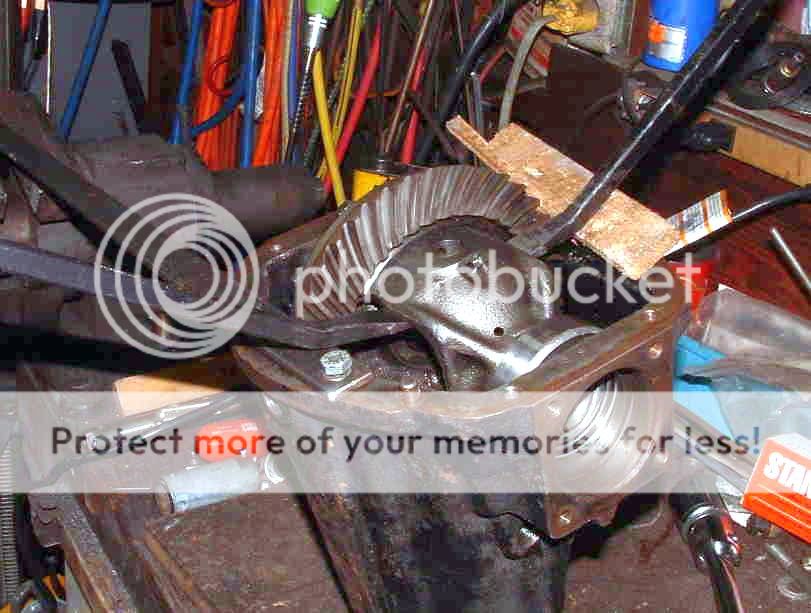
Here's a shot of the carrier coming out:

DSCF0067crop1.jpg
 
Ok... Crafty guys don't need the case spreader.
Still -- not a job for the timid.
Though, neatness of workbench doesn't seem to be a prerequisite.
:whistle:
 
Moseso said:
Though, neatness of workbench doesn't seem to be a prerequisite.
Guilty as charged. No one has ever accused me of being neat! (Part of the reason I prize my amateur status, no professional would ever be allowed to work as I do.)

Tho to be fair, a lot of what shows in that photo is actually hanging on the wall to the left of the bench and on the "shelf" behind the bench.

Didn't save the link, but I saw a series of photos recently where a diff carrier apparently got removed and replaced in a hotel parking lot! Desperation is the mother of invention or something like that.
 
TR3driver said:
... no professional would ever be allowed to work as I do...

I guess you've never been to John Esposito's shop. (Quantumechanics). :shocked:
 
Eric,


Here is the "why" the carrier should come out:

When an axle breaks like yours did, it is like a wound spring popping. Little chunks of metal likely were slung out. What concerns me is that these little chunks of metal are sitting in the axle tube, just outside of the carrier bearing on that side. More tiny filings were left when the broken stubs ground against each other after the break.

Here's what I would suggest:

Use a good flashlight and look down the outside of the axle tube on the side that broke. You are trying to look all the way to the carrier bearing, and you are looking for bright colored chunks of metal, or even tiny filings from the broken parts grinding against each other. They should stand out against the black grunge coating the tube.. If you see ANY at all, the carrier must come out to remove them. If you don't remove them, they will eventually get caught up in the bearings and gears...and the axle will then start the tell-tale "whine", signalling a total rebuild.

I have never had much trouble just pulling the carrier and putting it back. It is a tight fit, but it can be done without much difficulty. Undo the four bolts...2 on each side. You will then have to tap the bearing caps to loosen them. These caps MUST go back on the same side and same orientation as they come off.

A crow bar like Randall shows will get the carrier out...and a big mallet will work it back. You do not need to change the shim packs, unless you have to change the bearings. If it was working right before, then it will operate just the same if you reinstall everything the way it came out. That's the beauty of it having a tight fit.

Just remember, as the carrier comes out, the shim packs and bearing races, which are on each side of the carrier bearings, will fall out, and they have to go back on the same side. Good idea to have someone with you as it comes out, just to watch the shims and races, and label them right away. (I know that if I even set them down for a minute, I start talking myself out of which is which!?!) The shims set the position of the gears, and have to stay the same or you will get gear noise and the ring and pinnion gears will wear quickly after that.

Now, while the carrier is out, the important thing to do is to use magnets, kerosene, brake cleaner, rags...basically whatever it takes, to get every trace of metal out of the broke side axle tube. This is very important, so plan to spend some time working on it.

Once you are absolutely sure all is clean. You can reinstall the carrier. Place the bearing races first, and then the shims, on their respective sides. You have to hold them in position, on the outside of the carrier, as you lift the carrier up and into the housing. You can usually wedge it in a short distance, and then tap it in with a mallet or using a wood block and hammer. Watch the shims as you go to make sure they do not get hung up and damaged. You may have to tap them in slightly before reinstalling the caps.

If you have trouble with the above method, then start over. This time just slip the carrier in easily, by leaving out the larger of the shims. Once the carrier is in place, tap it away from the side you left the shim out...and then gently tap the shim into place using a drift. This method is easier, but you must be VERY cautious not to bend or otherwise damage the shim. If it binds, stop and figure out why...don't force it.

Torque the caps to 35ft-lbs.

I won't kid you, setting a carrier up from scratch is one of the most difficult things you can do, and it requires some pricey tools. Luckily, you don't need to do that. You just need to take it apart and put it back the way you found it. This job requires no money, just time.

John

 
I mostly agree with John, except that on the TR axle, the carrier bearing shims go between the inner race and the carrier. The book shows that detail to be the same for the early axle as the later one. Thus there is no chance of them falling out as you remove the unit (or being damaged as you install it).

The downside is that, if you remove the inner races from the carrier, the shims will be damaged and need to be replaced. But as long as you leave the inner races in place, there should be no problem.

Installing the carrier on the bench is actually pretty easy. Just pick up a (clean) cup in each hand, position them over the (clean) cones on the carrier, then pick it up with a hand on each side. You can let the cups tip just a bit to get them started into the housing, then tap on alternate sides of the carrier, just like installing a cup into a wheel hub.

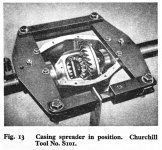
If you would prefer to use a spreader, it shouldn't be too hard to make one. Go over to Home Depot and look back in the construction materials department for a heavy flat iron stake (used to hold concrete forms in place), plus a couple of big turnbuckles with eyes on both ends. Cut the iron to length, drill to match the holes in the diff housing, plus holes at the end for bolts through the turnbuckle eyes.
 

Attachments

  • 27045.jpg
    27045.jpg
    84 KB · Views: 192
CJD said:
and it requires some pricey tools.
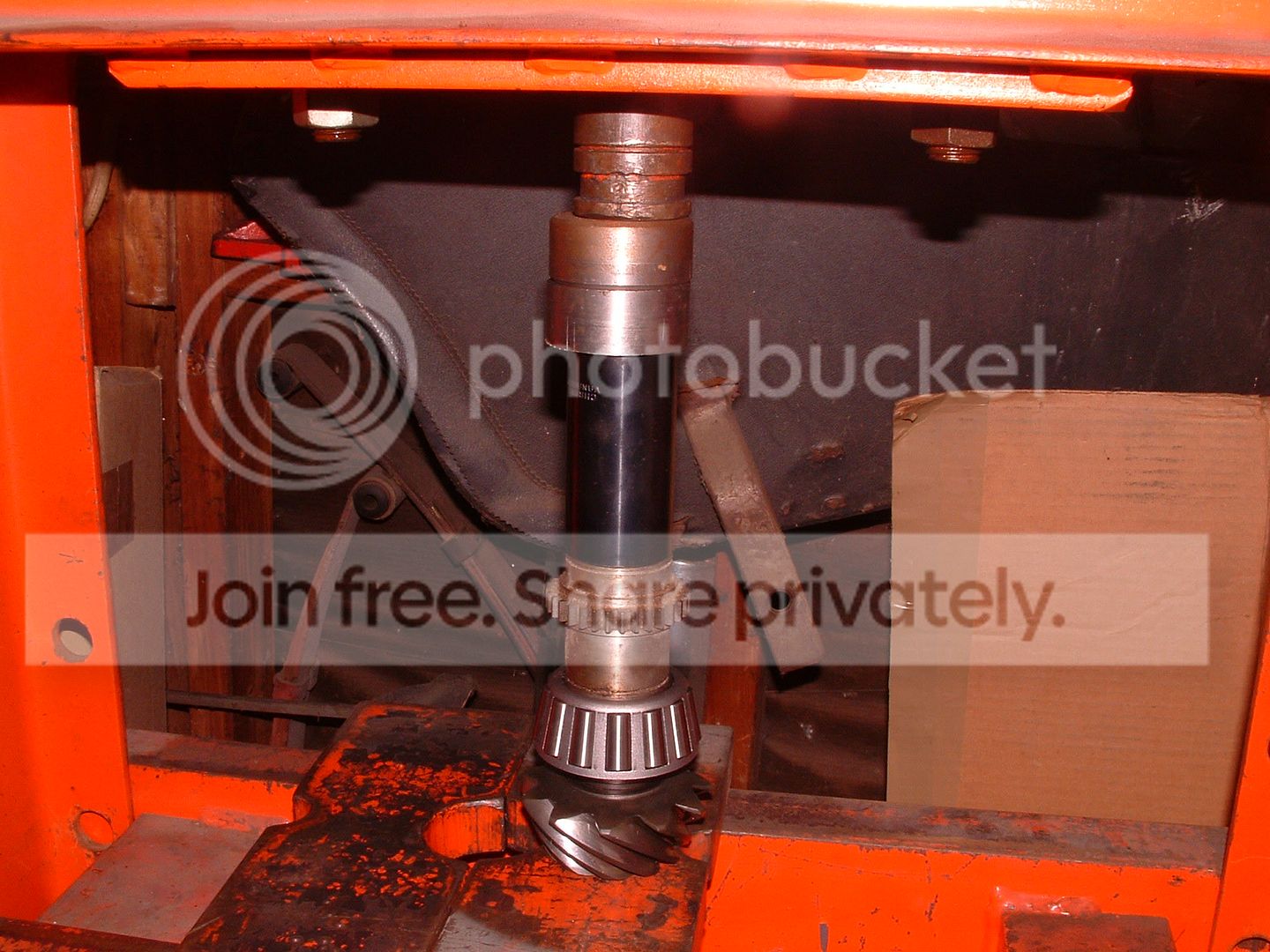
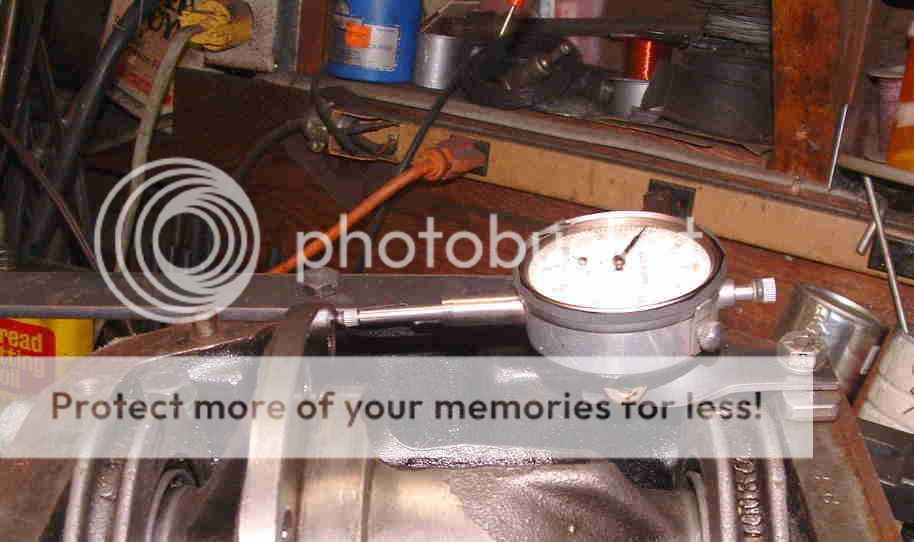
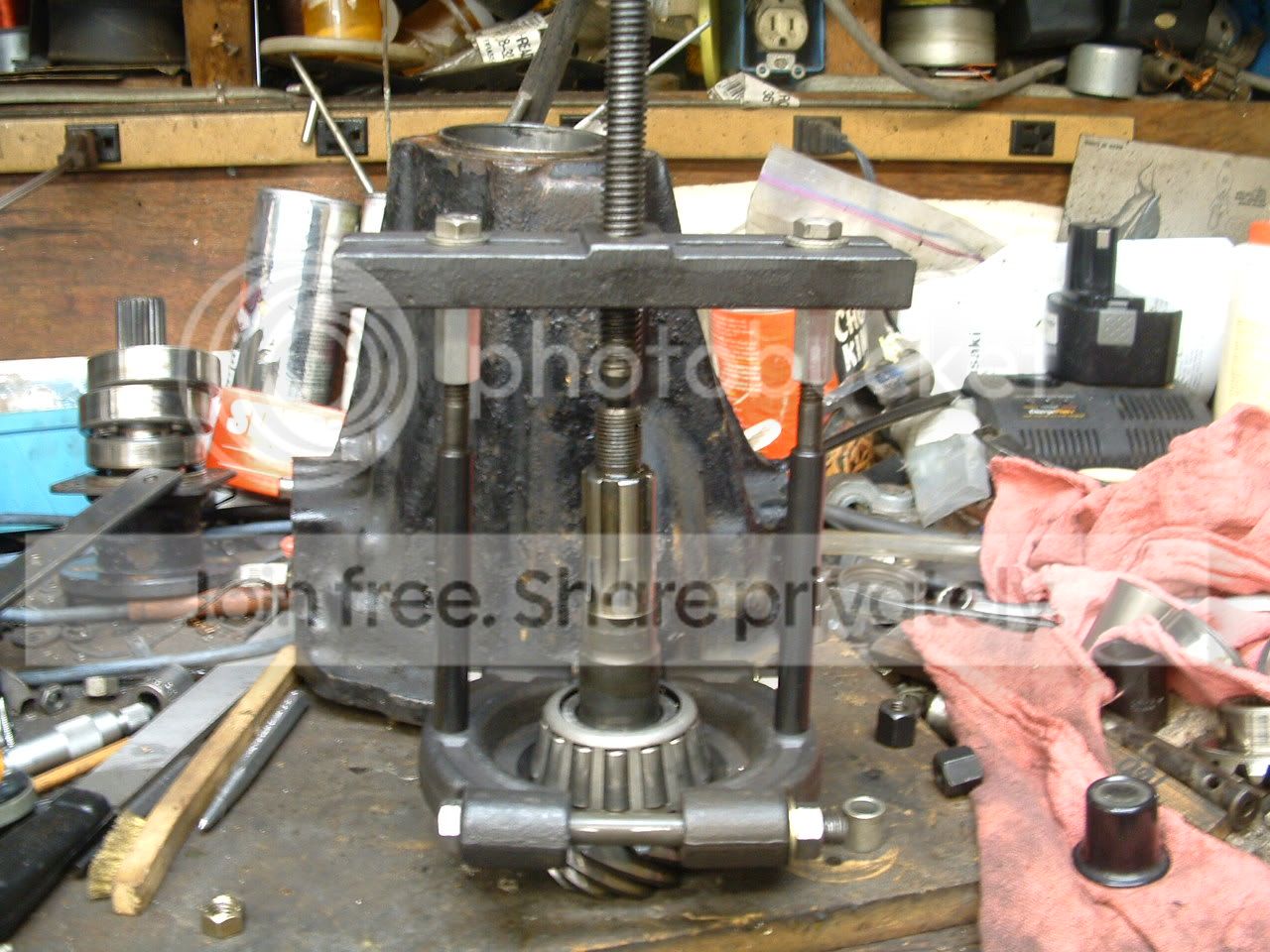
Let's see, the priciest tool I used was a $100 hydraulic press, followed by a $25 dial indicator.

DSCF0005.jpg


DSCF0051_CROP.jpg


Don't recall what the bearing separator cost offhand, but it's not what I would call a pricey tool.

DSCF0046.jpg
 
Alright, you've convinced me, I'll give it a go. No plans to take anything apart, the carrier assembly doesn't seem to have any slop in it, best I can tell. I will give it a go, hopefully tomorrow and let you know how it goes. If I find something strange upon closer examination, you can expect further questions at that point.

Wish me luck!

Eric
 
What are the odds? One breaks, and one shows up on ebay:
early axle

Just in case you need another one..
 
I have had good dealings with that eBay seller......
 
Eric,
I'm not sure what is wrong, but if I guessed it would be the pinion shaft in the differential drive. Also, I think the only difference between the early and late units are the axles themselves and hub assemblies. The banjo casing and differential gear units are the same (I think). I have several rearends and I'll make a measurement for you today and post later. Good luck.

PKPoole
______________
'58 MGA
'62 TR3A
'60 TR3A in progress
 
Thanks Randall...I stand corrected. And Eric...that's two less things to worry about keeping track of.

Best of luck today!

John
 
Back
Top