

-
 Hey Guest!
British Car Forum has been supporting enthusiasts for over 25 years by providing a great place to share our love for British cars. You can support our efforts by upgrading your membership for less than the dues of most car clubs. There are some perks with a member upgrade!**Upgrade Now**
(PS: Upgraded members don't see this banner, nor will you see the Google ads that appear on the site.)

Tips
- We have a special forum called "Member Articles" where you can submit actual articles for consideration for publication. Learn More
- Don't have an Avatar? If not, your avatar will default to the 1st character in your username. Go into "Account Details" to change your Avatar.
- Some basic forum navigation info: click
 Hey - did you know if you click on the title of a thread it will take you to the first unread post since you last visited that thread?
- Hey Guest - Is your British Car Club in our Clubs database? If not, send me a PM - Basil

- Looking for a local club? Click the "Clubs" tab above and browse hundreds of clubs world-wide.
- Add Android or iPhone APP: click
- Did you know - any picture or video you add in your posts in any marque-specific forum will also get added to the Media Gallery automatically.
- A few more tips about posting and replying: click
- Hey there Guest - be sure to keep your profile page up to date with interesting info about yourself: learn more
- More tips and tricks on Posting and Replying: click
 but were afraid to ask:
  STOP!! Never post your email address in open forums. Bots can "harvest" your email! If you must share your email use a Private Message or use the
  smilie in place of the real @
- Want to mention another member in a post & get their attention? WATCH THIS

- So, you created a "Group" here at BCF and would like to invite other members to join? Watch this!
- Hey Guest - A post a day keeps Basil from visiting you in the small hours and putting a bat up your nightdress!
- Hey Guest - do you know of an upcoming British car event?
 Pretty Please - add it to our Events forum(s) and add to the calendar! >> Here's How <<
- Hey Guest - you be stylin' Change the look and feel of the forum to fit your taste. Check it out
- If you run across an inappropriate post, for example a post that breaks our rules or looks like it might be spam, you can report the post to the moderators: Learn More
- If you would like to try some different "looks" or styles for the site, scroll to the very bottom, on the left and click the Style Selector.
You are using an out of date browser. It may not display this or other websites correctly.
You should upgrade or use an alternative browser.
You should upgrade or use an alternative browser.
Headlight Relay Question
- Thread starter RedTR3
- Start date

vivdownunder
Jedi Warrior
Offline
Can't hurt, but suggest going well overspec with the fuse amperage. Not ideal for the fuse to blow at the first hint of trouble and no headlights.
Fusing the headlight circuit cuts the risk of the wiring catching on fire in the event of a major short circuit.
Viv.
Fusing the headlight circuit cuts the risk of the wiring catching on fire in the event of a major short circuit.
Viv.


TR3driver
Great Pumpkin - R.I.P
Offline
I have had a headlight fuse fail while driving at 80 mph down a mountain, on a dark night. I would definitely suggest either using a fusible link instead, or having separate fuses for each side. My current plan is to actually use a separate circuit breaker for each side.
The fuse failure was eventually traced to some invisible corrosion on the fuse clip. Just enough to get hot after extended operation, and melt the solder inside the fuse.
The fuse failure was eventually traced to some invisible corrosion on the fuse clip. Just enough to get hot after extended operation, and melt the solder inside the fuse.

dklawson
Yoda
Offline
I have headlight relays in the Mini and the Spitfire. I used the readily available 30A Bosch/ISO relays you will find at the parts store (and cheaper on eBay). I have two fuses, one for the low beams, one for the high beams. Each is a blade type 15 Amp fuse. After more than a decade of use I have not had brighter headlights without any problems.

hondo402000
Darth Vader
Offline
well they say not to fuse head lights, but either way if you have a short the wire will turn in to a fuseable link at the place of highest resistance, and you will burn the wire into and then have a live wire dangling and with the chance of shorting and causing a fire, I would much rather have a fuse to blow. just add some driving lights so if you loose your head lights you will have driving lights to get you to a safe pull over spot.
I put relays on my headlights and have had no issues
Hondo
I put relays on my headlights and have had no issues
Hondo


Online
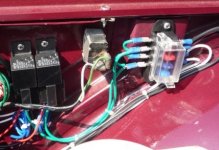
I added relays to my headlights a few months ago. So far everything is good; the lights appear brighter and I know the load is finally off of the switch.
I also added 4 fuses 2 for each low beam and 2 for each high beam. There really is no down side to fusing the circuit.
I also added 4 fuses 2 for each low beam and 2 for each high beam. There really is no down side to fusing the circuit.
Attachments

TR3driver
Great Pumpkin - R.I.P
Offline
A proper fusible link is designed so that does not happen. The ones that look like a length of wire use special wire and insulation; so the insulation does not burn even after the wire has melted.hondo402000 said:but either way if you have a short the wire will turn in to a fuseable link at the place of highest resistance, and you will burn the wire into and then have a live wire dangling
It's basically a very slow-blow fuse. It has to be replaced after a short, of course, but if properly sized, it will fail before the rest of the harness is damaged. Without a fusible link, the entire length of the wire gets hot enough to melt the insulation, long before the wire actually melts.
As John Herrera used to say, I have experimented with this. In fact, the short in the high beam wiring was what led to installing the relays on my TR3A, as I had to abandon those wires in the harness.


dklawson
Yoda
Offline
hondo402000 said:well they say not to fuse head lights,
While I know our old British cars typically do not have fused headlights, I have to ask "why". Why are headlights typically not fused and out of curiosity, who is "they" who say not to do it?
I chose to fuse my headlights when adding the relays as the headlight relay kits I've seen (the one sold by VB and the one from Advance Auto Wire (Dan Masters design)) include fuses. What is the argument against fuses?
TR3driver
Great Pumpkin - R.I.P
Offline
dklawson said:What is the argument against fuses?
I believe it is basically the same as I outlined above : fuses sometimes fail for reasons other than a short, leaving you without headlights. <span style="font-weight: bold">Very</span> disconcerting, especially if you happen to be on a dark winding road next to a cliff when it happens.
There is an additional reason, which I believe is the real reason TRs don't have them, which is because they add cost and complexity. Triumph Stags, for example, do have 4 headlight fuses from the factory.
Most American cars (since at least 1960 or so) use a thermal self-resetting circuit breaker incorporated in the headlight switch.
My 1970 Audi had 4 headlight fuses, and they did fail occasionally for no apparent reason. (In retrospect, I believe it was similar to the problem I had on the TR3A, where a marginal contact at the fuse holder was heating the fuse up until it failed.)
The wife's Toyota uses a single fusible link for the headlights.
dklawson
Yoda
Offline
I see your point and I too have had fuses fail (in other circuits) without an apparent short. Perhaps I'll switch to the circuit breakers instead of the blade fuses I'm using. But if fuses (without moving parts) fail without a short... what is the expected life and reliability of a circuit breaker? Regardless, as it is now I have separate fuses for the high and low beams. If I lose one fuse and its lights, at least I can switch to the other beam.
TR3driver
Great Pumpkin - R.I.P
Offline
dklawson said:what is the expected life and reliability of a circuit breaker?
All I have is anecdotal evidence, which of course proves nothing. But I have never seen a circuit breaker fail, unless there really was an overload.
The TR3 is still using the circuit breaker I bought in perhaps 1985 (which plugs into the fuse block in place of a fuse) and it worked as designed when I had a short last year.
The original circuit breaker for the Stag's power windows failed, but that was because the switch stuck on (and the motor stalled when the window hit the stop). In other words, it was supposed to open (and did), it just didn't close afterwards. Not bad for a nearly 40 year old Lucas part !

sail
Darth Vader
Offline
Geo Hahn said:in case that isn't obvious.
Nothing about wiring is obvious to me. Geo please correct me on the basics of your setup, I'm trying to get this straight in my head.
1. New power wire w/ fuse from solenoid to relay?
2. New wires from relay to both headlights. Also parking and turn?
3. Existing switch wires in loom to relay?

Geo Hahn
Yoda
Offline
sail said:...I'm trying to get this straight in my head.
1. New power wire w/ fuse from solenoid to relay?
2. New wires from relay to both headlights. Also parking and turn?
3. Existing switch wires in loom to relay?
I did it and I have to ponder how it was done.
1. Yes, new (blue) wire from Control Box (aka Voltage Regulator) to relays.
2. No, used existing (blue/white & blue/red) wires from relays to headlights.
3. Yes, existing switch wires to relay.
Basically I just made a couple of jumpers (out of Bl/R and Bl/W wire from an old harness) and a couple of ground wires (Bk) for the relays. Changed a couple of single bullet connectors to doubles to accomodate the extra wires.
Must be many ways to do relays and other places to locate them, this is just one way.