• Hey Guest!
    British Car Forum has been supporting enthusiasts for over 25 years by providing a great place to share our love for British cars. You can support our efforts by upgrading your membership for less than the dues of most car clubs. There are some perks with a member upgrade!

    **Upgrade Now**
    (PS: Upgraded members don't see this banner, nor will you see the Google ads that appear on the site.)
Tips
Tips

head rebuilding

Sometimes you get a shop where guys are opened minded, I am as well if I feel the person giving the advice knows what they are talking about, but often times you get advice from folks who have never did the job. I sell engine rebuild kit for MG motors, using the same quailty parts I use in my rebuilds. Anyway I sold a MGB 5 main engine rebuld kit to a guy in Alabama and he was letting a machine shop/engine rebuilder build his engine, the guy was very expereicne engine builder, but not a MGb engine builder, but these engines are pretty basic, but there's always a few tricks/booby traps to know about with any given engine. The guy at the machine shop called me, he needed some additional parts that the owner did not order, and I ask him if he had any questions on the rebuilding of a MGB motor, he was somewhat put off by this, but I was only offering to help, but he did ask me if there was anything I could add, and I told him about the Payen bottom end gasket set having both a 3 main and 5 main oil pump gaskets in the 5 main set, I told him there was no reason for the 3 main gasket to be there, and over the years it had goofed quite a few folks up, and if the 3 main gasket was used on this 5 main engine, he would get any oil pressure. He ask me how he could tell the difference and I told him I had a picture on my computer file I could sent him that show the two gaskets and which one was needed on the 5 main engines. The next day I got a call back from the engine builder, he was very thankful for the picture I has sent him and sure enough he had the wrong oil pump gasket on the block. Bottom line , no matter how good we are or think we are, we can always learn, I find this profession to be a ongoing education, but the better you get at it, the less people you have to ask questions to, but for sure we can all learn.
 
Very interesting thread as I am in the middle of a TR6 engine rebuild with some budget restrictions. Machine shop just called to report a hairline crack in one chamber in the small space between the valve seats. Is this an area that can be worked with, like welded and intake and exhaust seats inserted and be okay? Machinist said to source another head.
 
simpson said:
Very interesting thread as I am in the middle of a TR6 engine rebuild with some budget restrictions. Machine shop just called to report a hairline crack in one chamber in the small space between the valve seats. Is this an area that can be worked with, like welded and intake and exhaust seats inserted and be okay? Machinist said to source another head.

I would follow your machinist's advice, Copper S heads crack in the same place because like the TR6 there not alot of material between the two seats/valves. There is only one place in the country I would trust to do cast iron welding, which could repair this head, but the cost for it would probably be more expensive than another head. Indy Cylinder Head is without a doubt the best at cast iron welding I ever seen, it just not cost worthy, unless you have very expensive race head you want to save and that is the only time I've used them.
 
Hap, thanks for clearing that up for me.

Don, and thankyou for the kind offer. I have a 72 and looking for another wide port head.
 
Yea ,I saw that and thought maybe you have an early one
 
MichaelG said:
Randall, can you refresh my memory on the bronze valve guide issue?
Well, in theory, they should last longer than the stock guides. The problem is that the bronze expands faster with heat than the cast iron head does, so at high temperatures the clearance between guide & valve stem closes up. This can cause the stems to gall and seize, so the valve doesn't close.

To prevent stuck valves, most builders ream the bronze guides oversize after installation, so basically they start out already worn! Net result, near as I can tell, is no overall improvement, just extra hassle and extra potential for problems.

In my case the extra oil consumption wasn't really noticeable, until I pulled the head apart for other reasons and saw all the burned oil caked on the backside of the intake valves. That can't have helped breathing any!

The factory setup actually works pretty well IMO, with just a minimal amount of attention (mostly keeping the oil changed and making sure the rocker shaft doesn't get clogged up).
 
If I can remember correctly from my old wrench turning days, a good fix would be to "knurl" the guides. Back in the late 60's Olds had a problem on the 350 and 455 heads of VERY premature valve guide wear and oil burning. The heads were actually machined a few thou too big. We experimented and sent several sets to a local machine shop who knurled the guides and that was a great fix. We stopped replacing heads and Oldsmobile management was very happy with our service department.

At the time we were number one or two in the country in Cutlass sales, so that didn't hurt either.
 
Curious if you guys are talking about spiral bronze valve inserts,or complete bronze guides.
Thanks
tom
 
TFB said:
Curious if you guys are talking about spiral bronze valve inserts,or complete bronze guides.
I was talking about complete bronze guides.

On the TR3, you don't even have to machine the guides for seals. There is a stock seal (for some American motor, don't recall which one) that will fit the intake stems and guides directly. I just walked into a local speed shop and gave them the dimensions, they handed me the seals.

But personally, I would suggest them only as a "band-aid" for worn guides, to get a few more miles before rebuilding the head. I believe they will actually deprive new guides of oil needed for lubrication, and shorten the life of the guides. Of course this doesn't apply if you've tried to re-engineer the lubrication system (external oil feed to the head).

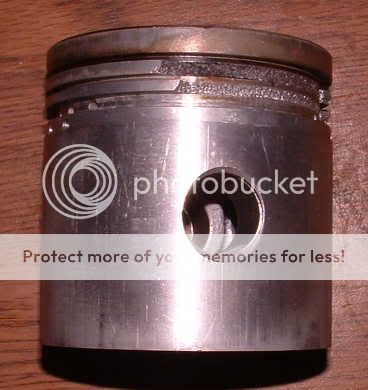
Here is the end result of my intake seals and external oil feed :
BrokenTR3piston.jpg


One of the seals came apart and allowed one cylinder to suck too much oil past the guide, which was severely worn from lack of lubrication (some previous mechanic had apparently installed the rear cam bearing wrong and no one, including me, noticed for a long time). Oil has a lousy octane, so that one cylinder was knocking under cruise conditions, and the knock eventually broke away the piston lands below both compression rings.
 
Back
Top