• Hey Guest!
    British Car Forum has been supporting enthusiasts for over 25 years by providing a great place to share our love for British cars. You can support our efforts by upgrading your membership for less than the dues of most car clubs. There are some perks with a member upgrade!

    **Upgrade Now**
    (PS: Upgraded members don't see this banner, nor will you see the Google ads that appear on the site.)
Tips
Tips

TR2/3/3A getting a new multi meter

sp53

Yoda
Country flag
Offline
I am looking to get a new multi meter for general work and work on my tr3 and really do not know what to get. I went to HF and looked around .Everything is digital and priced low. I wanted something to measure DC amps; is that something that cannot be done by a meter without opening the circuit? Anyways looking for suggestions and know little about the stuff. I was thinking of Sears?

Thanks steve

 
Even the cheap (free) HF multimeters will measure current, but are limited to 10 amps. They work fine for me for most purposes - I have other instruments if accuracy or higher capacity is needed but I'm just clumsy enough that the free ones are a good choice for everyday use.
 
I keep a cheap (free) HF meter in the trunk of the TR3 at all times. I have a yellow one for my (yellow) TR3 and had a red one in my (red) TR6. My 'good' meter is also from HF but includes capacity to measure 20A-DC (still no where near enough to measure starter current). It has a temperature probe that works well assuming you can physically attach the probe to something you want to measure. It can measure the capacitance of a condenser. Although you can purchase DC Current meters that clamp on, they are more expensive and generally not needed. Generally, any (current) meter requires the circuit be 'broken' with the ammeter inserted (across the break) to measure current. That can be done simply by disconnecting the battery, and 'jumping' the open with the ammeter. The really nice thing about most cheap meters, is they are tolerant of almost any abuse -like connecting them backwards. The old high accuracy needle movement meters could easily be destroyed by not having the scale properly set. My meter is completely protected -except for the high current mode.
 
As others above, I have several "disposable" HF meters which I keep in my various cars. They are OK but you get what you pay for.

You asked about inline ammeters. Yes, most digital multimeters require you to open the circuit and put the meter in series with the wiring to measure current. There are clamp-on ammeters which don't require this but the bulk of them are for AC, not DC. Several years ago I stumbled on a surplus test equipment web site that had a clamp-on meter suitable for DC. It was not too expensive so I bought it. I used it once or twice. Then when I needed it a third time, the display was intermittent. I got what I paid for. So you can get a clamp-on ammeter for DC but don't expect to get a cheap one that is reliable. Also expect to shop more places than HF or eBay to find a good clamp-on meter.
 
I have yet to find one that lasts very long...regardless what I spend on them. First to go is the high amp circuit. I'm interested to hear what everyone else are using.
 
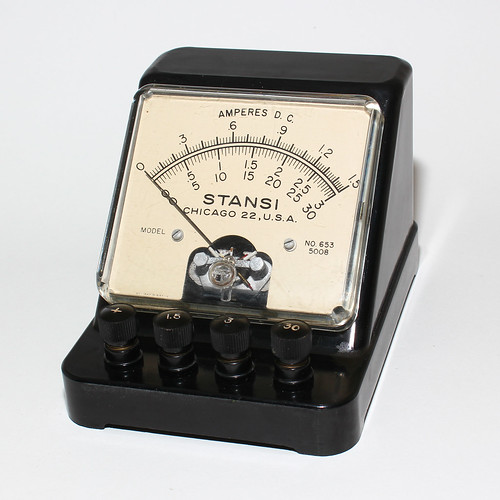
I found one like this (only a Weston) at a flea market for a couple of bucks:

9714999294_194c9e32ae.jpg


I seldom need to measure current and have been known to smoke a HF multimeter when I didn't move the leads back to the normal position after using 'amps' -- so a dedicated instrument like this is handy for me.

I got an big old analog multimeter off eBay cheap - because there a couple of things that it seems analog is better suited for (e.g. checking the voltage stabilizer on the TR4).
 
I recently bought a Fluke 117, plus some cables and test leads with silicone insulation (much better than the plastic cables that come with the multimeter). It was not cheap. But I grew tired of my simple Radio Shack multimeter giving inconsistent readings when we were redoing our kitchen in our old house (I did not appreciate the 120V shocks...). For most things, the Radio Shack unit is fine, and I can "toss" it in my tool box without worry. But the Fluke is just good quality.

Note - I made this purchase using the same principal as I buy other tools: Start with a cheapie tool from HF (or equivalent), and if I use it enough to break it, buy a quality equivalent.
 
I've got a Fluke 79 III that I've had for over twenty years. It saw everyday use while I was working. Not cheap, but built to last. It has the DC ammeter section fused, but the fuses are an odd rating specifically for Flukes. I also have two AC/DC clamp-on ammeters. Both are Amprobes, also not cheap. I also have a couple of cheap multi-meters and they are just fine for occasional use. I even have an cheap, old Radio Shack analog multimeter that I've had for at least thirty years that still works fine.
 
As I mentioned earlier, I keep the HF meters in the boot of my cars. For garage and house use, I also have an old Fluke 77 meter which I have owned for almost 25 years. It is a solid, reliable unit. Like others above, I have blown the current fuses on occasion but the meter has continued to work flawlessly. If you want to invest in a good meter, I endorse Fluke products.

The worst cheapy meter I have seen is the one my father-in-law bought from Northern Tool. Connecting the probe tips to confirm continuity does not give a "Zero" reading, it flashes "-1" and is inconsistent with that. I have zero confidence in its resistance measurement mode. Whenever I go to my father-in-law's house to work on cars I take my Fluke meter.
 
Back
Top