• Hi Guest!
    If you appreciate British Car Forum and our 25 years of supporting British car enthusiasts with technical and anicdotal information, collected from our thousands of great members, please support us with a low-cost subscription. You can become a supporting member for less than the dues of most car clubs.

    There are some perks with a member upgrade!
    **Upgrade Now**
    (PS: Subscribers don't see this gawd-aweful banner
Tips
Tips

Front Suspension Too Tight?

PatGalvin

Jedi Warrior
Country flag
Offline
Hello All

Progressing with my suspension rebuild in the 59 TR3. Installed upper and lower wishbones, lower trunnion, and upper ball joint and vertical link last night. Prior to fitting spring, how tight should this assembly be? I torqued all to factory specs and am using TRF Magic Kit poly bushings for upper. Takes about two very stong fingers and maybe 15 to 20 lbs (applied vertically to stub axle) to move the vertical link up and down. I think most friction is from upper wishbone as the poly bushings really get squished when you torque the castellated nuts down.

Thanks for advice.

Pat Galvin


PSSuspensionBuild.jpg
 
Pat,
I'm sure that's fine. I don't know anyone that's ever assembled it in this manner without the spring in place.
Although, you don't really torque down the uppers much (forget the factory setting). If you over do it you'll just accelerate the wear of the upper bushings.
The PO of my car overtorqued the uppers and that destroyed them (bushings) in short order.
 
prb51 said:
Although, you don't really torque down the uppers much (forget the factory setting). If you over do it you'll just accelerate the wear of the upper bushings.
The PO of my car overtorqued the uppers and that destroyed them (bushings) in short order.

I'm getting ready to rebuild my front suspension. What torque setting do you recommend for the uppers?

Thanks!
 
Upper bushing torque figures are for rubber bushings, which are compressed. Poly bushings should not be compressed. Just tighten them enough to remove any gaps between the bush and washers.
 
Thanks for the feedback. I'll reduce torque on poly bushings and hope I didn't damage the ones I installed.

I don't know any other way to fit the suspension. I installed it directly per the service manual, step by step. Now that I have upper and lower wishbone arms in place and torqued, I can add coil spring and spring pan.

The body is off the frame and I'm building on a bare frame, at this point.

Pat
 
Just to be clear - I am supposed to torque the lower inner wishbones on the lower fulcrum pins per factory settings, right? (I think it is around 25 ft lbs - it is in the manual. These are the big ends that have the nylon washers and inserts riding on the polished steel bushing. I had to gently sand one end of one nylon bushing so it would slip over polished steel bushing - was too tight.

And the small ends of the lower wishbones are tightened firm, backed off 1.5 to 2 flats, and then set with cotter pin, right? Then gently tap back washer off spline on Trunnion. This is also per manual.

Just checking. I learn something from you guys every day.
Thanks much.

Pat
 
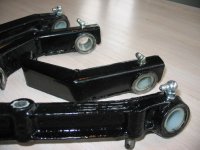
I removed everything, had it sand blasted, rewelded for two full days, and epoxy primed and painted with Eastwood two part ceramic black urethane. It looks great and should last another 50 years. Was a huge amount of work.

Pat
 
PatGalvin said:
Just to be clear - I am supposed to torque the lower inner wishbones on the lower fulcrum pins per factory settings, right? (I think it is around 25 ft lbs - it is in the manual. These are the big ends that have the nylon washers and inserts riding on the polished steel bushing. I had to gently sand one end of one nylon bushing so it would slip over polished steel bushing - was too tight.

And the small ends of the lower wishbones are tightened firm, backed off 1.5 to 2 flats, and then set with cotter pin, right? Then gently tap back washer off spline on Trunnion. This is also per manual.
Yup, all sounds good to me.

And I definitely recommend checking as you are doing, without the spring. It's much easier to detect and correct any binding now, than after the spring is installed.
 
Hope you used the white lube on the upper poly bushes that's usually supplied with them in a satchel. It cuts bush wear, helps keep water from rusting the pivot pins, and avoids squeaks.

Make sure the large nyloc nuts at the end of the lower pivot pins are really tight. They stop the inner steel sleeve from spinning so the suspension rotates only on the nylon bushes. Those nylon bushes like a smear of the white lube too, for the same reasons as the poly bushes.

It's good to put the spring and shocker in when you have the weight of the body and engine in place.

Viv.
 
Pat - Before you put the spring in, check that you can rotate the stub axle about the vertical link. If the "splines" (more like serrations) just above where the new ball joint bolt goes, are not lined up properly as before, this could make the vertical link hard to swing and this could make your steering hard (stiff) to steer the car to the right or left. The vertical links should be free so you can swing (rotate) them right now with rather gentle force on the short stub axle extension. If they are tight, you'll need to re-adjust the serrations on the ball joint to line up so the link is free to swing.

As for greasing all the poly or nylon bushes, I took all mine apart last spring and reworked the inner ends of the upper and lower wishbones ("A" frames) on both sides of my 1958 TR3A and added 8 extra grease fittings. Then I used red Amsoil synthetic grease in my grease gun to lubricate these new zert grease fittings.

It's the first time in 45 or 50 years that my front suspension has not squeaked. I used the synthetic grease to "try" to reduce the rotting
and tearing of the rubber boots on the tie rod ends and the ball joints. I also hope the lousy repro boots will no longer go "gummy" with the synthetic grease. Last summer, I only drove 1700 miles, so it may take a few more years before I can say if there are any advantages with the red synthetic grease.

But it was a "quiet" summer of driving.
 

Attachments

  • 19972.jpg
    19972.jpg
    61.5 KB · Views: 866
Thanks Don and Viv

Viv - I used red grease on the upper inner wishbone poly bushings. I wasn't familiar with the white grease and none was supplied. I hope that is OK, as I really don't want to disassemble the suspension again. I fitted the coil spring last night and you can imagine how difficult that was to compress, given that the bare frame is off the floor. I will be sure to tighten the lower inner fulcrum pin nyloc nuts. I understand how that would lock down the polished steel bush and allow nylon bush to slide on the polished steel bush.

Don - After I loosened the castelated nuts on the upper inner wishbone arms, the suspension was easier to move up and down (prior to fitting coil spring). I can grab the stub axle and the rotation side to side (as if wheel was steering) is very light and free moving - so I guess I installed the upper ball joint correctly, if I'm understanding your comment.

Thanks for the tips. I'm concerned about the white grease vs. red grease. It takes a a bit of effort to fit the suspension and I'd really rather not remove and refit all.

Thanks much.

Pat Galvin
 
Pat,
IMO, the red grease will be fine. The rubber seals are supposed to be able to stand up to pretty much any grease or oil, and indeed the original seals did that very well. But many of the replacements supplied in the past 30 years or so won't stand up to anything ... I've even pulled "NORS" rings out of the bag that were already in poor condition without even being installed on the car!

Fortunately, our vendors appear to have taken notice, and the currently supplied parts appear to be made of the proper synthetic rubber. Most of the seals I put on TS39781LO around 1998 or so were still in good shape when I removed them last year.
 
Thanks again for all the help. Slowly, this resto is getting done...

Pat

IMG_7995Large.jpg
 
Looks good.

I have always put the bottom plate of the compressor under the spring plate, not halfway down the spring as in your photo.

Have I been doing it wrong?
 
Twosheds said:
Have I been doing it wrong?
Not in my opinion. The book clearly shows and describes the compressor passing through the spring pan.
 
Sheesh, that would have been a lot easier to put the flat plate under the spring pan. But I suppose I'll have to cut holes for the four shock mounting bolts if I am to use the compressor in this way. Funny how these projects take 1/3 the time to do the second wheel, once one figures out the correct procedure. I'll get it right eventually.

Like my powder coated coil springs? Use the home powder coating kit from Eastwood. That is Argent silver covered with clear. Came out way too well! That is a lot of fun but takes a bit of time.

Pat
 
I have two internal spring compressors. One of them has 4 holes cut in the plate to fit on the studs for the shock mounts in the bottom of the spring pan. I quite like this style and it works very well.

Cheers,
M. Pied Lourd
 
Sticky White Grease for poly bushings is available from Summit Racing Products (find them on Google). I bought a large tube for $19 that should last me a lifetime.

I called TRF and asked what they recommended and they indicated that the poly bushings were self lubricated and that the manufacturer would not recommend any lube. However, Prothane bushings offer the white grease for their bushings and it is definitely more sticky than anything else I've ever used.

Pat
 
Back
Top