Hi Guest!

 Hey - did you know if you click on the title of a thread it will take you to the first unread post since you last visited that thread?
 but were afraid to ask:
  STOP!! Never post your email address in open forums. Bots can "harvest" your email! If you must share your email use a Private Message or use the
  smilie in place of the real @
 Pretty Please - add it to our Events forum(s) and add to the calendar! >>

Brosky
Great Pumpkin
Offline
When I got my TR8, I was surprised to find that just like my TR6, the entire fuse panel was filled on every circuit. I was not about to replace the entire fuse panel with a new one like I did to my TR6, which was great but not made for this car Classic Technologies TR6 Fuse Panel
So, I decided than rather fighting to tap into and possibly overloading a line, that I would add a new breaker style block under the hood where I could have a hot block that could be easy tapped in to for whatever and whenever I wanted. The decision was whether or not to feed from the ignition or directly from the alternator/starter block connector.
For this one, I decided to go from the ignition, so while Woody had it all apart to install the new engine, I asked him to run a wire from the switch out to the engine compartment so I could tap in to this block easily. You could just as easily tap this into the back of the alternator for full time power, as it does come with a nice 8 gauge wire lead to the buss.
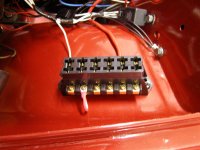
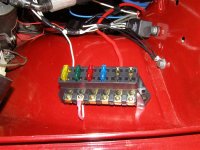
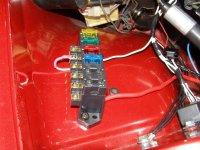
He ran the wire out when the engine bay was empty and I hooked it all up tonight, with access provided to my new fog lights. I now have an easy access that is constantly fed with the key on and has no hot lugs until you add a fuse or breaker. I may add a switched LED row on the inside of the top of hood for an under hood lamp when the hood is open at night.
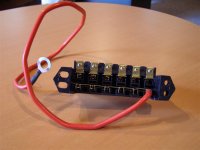
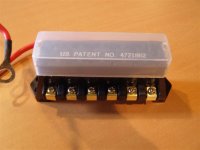
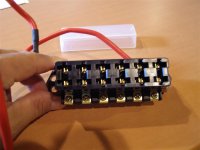
The pictures will explain what I meant, as the one side of the block is hot from the input, but the outboard lug side doesn't get power until a fuse is plugged in.
This is the link for the fuse block page and you will see mine in the middle: Wiring Products Fuse Blocks
So, I decided than rather fighting to tap into and possibly overloading a line, that I would add a new breaker style block under the hood where I could have a hot block that could be easy tapped in to for whatever and whenever I wanted. The decision was whether or not to feed from the ignition or directly from the alternator/starter block connector.
For this one, I decided to go from the ignition, so while Woody had it all apart to install the new engine, I asked him to run a wire from the switch out to the engine compartment so I could tap in to this block easily. You could just as easily tap this into the back of the alternator for full time power, as it does come with a nice 8 gauge wire lead to the buss.
He ran the wire out when the engine bay was empty and I hooked it all up tonight, with access provided to my new fog lights. I now have an easy access that is constantly fed with the key on and has no hot lugs until you add a fuse or breaker. I may add a switched LED row on the inside of the top of hood for an under hood lamp when the hood is open at night.
The pictures will explain what I meant, as the one side of the block is hot from the input, but the outboard lug side doesn't get power until a fuse is plugged in.
This is the link for the fuse block page and you will see mine in the middle: Wiring Products Fuse Blocks