• Hi Guest!
    If you appreciate British Car Forum and our 25 years of supporting British car enthusiasts with technical and anicdotal information, collected from our thousands of great members, please support us with a low-cost subscription. You can become a supporting member for less than the dues of most car clubs.

    There are some perks with a member upgrade!
    **Upgrade Now**
    (PS: Subscribers don't see this gawd-aweful banner
Tips
Tips

GT6 Early Gt6 Pushrod tubes

Richter12x2

Jedi Hopeful
Offline
I have a sinking feeling asking this question - it's been one thing after another with this car.

Is there a source for replacement pushrod tubes? Was having the head rebuilt to finally get the correct engine in the car, and it seems the builder has hottanked the head, only to discover that aluminum doesn't like it very much.
 
DOH! I have never seen them listed. They are pretty simple aluminum tubes. You could have some turned from stock and pressed in.

I may have a spare head but it would cost a mint to ship it to TX. GT6 heads are heavy.
 
Are they the same as the ones on the early Spitfire?
TRF has the Spitfire ones listed as P/N 104826

M.
 
You guys are all awesome. Thank you! I'll get a set shipped to the head builder.

Maybe 2 sets?

Thanks for the information guys. I hope to never need it but now I'll know where to look for the parts.
 
No one is asking the next question : How to get those dang tubes to seal!
:D
 
Yeah, so that turned out to be a bust - after being backordered for a couple of months, they admitted they don't know if they'll ever be produced again. Luckily, with some ingenuity I managed to extract and clean up a set from a backup head that I had.

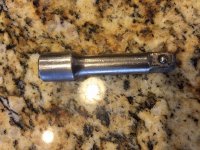
Turns out I had a special GT6 pushrod removal tool the whole time.

gt6 pushrod tool.jpg

The end that goes on the ratchet is about 1mm narrower than the diameter of the holes where the pushrod tubes sit, so I used a straight screwdriver to gently straighten the bottom flare (I wanted to keep the top perfect, since that's the direction the oil will most likely be coming from)

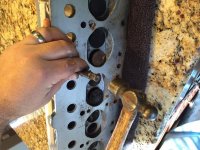
Then I used this and tapped then back through the holes. The size is the important thing - it doesn't take much force at all, (because it's thin aluminum and doesn't take much force to bend it totally out of shape, and useless). After you get enough to grab onto, you can just give it a little back and forth wiggle and usually just pull it through the top.

gt6 pushrod removal.jpg

After the new head is painted, my thought is to get the tubes mostly inserted, then put just a thin touch of oil resistant black rtv silicone around the tops and then seat them. The clamp them in place and flare the bottom back out using (hopefully) the tapered side of that socket extension, or failing that, I've also ordered a set of swaging tools (for A/C copper) and the 5/16" will probably do the trick - I just wish it nested inside the tube a little better to make sure the flare is straight - I may grind it down just a bit to make sure it seats properly before tapping the flare in.
 
image-20160322_224207.jpg

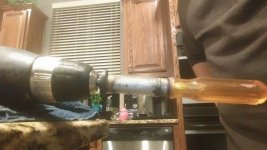
I was very pleased with myself on the polishing, with this trick I thought of. After spending 30 minutes to get one of the tubes not very clean of old paint, I thought there had to be a better way. This is what I came up with:

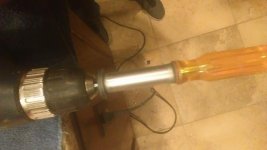
I found a pair of rubber washers, and a philips screwdriver the right length (pushrod + just enough to chuck in the drill)

IMAG0012.jpg

An actual bolt and nuts would work better, because it was tough to get it snug enough that it wouldn't spin - being able to tweak it down with a wrench would have been MUCH easier.

Then I cut strips of 320 grit wet-or-dry sandpaper, about 1" wide, and let them soak in warm water in the sink (plus just a dab of soap, seems to help bind the dust and make the pad easier to rinse - that tip works for wet sanding cars too.)

Locked the drill to on (has a little button) put my elbow on the drill, and wrap the paper around it like dental floss.

Run the paper until it loads up and starts to project visible dust (happens as it starts to dry out). Then rinse and repeat. After a repeat or two, much of the effectiveness is gone, so move to a new one. About 2 strips per tube, 3 if it's really bad. And also, there are some casting flaws, these weren't exactly showpieces to begin with, so there are spots that are just not going to come out.

But:

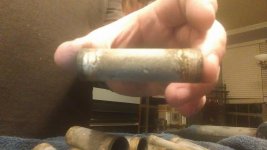
image-20160322_225212.jpg

It leaves a beautiful silky nearly brushed sheen. I went ahead and tried going further with 800 grit sandpaper and 1200, but it didn't make enough difference to make it at all worth it. Looking at it, it's almost indistinguishable from just 320.
At this point you could probably polish them further with compound and a buffing pad, but I think we're going to stick with it this way.

I'll update again when I push them into the head.

 
Oh another note - I gave the top flare about 1/4" of clearance with the sandpaper - I don't want it any narrower than it was, so it can still make a good seal - the bottom I didn't worry about, because having it be just a little thinner will help reinstall it in the head, and make flaring it back out easier.
 
View attachment 41940

I was very pleased with myself on the polishing, with this trick I thought of. After spending 30 minutes to get one of the tubes not very clean of old paint, I thought there had to be a better way. This is what I came up with:

I found a pair of rubber washers, and a philips screwdriver the right length (pushrod + just enough to chuck in the drill)

View attachment 41941

An actual bolt and nuts would work better, because it was tough to get it snug enough that it wouldn't spin - being able to tweak it down with a wrench would have been MUCH easier.

Then I cut strips of 320 grit wet-or-dry sandpaper, about 1" wide, and let them soak in warm water in the sink (plus just a dab of soap, seems to help bind the dust and make the pad easier to rinse - that tip works for wet sanding cars too.)

Locked the drill to on (has a little button) put my elbow on the drill, and wrap the paper around it like dental floss.

Run the paper until it loads up and starts to project visible dust (happens as it starts to dry out). Then rinse and repeat. After a repeat or two, much of the effectiveness is gone, so move to a new one. About 2 strips per tube, 3 if it's really bad. And also, there are some casting flaws, these weren't exactly showpieces to begin with, so there are spots that are just not going to come out.

But:

View attachment 41942

It leaves a beautiful silky nearly brushed sheen. I went ahead and tried going further with 800 grit sandpaper and 1200, but it didn't make enough difference to make it at all worth it. Looking at it, it's almost indistinguishable from just 320.
At this point you could probably polish them further with compound and a buffing pad, but I think we're going to stick with it this way.

I'll update again when I push them into the head.

Your shop has granite toped work bench! NICE!
 
This appears to be another thing we have in common. There can be little complaining about the kitchen when my wife doesn't cook! Besides, the GT6 parts that sometimes make it to the kitchen are from her car, not one of mine.
 
haha, exactly. This GT6 is hers as well, so she's usually so happy progress is being made that she doesn't complain too much. Which is weird, because it may be the only thing she doesn't complain about.

I will warn you, using the dishwasher as a parts washer is NOT a good idea. It does work remarkably well, but the time you save is negated by having to take the dishwasher apart and clean THAT.
 
Back
Top