Hey Guest!

 Hey - did you know if you click on the title of a thread it will take you to the first unread post since you last visited that thread?
 but were afraid to ask:
  STOP!! Never post your email address in open forums. Bots can "harvest" your email! If you must share your email use a Private Message or use the
  smilie in place of the real @
 Pretty Please - add it to our Events forum(s) and add to the calendar! >>

CJD
Yoda

Online
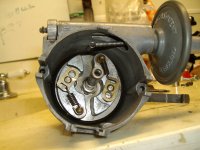
I am rebuilding the TR2 distributor...40403 is the number. I have a couple questions for any of you familiar with the first generation distributor.
Last year I bought a truckload of odd parts, including 3 distributors. I'm busy trying to build 2 working ones out of the 4. I have one 40403, and 2 somewhat newer models to work from.
First question...the early distributor came with a fiber washer between the bottom and the drive dog. The later washers are brass. Is there an advantage to using the brass washer from the later models on the earlier units? Assuming the main shaft is held down by gravity, I don't think the washer sees much load.
Second question...even with all these distributors, I do not have a single set of springs between the whole lot! Moss sells an assortment, but I have an assortment of springs already from decades of distributor rebuilds on other cars. So, can somebody tell me if I should use a light, medium, or heavy spring on the TR2?
Finally, I am missing one weight. Just one! Is there a supplier for those?
Last year I bought a truckload of odd parts, including 3 distributors. I'm busy trying to build 2 working ones out of the 4. I have one 40403, and 2 somewhat newer models to work from.
First question...the early distributor came with a fiber washer between the bottom and the drive dog. The later washers are brass. Is there an advantage to using the brass washer from the later models on the earlier units? Assuming the main shaft is held down by gravity, I don't think the washer sees much load.
Second question...even with all these distributors, I do not have a single set of springs between the whole lot! Moss sells an assortment, but I have an assortment of springs already from decades of distributor rebuilds on other cars. So, can somebody tell me if I should use a light, medium, or heavy spring on the TR2?
Finally, I am missing one weight. Just one! Is there a supplier for those?