• Hey Guest!
    British Car Forum has been supporting enthusiasts for over 25 years by providing a great place to share our love for British cars. You can support our efforts by upgrading your membership for less than the dues of most car clubs. There are some perks with a member upgrade!

    **Upgrade Now**
    (PS: Upgraded members don't see this banner, nor will you see the Google ads that appear on the site.)
Tips
Tips

TR2/3/3A Control Box Wiring Woes

Rob-Michigan

Freshman Member
Offline
I recently bought a TR3 with some wiring issues. The first thing I did was to burn out the Pertronix positive ground ignition so with that good news I figured I would install a negative ground unit and switch the battery over to negative ground. I gather I should disconnect the F wire from the control box, swap the battery and the amp meter wires then touch the positive side of the battery (now hot) to the loose F wire a couple of times to polarize the generator.

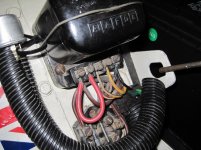
When I looked at the control box I saw that there is an old red jumper between A1 and A. I can’t tell what this would do inside the box but it doesn’t look right and I figure I should find out what it means or does before I continue. Anyone know why that was done?

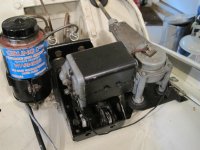
A secondary problem is the wipers that are not hooked up to the wires for them. I suppose the wiper could be a 2 stage and will attack that problem next along with the fuel gauge which is on the wiper circuit, but I thought I should mention it in case it has something to do with the red jumper between A1 and A. I’ll try to post a pic of the box. IMG_0915.jpgIMG_0918.jpg
 
The red jumper most likely indicates that the box has failed internally. Normally those two posts are linked together by a relatively short piece of heavy copper wire, that makes just a few turns around the regulating relay inside the box. The few turns don't do much, so it may still work well enough with the jumper installed; but I would be suspicious.

The wiper motor is single-speed, but has provisions to self-park. So one of the terminals sticking out (#2) gets a green wire that is hot whenever the ignition switch is on, and the other (#1) gets a black/green wire that is grounded when the dash switch is "on". The "park" switch is under that round cover with the wire leading to it; and grounds terminal 1 whenever the motor is not in the "park" position. So, the most common problem is that people mistakenly wire power to terminal #1, which causes the fuse to blow. Second most common is that the workshop manual does not show this arrangement and people try to wire the later self-parking motor by the diagram (which is for the earlier non-self-parking) and it either doesn't work or again blows the fuse.

Not likely that the wiper motor is related to the red jumper.

BTW, there are at least 5 variations of factory wiring diagram, not counting the changes to accommodate left hand drive vs RHD. It's worthwhile, IMO, trying to find the diagram that is closest to your car. The one from Practical Hints 4th edition matched TS39781LO the best (although it does show the ammeter and fuel gauges in the wrong places). Here's a version of that diagram, which I modified to show the LHD connections to the steering column, and marked the wiper motor terminals. (Click on the image, then look for the magnifying glass in the lower RH corner to blow it up to usable size)
 
No idea why A and A1 are jumpered, but they shouldn't be. I can only guess that there's a fault in the regulator - maybe a burnt-out winding, though they are so thick it's unlikely. A jumper like that could cause your generator to over-charge and possibly burn out.

Your method of re-polarising the generator is correct,the easy way being to remove the wire from the F terminal and touch it to the A terminal.


Edit - whoops, Randall got there first.
 
Randall and Roger,
Thank you both for helping with my wiring issues. I really appreciate it. I think the next step is to buy a new control box (I think we called them voltage regulators in my youth). I can still use the control box even if I switch over to an alternator, can't I?
The fuel gauge doesn’t work and I assumed from the wiring diagram out of the manual that it was probably connected in some mysterious fashion to the wiper ills. I am looking forward to seeing your diagram when the service where it is located is back on line (they are doing maintenance right as I type).
I took the wiper apart and whoever was there before me saw it was very worn and didn't bother re-assembling it with the supports for the brushes. As it stands, I think I'll try to find a replacement because this one is, as I say, very worn. There is a shop in UK that sells expensive re-built motors.
I think I’ll hold off going to negative ground because I have the Pertronix electronic ignition that is pos ground and don’t really want right now to buy another of those for negative ground but thanks for confirming the method.
I bought an overdrive transmission from John Esposito at Quantum Mechanics in Connecticut but the wiring remains a bit of a question and John has some personal issues going on so he is unavailable. Before I put it in I’d like to devise a switch that mounts on the shifter. If you have any ideas about that I would be most grateful to learn about them.
Cheers,
Rob
 
I can still use the control box even if I switch over to an alternator, can't I?
Only from a decorative aspect. I mean, you can leave the box mounted on the car, but it won't be serving any functional purpose. The alternator has to have it's own regulator (which is usually inside the alternator housing).

If you do replace the control box, try to get one that matches your generator. Later cars used a slightly larger generator, which is frequently supplied as a replacement for the early one. Lucas just warned against mixing them, but I believe that if you use the early box with the later generator, you'll just not be taking advantage of the higher output ability. The danger would be using a later control box with the early generator, which can overload and overheat the generator, shortening it's life.
The fuel gauge doesn’t work and I assumed from the wiring diagram out of the manual that it was probably connected in some mysterious fashion to the wiper ills. I am looking forward to seeing your diagram when the service where it is located is back on line (they are doing maintenance right as I type).
Pretty much the only connection is that they get power from the same fuse. Could be the fuse is blown, or there is a bad connection at the fuse block. There is also a funny little jumper between the two A4 terminals that can sometimes get broken or lost (causing the side A4 terminal to not get power).
I took the wiper apart and whoever was there before me saw it was very worn and didn't bother re-assembling it with the supports for the brushes. As it stands, I think I'll try to find a replacement because this one is, as I say, very worn. There is a shop in UK that sells expensive re-built motors.
TRF has them too, but still expensive ($250 plus core). Might be a few dollars cheaper than your UK source (by the time you pay shipping both ways), but maybe not.

I bought an overdrive transmission from John Esposito at Quantum Mechanics in Connecticut but the wiring remains a bit of a question and John has some personal issues going on so he is unavailable. Before I put it in I’d like to devise a switch that mounts on the shifter. If you have any ideas about that I would be most grateful to learn about them.
There is a special shift knob used on later Spitfires and Stags, that takes an OD switch. I'm not certain how easy it would be to adapt to the TR3 shift lever, but that is where I would start.

However, in all honesty, I like the TR3 OD switch better. The switch on the Stag is both harder to sense position and harder to move than the TR3 switch; especially if you are wearing gloves. The switch itself seems kind of fragile, as does the thin plastic knob cap. And, when a buddy of mine did something similar on his TR6 (by having a Spitfire OD shift lever welded to his TR6 lever), he had trouble with the wires shorting inside the shift lever. The TR3 dash switch is functional, rugged, durable, and quirky. Suits the car much better! :smile: And I love how, with practice, it seems to almost read my mind. I don't have to think about it at all.

OD wiring is pretty simple, but it helps if you follow the inset on the diagram I linked to above. The wiring shown on later diagrams (and the Dan Masters diagram) will work, but is more complicated IMO.

I do suggest one modification, though : Add an in-line fuse holder with a 5 or 10 amp fuse in the line labelled "45" in the diagram above. It will help protect not only the wiring to the relay and solenoid, but may save the solenoid itself if it gets jammed somehow and can't pull in all the way. I had a piece of gravel get inside mine once, and it burned up the solenoid.

Feel free to ask any OD wiring questions; but it would probably be better to start a new thread with an appropriate title.

 
Randall,
Thanks again for your reply. It has been lifetime since I worked on these cars and memory fades, along with ability. I apologize for mixing questions and will confine myself to the control box here and start new threads for the overdrive and fuel gauge question.

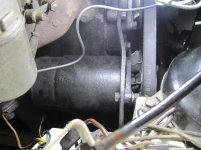
The car I bought seems to have a replacement generator, possibly from the 90s, at least it looks reasonably new, but it has no visible markings. The control box could be original, it certainly looks old and with the jumper wire between A and A1 it is probably damaged. Perhaps the jumper implies a mismatch with the generator?

I plan to replace the control box after what you said if I can figure out which new control box to buy. Are you aware of any way to match the two?

Cheers,
Rob
 
On the early C39PV-2 generator (which I believe would be original to your car), the body is the same diameter for the entire length. The later C40 generator is smaller at the brush end. You should be able to find the model number stamped into the housing near the pulley end


There is a Lucas booklet at https://drive.google.com/file/d/0B2...NDNmLWI0YTYtNjY5ZjQxZTA2NGFm/edit?usp=sharing that has on-car test procedures for both the generator and control box.
 
On the early C39PV-2 generator (which I believe would be original to your car), the body is the same diameter for the entire length. The later C40 generator is smaller at the brush end. You should be able to find the model number stamped into the housing near the pulley end


There is a Lucas booklet at https://drive.google.com/file/d/0B2...NDNmLWI0YTYtNjY5ZjQxZTA2NGFm/edit?usp=sharing that has on-car test procedures for both the generator and control box.

Ah-ha, I think I have the later one with the reduced diameter- the back is smaller than the front. So, now all I have to do is match it to the correct control box. Moss offers two "pre-tested and adjusted models”. Before TS60000 and after. Even though mine is TS 41492L, may I assume I should use the “after” 142-001 voltage regulator? https://www.mossmotors.com/Shop/SearchResults.aspx?SearchText=regulator&WebCatalogID=11. They also have a pdf that talks about adjustment: https://www.mossmotors.com/graphics/products/PDF/142-000_542-100.pdf

Buying a Pre-Tested & Adjusted Regulator
We realize that not everyone will want to deal with a regulator that needs to be cleaned and adjusted, and that in many areas finding a professional to do the job can be a challenge. For these reasons, we offer voltage regulators that have been professionally cleaned, tested and pre-adjusted to our specifications.
142-001 Voltage Regulator, 5-Post, Screw Terminals, Pre-Tested & Adjusted
542-101 Voltage Regulator, 5-Post, Spade Terminals, Pre-Tested & Adjusted
 

Attachments

  • IMG_0919.jpg
    IMG_0919.jpg
    187.6 KB · Views: 97
I think you would still be OK using the early control box with the later generator. If you get the later one, you'll need to add the quick connect (aka Lucar) terminals to your wiring harness.

Personally, I follow the Lucas adjustment instructions (and use a digital voltmeter). Works for me. I'm pretty sure that, if you use the Moss voltage setting, you'll find that your battery runs down as you drive at night with the headlights on. (For sure if you also have the heater and wipers on.) Probably works out OK if you never drive at night, but I drive home in the dark every night (this time of year) and I really hate having the battery low in the morning. But they might be right about it letting the battery last longer, as long as it gets recharged reasonably soon and doesn't sit for months in a partially discharged state (after driving at night).

I recall we discussed that Wilton is no longer offering the electronic regulator conversions. Has anyone taken over that yet?
 
I think you would still be OK using the early control box with the later generator. If you get the later one, you'll need to add the quick connect (aka Lucar) terminals to your wiring harness.

Personally, I follow the Lucas adjustment instructions (and use a digital voltmeter). Works for me. I'm pretty sure that, if you use the Moss voltage setting, you'll find that your battery runs down as you drive at night with the headlights on. (For sure if you also have the heater and wipers on.) Probably works out OK if you never drive at night, but I drive home in the dark every night (this time of year) and I really hate having the battery low in the morning. But they might be right about it letting the battery last longer, as long as it gets recharged reasonably soon and doesn't sit for months in a partially discharged state (after driving at night).

I recall we discussed that Wilton is no longer offering the electronic regulator conversions. Has anyone taken over that yet?

Thank you. Based on what you advise, I’ll buy the regulator they sell not adjusted and do it myself. Considering what you said earlier about the earlier boxes not taking advantage of the greater output of the later generators, it seems to sensible to buy the later control box 542-100 TR3 after TS60000 and follow the procedure Lucas suggests in the workshop manual. Doesn’t that make sense? Also It shouldn’t mess up the existing older wiring should it?

By the way, Moss seems to sell two regulators one with screws and the other with Lucar connectors for each generation car, so four different units in all. https://www.mossmotors.com/Shop/SearchResults.aspx?SearchText=regulator&WebCatalogID=11


Thanks again,
Rob
 
Last edited:
By the way, Moss seems to sell two regulators one with screws and the other with Lucar connectors for each generation car, so four different units in all. https://www.mossmotors.com/Shop/SearchResults.aspx?SearchText=regulator&WebCatalogID=11
I think the 4 different units are because they sell both the early and late units with or without being pre-adjusted. The listing I see shows only screws for pre-TS60k and only Lucar for post-TS60K.

What they don't mention is the current rating of the two regulators. I suppose that is "as original", but it irritates me anyway. Wish I could find the Lucas warning against mixing control boxes and generators, but so far it hasn't turned up.

PS, you might find this an interesting read. It offers a lot of insight into how the TR3 control box works, as well as a method of greatly extending it's life by adding one transistor to handle the field current. https://www.worldphaco.net/uploads/SAVING_THE_LUCAS_RB1061.pdf
 
I think the 4 different units are because they sell both the early and late units with or without being pre-adjusted. The listing I see shows only screws for pre-TS60k and only Lucar for post-TS60K.

What they don't mention is the current rating of the two regulators. I suppose that is "as original", but it irritates me anyway. Wish I could find the Lucas warning against mixing control boxes and generators, but so far it hasn't turned up.

PS, you might find this an interesting read. It offers a lot of insight into how the TR3 control box works, as well as a method of greatly extending it's life by adding one transistor to handle the field current. https://www.worldphaco.net/uploads/SAVING_THE_LUCAS_RB1061.pdf

Randall, I think the transistor idea is great but a little beyond my skill level, I could see the thing turning white hot and disappearing through the cowl and burying itself into the concrete with a loud hisss. I see you are quite right that I can either install the Lucar connectors on the existing wires or use the old regulator. Do you think the extra “higher output ability” is worth the trouble and are the Lucar connectors available? Thanks so much for your help, Rob
 
Do you think the extra “higher output ability” is worth the trouble
That's a tough question. I guess my answer is "no", as evidenced by the fact that I have a C40 generator and control box sitting on the shelf, while my TR3 is still wearing its apparently original C39 & control box. Although I am by no means a fanatic about originality, I think it's kind of neat to keep using the original setup. But, if I ever do tire of constantly keeping one eye on the ammeter, etc.; I'll just switch to an alternator (which is also on the shelf). I actually plan to do that eventually anyway, along with some engine upgrades I have planned. Depending on how things go, I may try doing a full electronic conversion on the old control box first, just to see what happens. It's a rather large compromise having only two spindles (instead of 3), so I'm kind of curious to see if a good, solid regulator will help any.

Most of the "Lucar" connectors are readily available, as they are functionally identical to the 1/4" quick connects that you can buy at any auto parts store. But the 3/8" wide ones are harder to find locally. Radio Shack used to carry them, but they didn't have them the last time I checked. TRF still has them listed, though, as LUCWB130.
 
That's a tough question. I guess my answer is "no", as evidenced by the fact that I have a C40 generator and control box sitting on the shelf, while my TR3 is still wearing its apparently original C39 & control box. Although I am by no means a fanatic about originality, I think it's kind of neat to keep using the original setup. But, if I ever do tire of constantly keeping one eye on the ammeter, etc.; I'll just switch to an alternator (which is also on the shelf). I actually plan to do that eventually anyway, along with some engine upgrades I have planned. Depending on how things go, I may try doing a full electronic conversion on the old control box first, just to see what happens. It's a rather large compromise having only two spindles (instead of 3), so I'm kind of curious to see if a good, solid regulator will help any.

Most of the "Lucar" connectors are readily available, as they are functionally identical to the 1/4" quick connects that you can buy at any auto parts store. But the 3/8" wide ones are harder to find locally. Radio Shack used to carry them, but they didn't have them the last time I checked. TRF still has them listed, though, as LUCWB130.

Right-o, I'll put in the old style control box with the new style generator. I suppose I will also do the alternator one day but I'll have to plan all that out with a rack and pinion and engine rebuild with larger pistons- all for another year. Meanwhile, I have the OD gearbox to finish, a wiper motor search and the u/s fuel gauge to fix. Thanks so much for your guidance. Rob
 
Back
Top