Hey Guest!

 Hey - did you know if you click on the title of a thread it will take you to the first unread post since you last visited that thread?
 but were afraid to ask:
  STOP!! Never post your email address in open forums. Bots can "harvest" your email! If you must share your email use a Private Message or use the
  smilie in place of the real @
 Pretty Please - add it to our Events forum(s) and add to the calendar! >>

AndreL
Freshman Member

Offline
On a '69 TR6,
is it possible to push the throw out bearing so far forward against the fingers of the pressure plate,
that the fork' dowel pins come out of the groove of the bearing sleeve/carrier?
The problem I have,
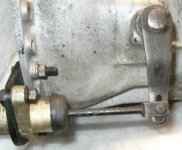
the push rod of the clutch slave cylinder came so far out, I lost the fluid.
The cross shaft lever felt like the fork was not engaged with the bearing.
I pulled the gearbox, thinking it was a broken pin.
The pins are all intact and now I can't see what the problem was
(unfortunately the lever moved, the bearing fell out and evidence was lost).
I've read almost everything I could find on the Buckeye website and other sources, and could not find a precedent.
Four photos:
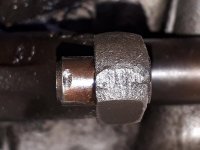
- the 'dent' or wear mark on the end of the fork dowel pin (driver side),
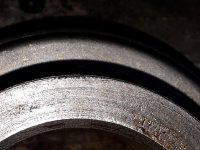
- the marks left (seemingly) by the pin on the back outer edge of the sleeve,
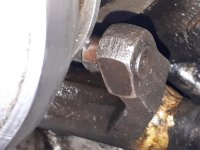
- the fingers, to show how little wear there is,
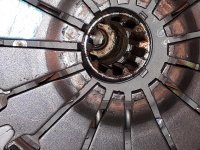
- where the pin and sleeve would've met to cause the damage (bearing no longer seated on the gearbox front cover).
The slave cylinder is new, the master cylinder is relatively new.
The clutch has approximately 20 thousand km, mostly highway miles, Automotive Product make, from Borg & Beck tooling, I surmise.
Two clues:
- the slave cylinder push rod was attached to the lowest hole on the cross shaft lever (incorrectly, trying to get better leverage),
- the link between the master cylinder push rod and the clutch pedal lever has a lot of play (shaft and clevis pin hole).
Those 2 issues should not have caused the problem, it should make it more difficult to release the clutch (me thinks).
Micrometer is not currently available to measure clearance between the sleeve and gearbox front cover.
I figured the bearing would have to move forward approximately 1.25 inch from its resting position against the fingers,
in order for the sleeve to come off the gearbox front cover.
Has anyone experienced this and how do I make sure it doesn't happened again?
Should there be a 'bumper' on the back of the clutch pedal lever, where it meets with the firewall, to restrict its travel?
I've had the car 44 years, no modifications from original-design replacement parts.
is it possible to push the throw out bearing so far forward against the fingers of the pressure plate,
that the fork' dowel pins come out of the groove of the bearing sleeve/carrier?
The problem I have,
the push rod of the clutch slave cylinder came so far out, I lost the fluid.
The cross shaft lever felt like the fork was not engaged with the bearing.
I pulled the gearbox, thinking it was a broken pin.
The pins are all intact and now I can't see what the problem was
(unfortunately the lever moved, the bearing fell out and evidence was lost).
I've read almost everything I could find on the Buckeye website and other sources, and could not find a precedent.
Four photos:
- the 'dent' or wear mark on the end of the fork dowel pin (driver side),
- the marks left (seemingly) by the pin on the back outer edge of the sleeve,
- the fingers, to show how little wear there is,
- where the pin and sleeve would've met to cause the damage (bearing no longer seated on the gearbox front cover).
The slave cylinder is new, the master cylinder is relatively new.
The clutch has approximately 20 thousand km, mostly highway miles, Automotive Product make, from Borg & Beck tooling, I surmise.
Two clues:
- the slave cylinder push rod was attached to the lowest hole on the cross shaft lever (incorrectly, trying to get better leverage),
- the link between the master cylinder push rod and the clutch pedal lever has a lot of play (shaft and clevis pin hole).
Those 2 issues should not have caused the problem, it should make it more difficult to release the clutch (me thinks).
Micrometer is not currently available to measure clearance between the sleeve and gearbox front cover.
I figured the bearing would have to move forward approximately 1.25 inch from its resting position against the fingers,
in order for the sleeve to come off the gearbox front cover.
Has anyone experienced this and how do I make sure it doesn't happened again?
Should there be a 'bumper' on the back of the clutch pedal lever, where it meets with the firewall, to restrict its travel?
I've had the car 44 years, no modifications from original-design replacement parts.