• Hey Guest!
    British Car Forum has been supporting enthusiasts for over 25 years by providing a great place to share our love for British cars. You can support our efforts by upgrading your membership for less than the dues of most car clubs. There are some perks with a member upgrade!

    **Upgrade Now**
    (PS: Upgraded members don't see this banner, nor will you see the Google ads that appear on the site.)
Tips
Tips

Choke cable question

bigjones

Jedi Warrior
Country flag
Offline
Hi folks,

I didn't mean to hijack Craig's thread (thought it was resolved) so I've started a new one.

Seems I have the opposite problem from Craig - the jets lower but the idle speed adjuster doesn't work.

I've taken some photos, as Randall suggested. Here's the general setup:
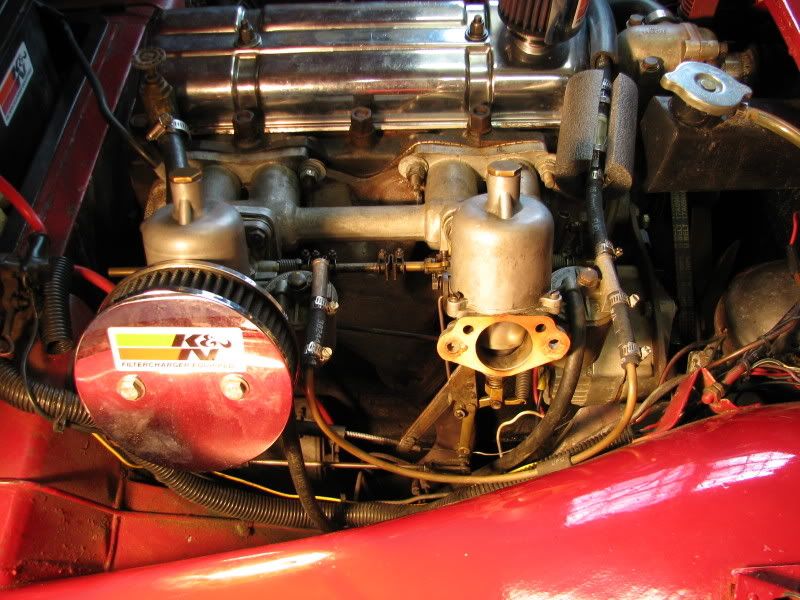
Setup.jpg

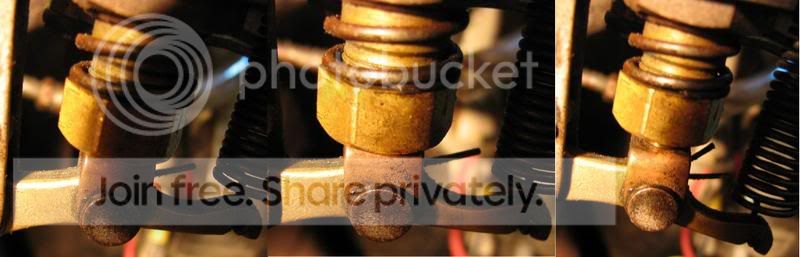
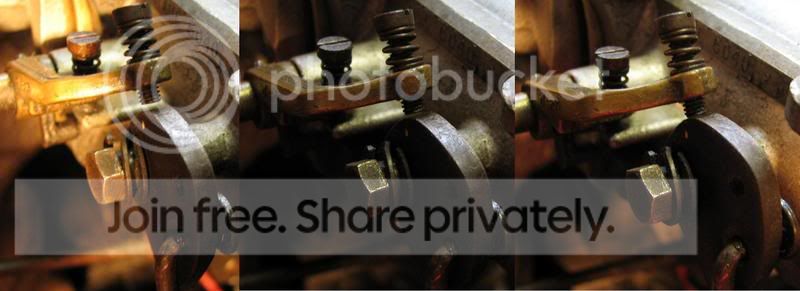
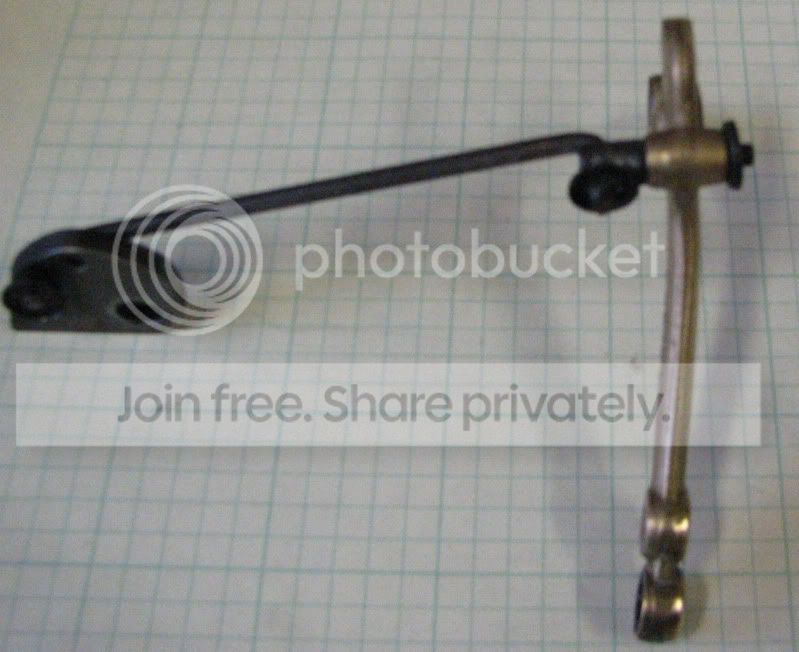
Left to right, is the effect of the choke cable at rest, one notch out and then two notches out:
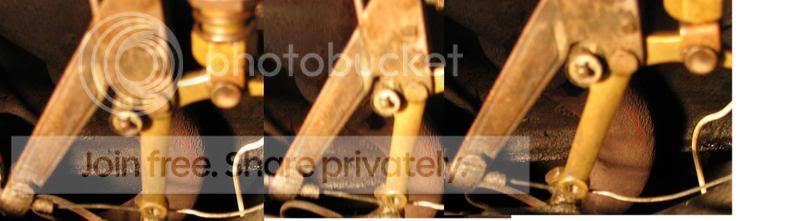
Linkage.jpg

Jet.jpg

Cam-1.jpg


Cheers,
Adrian
TS58324
 
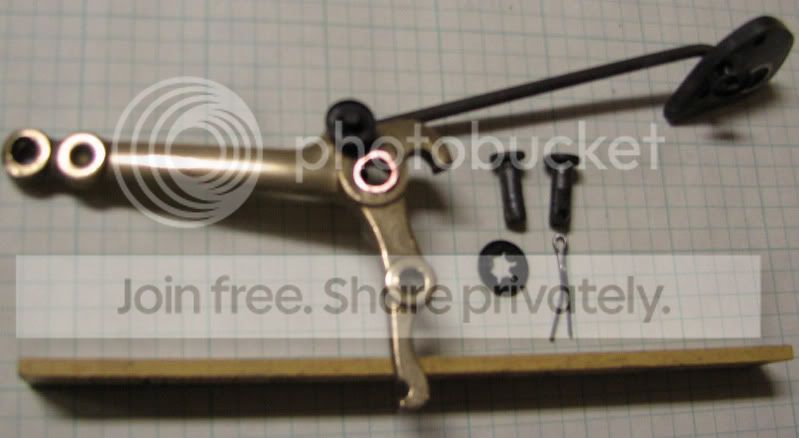
Hmm, hard to be certain without mine handy to compare with; but I think the problem is that the joint I mentioned before is too tight. The hole through the arm at that point is some 3/8" in diameter, while the pin is only maybe 3/16". The idea is that, at rest, the spring pulls the lever down until the pin hits the top of the hole. Then as you start to pull the cable, the lever pivots against the jet, until the pin hits the bottom of the hole. The net effect is to move the rod to the fast idle cam by roughly 3/16", before any downward force is applied to the jet.

On my TR3, the movement at the pin is very obvious, while I don't see any movement at all in your photos. Perhaps someone has tried to 'improve' that joint; or the bracket is just bent until it's tight against the lever.
 
OK, maybe this is where the problem lies:
IMG_1070copy.jpg
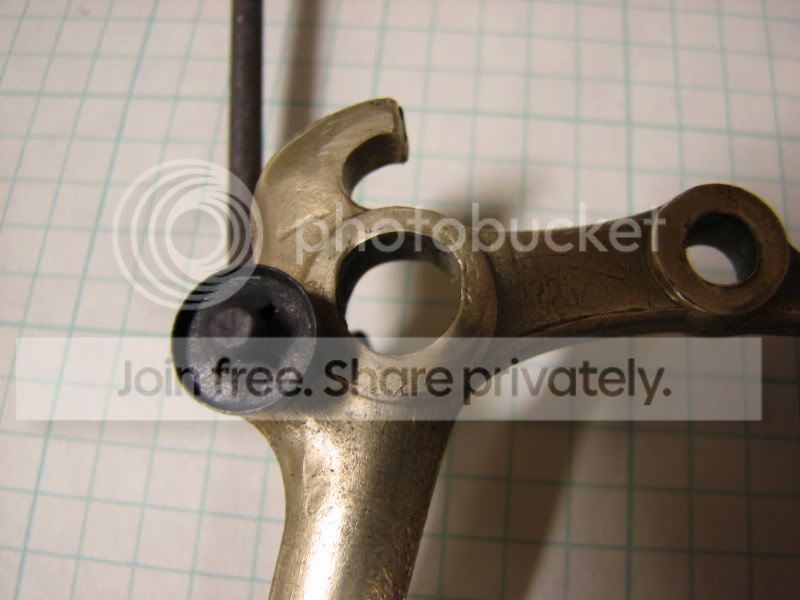
Here's a close-up:
IMG_1069.jpg


See how the hole is no longer round. Is that why the link is not being pushed up to turn the fast idle cam?

Cheers,
Adrian
TS 58325
 
I wouldn't think so. Just the usual wear, to my eye. And if anything, I think it should increase the movement of the fast idle pushrod.
 
TR3driver said:
Just the usual wear, to my eye.

Sad, I'd already fabricated something:
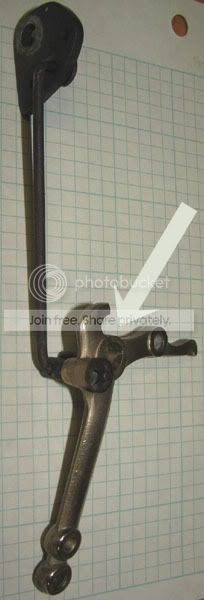
pipe.jpg

By some miracle, 1/4" pipe fitted in the hole and also gave a fair amount of requisite slop. I was just messing around - that jet lever is available from Moss Motors, fairly inexpensive.

I'm curious as to why some of those pins are held by star washers and others by cotter pins. Why is that?

Anyways, when I figure the fast idle cam problem out I'll report back.

Cheers,
Adrian
TS58325
 
Well, maybe I was just mistaken about how obvious the movement is. Here's before n after on mine:
 
Randall,

Thanks for taking the photos. Yeah, I can see that it does move up some.

Looking at the Moss Motors diagram, I'm missing what might be an important washer (between fast idle cam and carb) That might be why there is not much movement. I'm thinking it is special at $2.

I've gone ahead and ordered it, along with a jet lever. That one I have is a bit bent - maybe that's the problem. I'll stick it in a vice and try to straighten it AFTER I have the replacement from Moss in my hands. Brass should bend OK, huh?
Bent.jpg

Cheers,
Adrian
TS 58325
 
Maybe not. Rod and sheet will bend, but I don't think cast will. Maybe if heated first?
 
bgbassplyr said:
...Maybe if heated first?

"How did Jones die?"

"Well, he got this Bernz-Omatic propane burner and he was heating up this bit of brass, or something, off his car. Little did he know but..."
 
OK,

The good news is that the jet lever can easily be straightened in the vice without resorting to heat. This, and the new washer, (between cam and carb) however, did not help any.

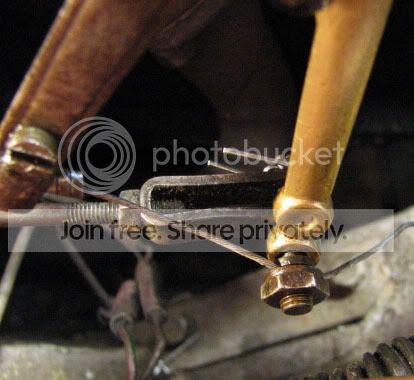
After fiddling around for a stupid amount of time on this I did get quite an improvement by switching the position of the choke cable where it attaches to the jet link, as shown below:
Cable.jpg

Both Haynes and Moss Motors catalog show the attachment point on the <span style="font-weight: bold">other </span>side, towards the engine.
Switching the position to as shown, I got a movement of 11 thou, as measured with a dial indicator on the throttle stop screw (hey, I said it was getting stupid)
So now the cam moves when pulling out the choke cable to the first notch and then, on pulling to the second notch, the jet lowers by about 1/4". All good stuff I thought.

However, driving around, when coming to a stop sign, the revs still drop like a brick to zero and the engine conks out. This is despite pulling the choke out to the first notch. The idle speed is set to 800 rpm with the engine hot. I've no idea on the history of this engine but last week I started the car up and left it idling (went back into the house for my shades) came back and it was idling at 50 rpm (yes, fifty) so it must be a stock,etc, don't you think.

I'm thinking of leaving the choke pulled out to the first notch for about 30 min (the time it takes to really warm up) and switching to the winter thermostat. Any other thoughts would be most appreciated as this problem does detract from the driving.

Cheers,
Jones
58324
 
Believe it or not, I was going to mention the cable being connected wrong, and somehow didn't do it.

In your photos, I see a lot of 'daylight' under the fast idle adjustment; is there some reason you can't turn it down a few turns? Never tried to measure it that closely, but IMO the motion should be a lot more than .011" before the jets start to move. With the engine warm, you should be able to pull the idle up to between 1500 and 2000 rpm.

And on cold mornings, I do find it necessary to keep the choke partially out for the first 10 minutes or so, for smooth operation.

Have you checked that the carb pistons move totally freely without the dampers installed? And that even with the dampers, if you lift the pistons (engine not running) and release them, you can hear the 'click' as they land? The slightest binding or tight spot can cause all sorts of strange problems.
 
Randall,

Thanks for the post.

That's interesting - the Haynes manual (and VB) shows the cable connection on the engine side for the H6 carb (called a H5 in Haynes). Moss shows it on the fender side. The cable was pointing more to the fender side so I relocated it there and it seems to work much better.

Haynes also says there should be a 1/16" gap between the adjustment screw and the cam - hence the big gap you saw.

It seems pulling the cable merely raises the cam - the cam does not rotate, as I would imagine it should. I took out the bolt securing the cam and polished the unthreaded portion with emery paper using the drill press. Put it back in and liberally oiled it up but no joy.

Anyways, the choke action is much better than before.

I'll take a good look at the carb pistons, as you have suggested, to see if there is any binding.

Cheers,
Adrian
TS 58324
 
There are several mistakes in the Haynes manual. Different editions even have different mistakes! Here's a photo from Practical Hints, 6th ed.
 
Back
Top