• Hey Guest!
    British Car Forum has been supporting enthusiasts for over 25 years by providing a great place to share our love for British cars. You can support our efforts by upgrading your membership for less than the dues of most car clubs. There are some perks with a member upgrade!

    **Upgrade Now**
    (PS: Upgraded members don't see this banner, nor will you see the Google ads that appear on the site.)
Tips
Tips

Chesley "Sully" Sullenberger

PAUL161

Great Pumpkin
Silver
Country flag
Offline
Chesley "Sully" Sullenberger

Watching a special last night on the Hudson River crash, a situation was brought up that I hadn't heard before and that was, "Sully" believes that even with thousands of hours in the "Heavys" and powered aircraft, his past glider training and experience was a critical factor in him landing his aircraft in the Hudson in one piece. Even though a lot of people think gliders are just like little paper airplanes, those of us who fly them know that the techniques to fly and land them are slightly different than powered aircraft. Fist thing is, you only have one shot! Along with Sullenberger, I agree that every pilot should have at least the basics of glider flight. Not only is it fun, it sharpens your senses immensely for powered flight. PJ
 
Re: Chesley "Sully" Sullenberger

Sully's comments remind me of the ~Gimli Glider~ pilot....he was also a glider guy and owned a Blanik L-13 sailplane (interesting that they were having a car race on the abandoned stip that he landed on too)

I don't know if you've ever done a real (not training) <span style="font-style: italic">dead-stick</span>.
I had a carb float stick once and was lucky enough to be <span style="text-decoration: underline">just</span> withing gliding distance to a small grass stip.
Fortunately, <span style="font-style: italic">Plan A</span> worked!
grin.gif


<span style="font-style: italic">ABC</span> (Airspeed, Best field, Check/Communicate)
 
Re: Chesley "Sully" Sullenberger

aeronca65t said:
Sully's comments remind me of the ~Gimli Glider~ pilot....he was also a glider guy and owned a Blanik L-13 sailplane (interesting that they were having a car race on the abandoned stip that he landed on too)

I don't know if you've ever done a real (not training) <span style="font-style: italic">dead-stick</span>.
I had a carb float stick once and was lucky enough to be <span style="text-decoration: underline">just</span> withing gliding distance to a small grass stip.
Fortunately, <span style="font-style: italic">Plan A</span> worked!
grin.gif


<span style="font-style: italic">ABC</span> (Airspeed, Best field, Check/Communicate)

Blantik L-13, that's what I learned to fly gliders in. Nope, all the years I've been flying, actually since 1958, I've never had an engine go out. Had a prop screw up once, wouldn't come out of cruse position, landed and it all worked out. But, anyway, I was always taught by my instructors, as we all were and also taught my students, to always keep a landing area in mind just for that reason. Basics, never get shy of the basics, if you do, you could get hurt real fast.
 
Re: Chesley "Sully" Sullenberger

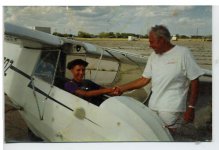
My son started his flying career by attending Glider training at the Civil Air Patrol Glider camp (the first one ever held in New Mexico). During the camp, all the kids got to solo in the glider. Shaun was the only one in his class who went on after the camp to get his glider license. His instructor was a guy named Al Santilli, who had his own glider ticket signed off by Orville Wright. Attached is a picture of Shaun after his first glider solo flight in Hobbs, NM. Also attached is a .pdf file about his instructor. Shaun went on to become a KC 135 Tanker AC.

Al Santilli
 

Attachments

  • 20105.jpg
    20105.jpg
    50.4 KB · Views: 247
Re: Chesley "Sully" Sullenberger

aeronca65t said:
a real (not training) <span style="font-style: italic">dead-stick</span>.

I remember reading an article, I think it was in Sport Aviation, by a pilot who made a real dead stick landing. He was amazed at the decrease in glide ratio as opposed to an idling stick practice landing.

You wouldn't think an idling prop would have much thrust, but he said that it made a noticable difference.
 
Re: Chesley "Sully" Sullenberger

I'm just so impressed with the depth of experience that Sullenberger has. How could you ask for a more experienced commercial pilot? Amazing, and such a dedicated professional.

No wonder he's so famous: he paid the dues one has to pay to be a top-notch professional and now, he reaps some of the rewards. I love it when that happens to a deserving soul!

Good for him, I'm a fan. :yesnod:
 
Re: Chesley "Sully" Sullenberger

DrJohn said:
You wouldn't think an idling prop would have much thrust, but he said that it made a noticable difference.

Wouldn't make a whit o' diff'rence to me... I'd be screamin' an' thrutchin' around like a six-year-old either way.

But at least I'd be first to the crash site! :jester:
 
Re: Chesley "Sully" Sullenberger

Basil said:
His instructor was a guy named Al Santilli, who had his own glider ticket signed off by Orville Wright.
That right there really shows the short amount of time humans have been flying. Amazing how fast we got where we are now.
 
Re: Chesley "Sully" Sullenberger

Basil- That picture of your son looks like he is in a 2-33. They are true work-horses and have taught many people to fly gliders.

Paul- You are right... flying gliders really teaches you how to fly the plane.... they is no "Go Button"
grin.gif
 
Re: Chesley "Sully" Sullenberger

I've never flown a glider but had my first total engine failure at 23 hours total time (I was solo and doing touch and goes)...in a 1946 Taylorcraft. Hard to believe but I had several partial and total engine failures in my flying career. Never damaged one due to that though!
 
Re: Chesley "Sully" Sullenberger

If you could see how one of the (if not THE) most prestigious flight schools in the country has their students fly you'd be convinced they'd NEVER be prepared for an engine failure. They're scary.
 
Re: Chesley "Sully" Sullenberger

aerog said:
If you could see how one of the (if not THE) most prestigious flight schools in the country has their students fly you'd be convinced they'd NEVER be prepared for an engine failure. They're scary.

What's an engine? :jester:
 
Re: Chesley "Sully" Sullenberger

:lol:

You dead-stick guys crack me up. :wink:
 
Re: Chesley "Sully" Sullenberger

Gliderman8 said:
What's an engine? :jester:


Hehe. Exactly. I was taught to land as if the engine was going to quit. These guys put the flaps all the way down and drag it along at 500' for a couple of miles.
 
Re: Chesley "Sully" Sullenberger

Twosheds said:
aeronca65t said:
a real (not training) <span style="font-style: italic">dead-stick</span>.

I remember reading an article, I think it was in Sport Aviation, by a pilot who made a real dead stick landing. He was amazed at the decrease in glide ratio as opposed to an idling stick practice landing.

You wouldn't think an idling prop would have much thrust, but he said that it made a noticable difference.

It really isn't that an idling prop has any thrust, it's that a turning prop is gently screwing it's self through the air and creating no drag in slow flight. A dead prop however is like nailing a 5 foot 2-by-6 board out front creating a drag situation, like an air brake. Big difference in a critical situation. I used to ask my students, "what is the propeller for"? They would give me all the technical answers and I would tell them they were right but there's another reason. Looking like they made a drastic mistake, I'd tell them it was for keeping the pilot cool, because if it stops turning, it's going to get mighty hot in the cockpit. Seems like they never forgot that little message. As I mentioned before, I had a prop stuck in cruse position and landed ok, the problem in that situation is, if you touch down and then have to take back off for some unseen reason, the chances of making that happen in a low powered aircraft and needing all it's power to do that, would probably be in the 50 to 1 range, meaning it might work once in fifty tries without blowing the engine due to a super high manifold pressure situation. But, with all that said, mileage wise, flying is the safest form of travel and automobiles are the most dangerous.
 
Re: Chesley "Sully" Sullenberger

PAUL161 said:
It really isn't that an idling prop has any thrust, it's that a turning prop is gently screwing it's self through the air and creating no drag in slow flight.

That's a better way to put it.

I read another article about finding the airspeed in a glide at which the fixed-pitch prop would neither provide thrust nor drag. They put very sensitive sensors on the case near the flange that would illuminate one of two lights in the cockpit as the crank moved fore-and-aft due to the crank endplay.

Then they would fly at different RPMs and airspeeds. If the prop was pulling the plane, the crank would move forward and a light would illuminate. If the prop was holding the plane back, the crank would move back and the other light would illuminate. If both lights were out, the prop was not doing anything.

I disremember why they were doing it, though! I think it might have been a way to test the effective pitch or slip of the prop. I forget.
 
Re: Chesley "Sully" Sullenberger

A friend of mine took off in a Super Cub and snapped the crank at about 200' AGL.

I think this is probably everyone's worst nightmare. Prop stuck solid. No "windmilling" of the prop.

He did a gentle U-turn and *just* made the runway threshold, but the ground was rough and the bird flipped over. He and his passenger got out but the ship burned to the ground.

I flew that Cub about two weeks before and I remember it was low on oil. He's a great pilot....wonder if I could have done what he did?
 
Re: Chesley "Sully" Sullenberger

aeronca65t said:
He's a great pilot....wonder if I could have done what he did?

What? Neglect to check the oil on a pre-flight?

I doubt you would!
 
Re: Chesley "Sully" Sullenberger

Faith based preflight? :devilgrin:
 
Back
Top