• Hey Guest!
    British Car Forum has been supporting enthusiasts for over 25 years by providing a great place to share our love for British cars. You can support our efforts by upgrading your membership for less than the dues of most car clubs. There are some perks with a member upgrade!

    **Upgrade Now**
    (PS: Upgraded members don't see this banner, nor will you see the Google ads that appear on the site.)
Tips
Tips

Castrol LMA Lo Moisture Absorbsion and Natural

carello

Freshman Member
Offline
I am sure this may have been discussed, but i cant find good info yet.
1) is this a true fact? - yes or no please -
British brake & clutch systems use natural rubber components which are only compatible with vegetable based brake fluid. American brake & clutch systems use synthetic rubber components which are only compatible with mineral based brake fluid. The only vegetable based brake fluid commonly available in the US is CASTROL GT LMA. Use of improper fluids or mixing of fluids can lead to complete failure of brake and clutch hydraulics. Use of any fluid other than CASTROL GT LMA violates all warranty on brake/hydraulic parts.
2) disc brake cars - master cyl, hose, square rings - when you buy a 2006 kit for your car, does it contain natural rubber parts?

any help would be great
carello
 
1. British cars quit using natural rubber in the '50s.
2. No.

I've not used anything other than off the shelf brake fluid since I began with Brit cars in 1961, and have never had a failure.
 
Thanks for the replies so far. The VTR site info is a copy paste of other sites and while it looks like it is providing a tecnical understanding, it is not. At least not for me.
1) Is Castrol GT LMA a mineral based product or vegetable? and how do we document this?

2) Can we find supporting documentation for the "end of natural rubber in brake systems"?

any help is great, thanks
carello
 
Hi Carello,
Castrol LMA; Reading from the back of the can, "Contains Alkyl Polyglycol Ether Esters". This means that it is neither mineral nor vegetable, but is a synthetic.

I have never been concerned about the parts being "natural rubber". To my knowledge, natural rubber was phased out of brake systems many years ago. There "could" be some 40 year old "new old stock" natural rubber brake parts around, but nothing that I would even consider using in MY car. They would be so deteriorated as to be useless.

The original Castrol was vegetable based & not harmful to natural rubber seals. That era is long gone. No proof, just common sense.
D
 
To quote one line from the VTR site..." DOT3 will damage natural rubber brake seals and should not be used in any car suspected of having natural rubber seals (most Triumphs prior to 1968)."

Well, I'm restoring a '59 TR3. Am I to assume that the hydraulics have natural rubber in them?? What brake fluid needs to go into Triumphs prior to '68??
 
Martx, I have used Dot 3 for several seasons with no ill effect in a 1965 car. If there were to be a problem I suspect it would be with seals in either the master cylinder or rear wheel cylinders.

Since these rquire periodic replacement or rebuilding they will have been replaced, likely several times, since your car was made.

I am now planning to use Castrol LMA when my car is back on the road as there will now be longer intervals between fluid changes.
Simon.
 
One of the interesting things that happen on forums, is rumor mongering. Let me give you two examples. I earlier said that natural rubber has not been used since the '50s. Martx-5 quotes someone (unidentified) saying that everything prior to 1968 still does.

Do either of us know what we're talking about? What are our sources? My suggestion is that if you cannot be satisfied with someone's personal experiennce ('been using off the shelf fluid for 45 years without incident'), then do the primary research.
I'm not flaming anyone here, just pointing out that these debates continue on endlessly, with no one ever sussing out the primary source. Dave did that above, simply looking at the can on his shelf. My Prestone contains polyalkylene glycol esthers.
As to direct sources, I'd suggest the Castrol website where they should list all of the chemicals in their product. Another source would be the US DOT, which will specify exactly what can and cannot be sold in this country. As a last resort, take one of your pieces to any nearby test lab. An organic chemist will tell you in nanoseconds whether it is natural or synthetic rubber.
 
See what I mean about people getting fired up? I'm a DOT 5 guy, myself. I've seen serious disagreement over that issue.

Carello, if you have any doubt that there's some natual rubber left in your brake system, just get it out of there and don't obsess over it.

Weather your pre-68 car has natural rubber or not somewhere is pretty much anyone's guess, unless A: you replaced all the rubber products in your brake system after 1968 (and then you know it doesn't) or B: you're the original owner of a pre 68 car and you know it's %100 original and untouched. (And then you know it very well might.)

I would find it somewhat unlikely that any roadworthy car would still have any natural rubber left in its brake system and I myself would make sure that it does not by replacing every bit of it if I was not sure. Especially since we know from reading on the can of LMA (I would regard this as a primary source)that it is no longer a vegetable based product, and presumably, no longer compatible with natural rubber.

I would love to know what vegetable oil the orignal LMA was based on. Linseed? Olive? Sesame? Anyone know?

I know some cars used Mineral oil for brake fluid. And I'm pretty sure every car I've owned since 1980 has used DOT 5. Although I'm not sure about my new Odyssey...
 
Hi T owners, thanks for the discussion. Yes i see all are at a point like me where, no real information has been forth coming from brake suppliers other than tables of boiling point info, watch out for natural rubber, squishy silcone performance. My #1 original question or statement comes from a 2006 website dealing with British brakes.

So recapping -
A) No one has any idea what elastomer products are supplied with a master cylinder kit, brake hose, or wheel cylinder/caliper kit, but it is assumed it is not natural rubber because some overseeing agency in China is making sure of this.
B)All non-silicone brake fluids are the same, sure the boiling points, price, color, etc, but they all mix together so you can change the stuff to the product of the month each time you change.
C) I am an absolute idiot when it comes to brake chemistry and most everyone else is too.
D) We could use a little factual information on brake chemistry - Gee would Castrol or Girling be up for this?

i hope i am not too sarcastic. Yes i personally have survived for many years without brake failure with hi tech fluid from Walmart
cheers
carello
 
Exactly. No one knows nuthin' except that fresh seals and fresh fluid work great together. /ubbthreads/images/graemlins/thumbsup.gif
 
[ QUOTE ]
Exactly. No one knows nuthin' except that fresh seals and fresh fluid work great together. /ubbthreads/images/graemlins/thumbsup.gif

[/ QUOTE ]

Right on! Rebuilding everything in the brake system on a Triumph isn't terribly complex, even for inexperienced mechanics. Also, given the relative simplicity of our cars, it doesn't take very long. In about a day and a half (with lots of brakes to contemplate baseball, etc.) I recently changed rotors, rebuild my front calipers and rebuild my PDWA. I imagine doing the rear brakes and the servo would add another day and a half at the most. Then you have complete confidence that everything is cool, and you can have fun doing it! /ubbthreads/images/graemlins/grin.gif
 
Pretty much all brake seals have some amount of latex in them, which is why you should never get anything mineral or petroleum based on them. Both DOT 3 and DOT 4 are based on polyglycol esters, whereas DOT 5 is based on silicone. I use DOT 5 in my Midget, and have been very happy with it. When I first got the Midget going, it had rusty sludge in the lines from DOT 3 that had soaked up so much moisture it rusted things out from the inside. The rear pistons had also frozen because of this. DOT 5 doesn't have that problem, so I switched, but I did that when I replaced the master cylinder, lines, and hoses. It is true that DOT 5 doesn't mix with the other two, and it doesn't play nicely with antilock brakes, so don't use it in your new car that has ABS. To try to answer Carello's questions, I would say go ahead and use Castrol LMA. It doesn't absorb moisture quite as readily as DOT 3. If you're going the less expensive route, use DOT 3, but you should replace it often before it gets too wet. If you don't want to risk taking paint off, and don't mind having a slightly softer brake pedal, use DOT 5, and you may never have to change the brake fluid again.
 
Well... hmmm...

Interesting debate.

Here are the facts from my personal experience:

In 1984 I purchased a TR3 with dubious pedigree that had been sitting since 1978 or so.

I purchased "Genuine Girling" parts new from Moss and replaced all of the rubber in the entire hydraulic system. I was young, dumb, and cheap and I filled it with "Off the Shelf-R-Us" Dot3 from wally world (at that point I honestly didn't even know that LMA existed). The next morning I hit the brakes pulling out of the garage and was met with a dead pedal and found a nice mush of paint peeling off of the inside of my rear wheels and a big puddle on the floor. I pulled the brakes again and found that the rubber had turned into a squishy version of their original shape - not liquified but certainly not firm either. I drained all the fluid, replaced all of the rubber again (including the MC kits that didn't seem to be affected just to be safe) and used Castrol LMA from that point on. Perhaps I was the first person at Moss to buy brake parts for a TR3 in 30 years and they had been sitting on the shelf that long.... but I really doubt it.

Plenty of fuel for the fire I know... But I saw it. The rubber fell apart. In ONE day. With DOT3.

Maybe I'm drinking the Castrol Kool-ade. That's fine. Maybe I'm an idiot. That's fine too. I'm not putting lives at risk to save 3 bucks on a pint of brake fluid.
 
[ QUOTE ]

I would love to know what vegetable oil the orignal LMA was based on. Linseed? Olive? Sesame? Anyone know?

[/ QUOTE ]
Castor oil, just like the name, you know, Castrol.
D
 
Guys,
I will try to spend a little time this afternoon in our standards library and see if I can't find the SAE and DOT specs that the different fluids are tested to. I think I have seen them in our system at one point and if I remember correctly (that's a huge question), there were very extensive tests for compatibility between the different fluids and different materials. One of the reasons for the different DOT numbers is different chemistries and different compatibilities. I'll see what I can find.

Personally; I'm a DOT 5 guy. I just had to pull my rear brakes when I replaced the diff. and the fluid back there was orginal to when I last did the brakes 18 years oag. It was some of the early DOT 5 and it looked fine and the seals and lines looked fine. I don't drive the car hard enough to feel the 'DOT 5 mushiness'; any feel is lost in chassis flex and cowl shake as well as being tire limited.

Brake fluid is a very personal choice. You have to pick what you think is best for your applicationa and useage

Dick
 
Neato. Did that happen in 1984? If so, not exactly 30 years since the last reported OEM use of natural rubber. More like 17. And god knows how long natural rubber was in the spares supply chain. We know what happened but we still don't know why. I guess even nowadays it would be a good idea to ask your parts supplier what those seals are made out of. In 2005 I don't want natural rubber anything.

When I did my first Triumph brake system total rebuild in 1989 (MKIV Spitfire) I used LMA just because VB advertised it on the same page. Never thought twice about it.

Just to clarify, when I said "Fresh seals and fresh fluid work great" I assumed DOT4 or DOT5, not necessairly Castrol, but certainly not some mystery fluid from the local Megamart.
 
Most new cars include changing the brake fluid in their maintenance schedule. The reason (according to unknown sources who came to me in a dream) is because brake systems are more complicated, hence expen$ive. Fresh brake fluid every 2 years helps extend the life of the system.
If you are concerned about the hydroscopic nature of brake fluid and the corrosive effects of water. Follow the their lead and change it every couple of years.
A number of sites talk about boiling points. The Stoptech sites mentions water boils at 212. This is true in a non pressurized environment. The higher the pressure the higher the boiling point. Your fluid is not going to boil at 212.
This topic is as wide open for opinions as is what oil to use in your carb dampers. Anyone want to tackle that issue?
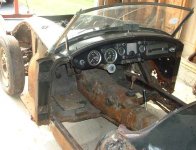
Take a look at the attachment. The owner used DOT 5 in his MGA.
 

Attachments

  • 205463-rustbucket.jpg
    205463-rustbucket.jpg
    35.3 KB · Views: 151
[ QUOTE ]
Take a look at the attachment. The owner used DOT 5 in his MGA.

[/ QUOTE ]

Okay... What is the significance of the picture? /ubbthreads/images/graemlins/confused.gif
 
Back
Top